

MigBuster
-
Posts
9,165 -
Joined
-
Last visited
-
Days Won
27
Content Type
Profiles
Forums
Gallery
Downloads
Store
Everything posted by MigBuster
-
Hmm - well remains to be seen if the code is more optimized or whether they do a TW and just hope everyone is happy to upgrade again Waiting for the Nvidia 880 to come out myself..........
-
USA nearly did it and were far better IMO - great to watch for the neutral. Germany are top class for sure - but anything can happen in Football..........
-
IS there an option in strike fighters 2 to record a replay ?
MigBuster replied to Reblok's topic in General Discussion
No - you would need to use FRAPs or something similar -
F-86 Sabre 10:1 Kill ratio over Korea
MigBuster replied to streakeagle's topic in Military and General Aviation
Always comes down to where you hit it I guess - its certainly overmoddled if you take DCS P-51 as accurate in that regards An adjustment of the gun data can probably be done to reduce effectiveness - more akin to First Eagles Have looked into this before - its almost like the A6M Zero verses the Hellcat Have looked into this before - seems almost like the A6M Zero Vs F6 Hellcat but reversed! The F-86 had a better gunsight - but needed it to put in the required amount of ammo. -
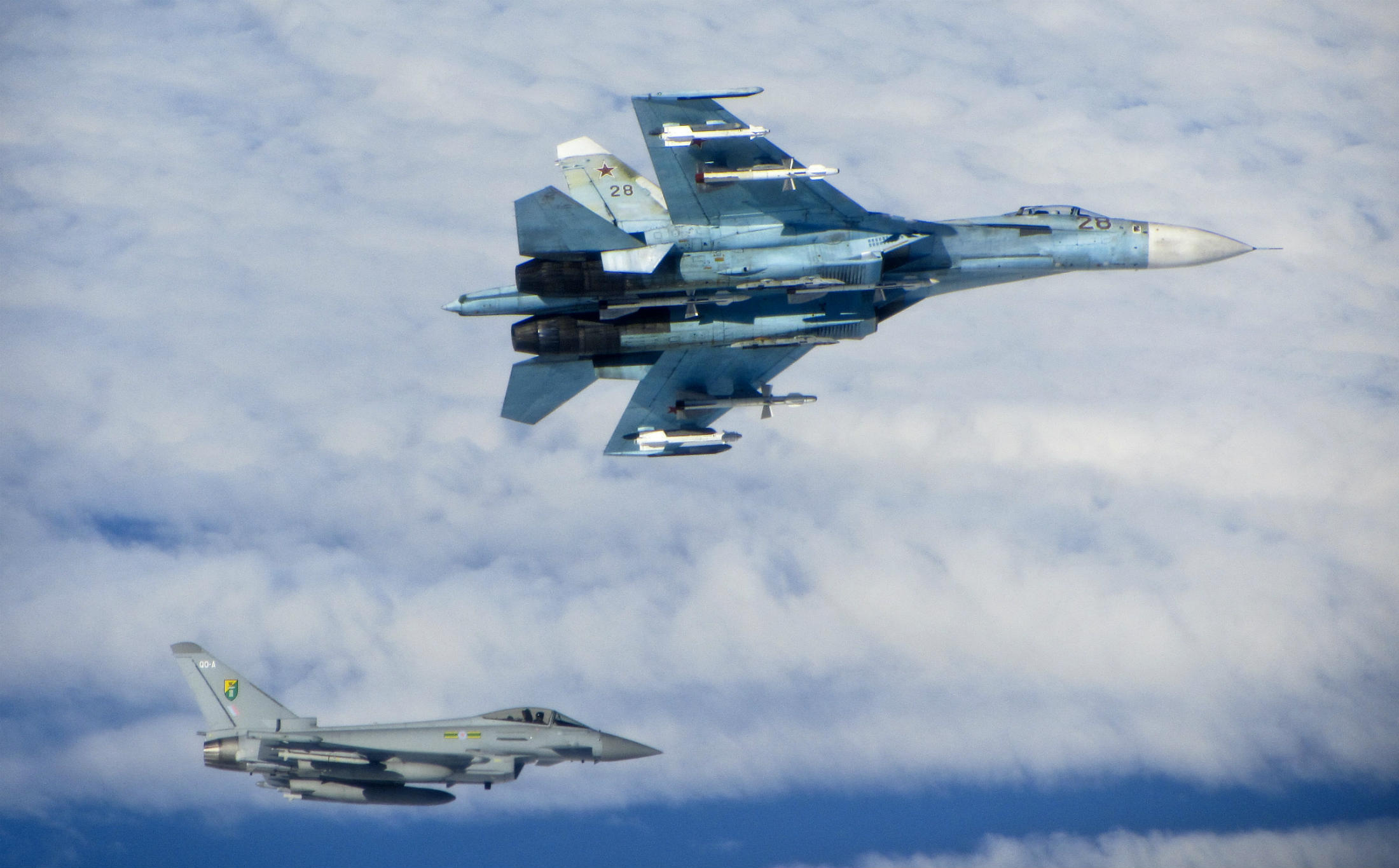
Traced the photo source back to the RAF site http://www.raf.mod.uk/news/archive/baltic-air-policing-18062014 another
-
Laugh or cry?
-
If you have access to BBC iPlayer - nice intro to WW1 dogfighting http://www.bbc.co.uk/iplayer/episode/p0211xzr/ww1-uncut-8-combat-in-the-skies
-
I was thinking that it didn't look right before I posted it - are you sure? The Su looks a lot brighter for sure - should look like this
-
Born as a long range escort fighter for U.S. Air Force Strategic Air Command (SAC) bombers, the McDonnell F-101 was developed in several versions. Both were involved in the Cuban Missile Crisis. The McDonnell F-101 Voodoo was a supersonic fighter plane which flew with the United States Air Force (USAF) and the Royal Canadian Air Force (RCAF). The F-101B was configured as a two seat interceptor for the Air Defense Command (ADC), the F-101C was used as tactical bomber relying on its beefed-up structure, and the RF-101C was the tactical reconnaissance version of the F-101C. These three models were used or kept on alert during the tense moments of the Cuban Missile Crisis. When a U-2 revealed the presence of the Soviet R-12 (SS-4 in NATO designation) theater ballistic missile sites in Cuba on Oct. 14 1962, post-mission analysis highlighted the presence of SA-2 surface to air missiles. With several SAM batteries surrounding Cuban missile sites, subsequent reconnaissance missions had to be flown by fast tactical aircraft flying low level “recce” missions. Tactical Air Command (TAC) RF-101As and Cs as well as by U.S. Navy RF-8A Crusaders were tasked to spy on Soviet progress on the island. Image credit: U.S. Air Force After President Kennedy announced that photos from American reconnaissance planes had disclosed the presence of Soviet surface to surface missile armed with nuclear warhead at Cuba, U.S. homeland air defense forces were put on heightened alert status, preparing for the imminent war. “In the Air Force, while our bombers reinforced their around the clock airborne alert flights, fighters deployed to and near Florida, in preparation for tactical strikes, while our air defense units sent interceptors to emergency fields, for both survival and readiness should Soviet bombers attack,” Jonathan Myer, an F-101B pilot, recalls in Ted Spitzmiller’s “Century Series The USAF Quest for air supremacy 1950-1960” book. “I remember our 13th FIS (Fighter Interceptor Squadron) aircrews listening tensely to President Kennedy’s October 22nd speech, as some of us prepared to deploy from Glasgow AFB (Air Force Base), Montana, to the municipal airport at Billings.” The deployment was accomplished with the F-101Bs loaded with both the pair of AIR-2A Genie unguided rockets with nuclear warheads and the pair of infrared-homing AIM-4C Falcon missiles, mounted in the “rotodoor” (the F-101B weapons bay’s rotary armament door). “We flew there fully loaded, in pairs and with our AIR-2A nucs and IR missiles ready for war, while maintenance and supplies followed by truck. Landing on Billings’ unprepared runway incurred a few cut tires, while our makeshift alert area was cordoned off and a 24 hour phone alert set up in a hangar. […] Fortunately, no Soviet escalation ensued and a couple of weeks later we returned to Glasgow to resume regular alert and training,” Myers says. Bon Hanson was instead an 81st TFW (Tactical Fighter Wing) F-101C driver, who gave his account to Spitzmiller, explaining the preparations for a nuclear strike mission that had to be undertaken across the Atlantic Ocean, after the take off from RAF Bentwaters: “I was on alert the day the Cuban Missile Crisis balloon went up. It was around 0900, and we went to RED cockpit alert until nightfall, and then reverted to 15 min. But, initially we really thought we were going! And for the next week or more the whole wing was loaded and ready to launch! It was serious!” Eventually, the Soviets withdrew their missiles from Cuba and the U.S. removed their Jupiter missiles from Turkey and later from Italy, thus avoiding World War III. RF-101C Voodoos flew the reconnaissance flights that the provided Washington the required evidence that Soviet nuclear missile site were being removed from Cuba. Top image credit: U.S. Air Force via Aircraftinformation.info http://theaviationist.com/2014/06/20/f-101-voodoo-cuban-crisis/


-
Aerial combat between U.S. Air Force F-22 Raptors and F-15 Eagles, seen from the inside. The image in this post was taken from a U.S. Air Force F-15 Eagle from the 131st Fighter Squadron, 104th Fighter Wing, Barnes Air National Guard Base, Massachusetts, during a close range aerial combat exercise against a U.S. Air Force F-22 Raptor from the 154th Wing, Joint Base Pearl Harbor-Hickam, Hawaii. You can clearly see the two planes maneuvering at very close range, pulling Gs, with the F-22 releasing flares counter measures against (simulated) heat seeking air-to-air missiles. The dogfight took place off the coast of Penang, Malaysia, Jun. 16, 2014, during “Cope Taufan 2014″ a biennial LFE (large force employment) exercise taking place June 9 to 20 designed to improve U.S. and Malaysian combined readiness. Both aircraft are currently deployed to Royal Malaysian Air Force P.U. Butterworth, Malaysia. The exercise, that marks the F-22′s first deployment to Southeast Asia, featured also some interesting mixed formation between U.S. planes with Royal Malaysian Air Force MIG-29N Fulcrum, Su-30 and F-18 Hornet jets. Image credit: U.S. Air Force It’s not clear whether the F-22 has flown DACT (Dissimilar Air Combat Training) against Malaysian Migs or Sukhois; if this is the case, it would be interesting to know which ROE (Rules Of Engagement) were applied and the outcome of the confrontations between the Russian multirole planes and the U.S. most advanced fighters. http://theaviationist.com/2014/06/18/close-aerial-combat-f15-f22/


-
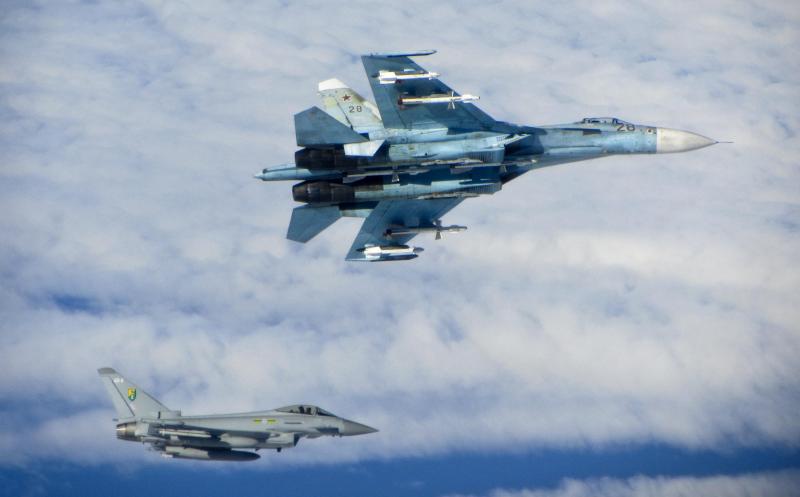
The Royal Air Force detachment flying Eurofighter Typhoons in support of NATO’s Baltic Air Policing (BAP) mission had an interesting day at the office in Lithuania earlier this week. On 17 June, the quick reaction alert at Siauliai air base was put into action, in response to “four separate groups of aircraft in international airspace near to the Baltic States”. These turned out to be a Russian air force training formation of a Tupolev Tu-22 bomber, Beriev A-50 airborne early warning aircraft, four Sukhoi Su-27s and an Antonov An-26 transport. The Crown Copyright image below shows how close a look the pair of RAF Typhoons took at their counterpart fighters, which the UK says were monitored and then “escorted on their way”. The RAF’s 3 Sqn has been supporting the current Polish air force-led BAP rotation at Siauliai since 1 May. http://www.flightglobal.com/blogs/the-dewline/2014/06/name-su-27/
-
Options -> Sound -> Speech Subtitles?
-
There are a few photos of the Argentine A-4Cs having the 5 hardpoints as well as the one above - must have been upgraded before handing them over in the 70s
-
OK only lost again - but luckily all we need to do now is hope Italy beat both Costa Rica and Uruguay - then we have to beat Costa Rica about 4 nil
-
Looks to be correct - wonder if they got a new wing Their A-Bs (A-4P/Q) still looks to have the 3 A-4C Some other upgraded C/Ls A-4SU A-4PTM
-
Chile were good - but Spain looked like they would rather be on a beach
-
Not in anything I have outside of test firings the A-4E can though which is my fave version Argentina had a few Cs - just thinking where they would fit outside of Vietnam
-
The A-4C only had 3 hardpoints - 1 centreline and 2 under the wing Some were upgraded to A-4L with a hump - but still only had the 3. The later longer nosed A-4E/F have 5 points. The weapons it carries in SF2 are probably pretty accurate including MER/TER Standard Gravity bombs MK-81 to 84 /M-117 and LAU rocket pods for example, AGM-12 Bullpup
-
Iraq has formally called on the US to launch air strikes against jihadist militants who have seized several key cities over the past week. "We have a request from the Iraqi government for air power," confirmed top US military commander Gen Martin Dempsey in front of US senators http://www.bbc.co.uk/news/world-middle-east-27905849
-
Normally changing the Opacity - What are you editing the TGA in Photoshop?
-
Watching the USA v Ghana match - US are 1 up after 31 seconds!
-
Trailer - Aug 2014?
-
-
Seemed a bit lethargic - frustrating but predictable for us - all the best to Italy And Costa Rica are top of the group! - was hoping they would be beatable! France up tomorrow.