

MigBuster
-
Posts
9,156 -
Joined
-
Last visited
-
Days Won
27
Content Type
Profiles
Forums
Gallery
Downloads
Store
Everything posted by MigBuster
-
Gripen E first flight with video
MigBuster replied to MigBuster's topic in Military and General Aviation
Although it doesn't look great on paper there is no way to really tell without getting hold of the flight test data to give an actual idea on performance........the thrust figures can be misleading (as Ceasars post) and there is no way to account for drag............let alone any with extra drag & weight of stores. Typically where you add more thrust to the same airframe you always have more T/D if not T/W thus flight test data reflects performance increase in acceleration & climb...........however increasing thrust also increases fuel consumption so they have had to hit a compromise and many pilots prefer the legs if the thrust is adequate. Of course Caesar where is the universal measure for >1:1 T/W ?........even the MiG-21bis flight manual shows it put out 21,825 lbs thrust at MACH 1 from a Emergency Thrust rating of 15,652 lbs at zero speed. I think the 1:1 T/W must be public and related to static thrust.............considering the actual thrust charts are very hard to get hold of / are never published outside the OEM. -
Tired of the same old Tu-95s being intercepted...well here are some Su-27s flying with US bombers for a change https://fightersweep.com/8040/pictures-day-russian-su-27-intercepts-formation-u-s-air-force-aircraft-baltops-2017/ https://theaviationist.com/2017/06/12/cockpit-video-from-inside-a-u-s-air-force-b-1b-lancer-as-the-bomber-is-intercepted-over-the-baltic-by-a-russian-su-27-flanker/
-
- 3
-

-
Gripen E first flight with video
MigBuster replied to MigBuster's topic in Military and General Aviation
The original ones advertised around 15K lbs weight with 18K lbs Max thrust. For the E looks like: Max Sea Level Static thrust rating increased ~22% Weight increased ~19% Might have a tad better T/W over the older one at max thrust. Mil thrust not advertised but claims of Supercruise at unknown parameters. -
Gripen E first flight with video
MigBuster replied to MigBuster's topic in Military and General Aviation
Some of those figures are out of date.....SAAB now advertise: http://saab.com/globalassets/commercial/air/gripen-fighter-system/pdf-files-download-section/facts/gripen-e-fact-sheet--en.pdf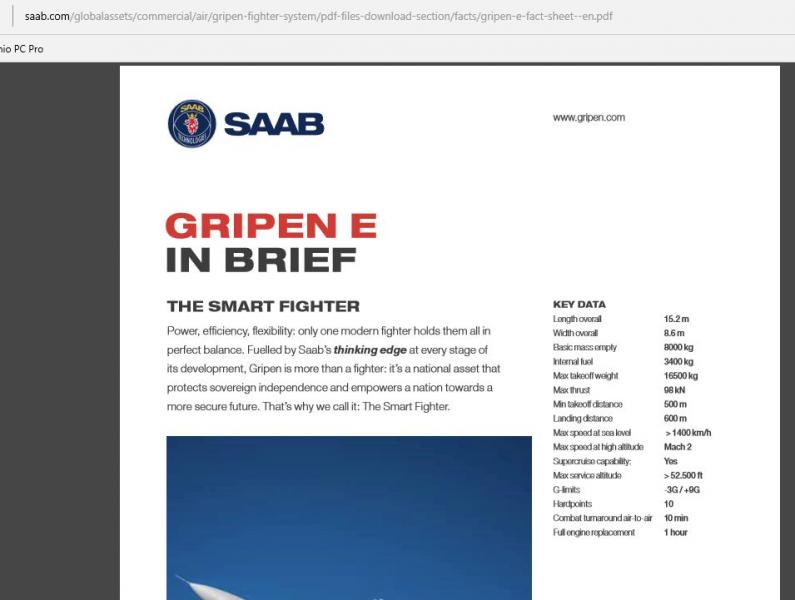
-
At 10:32 on Thursday June 15, Gripen E took off on its maiden flight, flown by a Saab test pilot. The aircraft (designation 39-8) left from Saab’s airfield in Linköping, Sweden and flew over the eastern parts of Östergötland for 40 minutes. During the flight, the aircraft carried out a number of actions to demonstrate various test criteria including the retracting and extending of the landing gear. http://saab.com/air/gripen-fighter-system/gripen/gripen/evolution/first-flight/
-
F-5 & MiG-21 Soviet evaluation video
MigBuster replied to MigBuster's topic in Military and General Aviation
This is related but more regarding the fly offs so not scientific manual figures as above and you can of course bring the pilot factor into it. I think this can be of a great interest to the community, as it was for me. This is an excerption from the book "Life-Long Runway" written by the Soviet Air Force test pilot Vladimir Kondaurov. The story is that in 1976 the Soviets got an F-5E to test. Here is what the test pilot made out of it. The translation was made by myself. English is not my native language, so, please, forgive me if the text is not perfect. In the summer of 1976 a disassembled American F-5 fighter jet was delivered to our base at Aktubinsk. To be correct, it was F-5E - the latest variant with increased engines thrust. By the size it was smaller than MiG-21, had two engines installed side-by-side in the fuselage, a sharp swept-down nose and short tapered wings. The war in Vietnam had finished, and the United States Air Forces were leaving this long-suffering country, hastily abandoning several aircraft of this type on one of the airfields. One of them was handed over to the USSR together with its pilot manual. There were no technical descriptions, but our engineers figured everything out, assembled it to the last bolt and made it flyable, bringing not only the foreign hard pieces together, but also tons of electric wiring. A test brigade was formed to conduct special flight tests, and a program was written, which assumed 35-40 test flights. I was one of the test pilots, our lead was Nikolay Stogov. After a proper training I was trusted to perform the first speed run on the runway and then a run with a 3-6 feet jump. These precautions had their reasons in our uncertainty, that all the systems had been assembled and connected correctly. And finally, we were alone. The "Foreigner" hid within. From the manual I knew, that it had had no problems in operation whatsoever. But I also knew that every manufacturer had their own zest in the product. Unlike our fighters in production, the "Foreigner" had brakes on pedals, which we had on heavy aircraft only. The cockpit was not cluttered by various switches and circuit breakers unneeded in flight. They were all concentrated in a single horizontal "stock" away from the working area. I understood that F-5 was a way not the most modern plane and that it was inferior even to MiG-21, but, nonetheless, I liked the cockpit layout. I decided to make the run on the second runway, which was the longest one. "There is never too much runway ahead," I thought, taxiing to the runway. It was the winter of 1976-77. Of course, there was no reason to hide I was proud that the only aircraft of this type available in the USSR was trusted to me. I turned on the extension of the nose strut - the electrohydraulic retractor engaged, and the nose of the aircraft started to "crawl" up. "How about that?" I shook my head surprised. "Couldn't you do without it on this little one?" As for me, not a common way to reduce your takeoff roll. In the USSR, only Myasischev used this on M-3 and M-4 - the heavy long-range bombers with a tandem gear layout, thus with very short nose struts. "Alright," I thought, "we kneeled, so let's run. It is awkward to fool around this way." I increased thrust and released the brakes. The aircraft started to roll. It rolled evenly, reluctantly gaining speed. Aha! That's why they raise the nose strut! The engines are feeble, and the wing is too small. I lifted the nosewheel off the ground and held the airplane from the premature liftoff. Enough for this time. I powered back and lowered the nose. And then... what the heck? The entire nose started to shake and vibrate, then it started to wander left and right so violently, I thought it would just fall the hell off in a moment. Something was screeching and rumbling below. My first thought was about the nosewheel shimmy, but then I realized the nosewheel had been destroyed. I pulled the drag chute handle. "Not the brakes... Main wheels damage is the last thing we need: we don't have spares," the thoughts were rushing in my mind. Gradually reducing the speed, I stopped. I switched everything off, opened the canopy and impatiently jumped down onto the tarmac. I looked and I was puzzled: the wheel was intact. "That's strange! So what were you so unhappy with?" I looked at the "Foreigner" suspiciously. It turned out that he was unhappy with our runway condition: rough grooves and seams were so deep, and the surface of the concrete was decayed, so he just didn't stand it. One bolt was cut off, and the strut together with the wheel was turning around. - "Nice! Ours don't do things like that," I gave his nose a pat and whispered: "Don't worry, we'll find a new bolt for you and you'll gallop around again!" As I got to know the "Foreigner" I grew up in my respect to him both as to the flying machine and as to the fighter jet. Unapt to aggressive maneuvering when in "cruise" configuration (flaps and slats up), he would have changed when the pilot put it into the "maneuvering" configuration (flaps and slats down). Then from a heavy clodhopper he turned into a swallow. Checking out the capabilities of the optical sight, I enjoyed keeping the reticle on the target while attacking with a 6g pull, whereas on MiG-21 it would disappear from the view at 3g. After determining the basic specification we decided to set up for a mock air-to-air combat with MiG-21bis. I would fight on my "native" MiG-21, and Nikolay Stogov - on F-5. The close air combat started head-on in equal positions. Every flight ended with the same result: MiG-21 lost, although he had much higher thrust-to-weight ratio. I laid myself out just to keep the initial position. I took the most out of the aircraft, took all he could give, but the targeting angle grew steadily and in a few minutes the "bandit" was on my tail. Only tactics could save me. What I was stricken by the most is that the result of the mock fights took not only the generals by surprise (one could explain this somehow), but also the military research departments of the Air Force and even the aviation engineers. They would review the data records for thousand times, ask the pilots, especially me. Frankly, I was somewhat confused as well, but when I tried the F-5, I realized that it was not an ordinary one. So, what was happening in flight? At the speeds of 800 km/h (430 kts) and above the fight was on equal terms, nobody had explicit advantages, but the fighting was not literally maneuvering because of the large radii of the maneuvers. We would both stay at the equal maximum allowable g-loads. Whilst at the speeds below 750 km/h (400 kts) one couldn't sustain these g-loads even with the afterburner. And the lower the speed was the faster it decayed, thus lowering the maximum available g-load. It turned out that the aerodynamics was what won the day, not the thrust/weight ratio. But how was I to explain all this to the people above? They wouldn't have patted our backs for this. Then the MiG company representatives suggested: - "Let's set MiG-23M against him." - "But they cannot be compared to one another; they are from different generations." The chief of our research institute objected. The chief of our institute, colonel general I. Gaidayenko had been a fighter-pilot during World War II and a wingman of the very P. Kutakov, who was the supreme commander of the Air Force at the time of our struggle with the F-5. The result of the test flights was supposed to be reported to Kutakov. - "So what? We will kick his ass anyway!" 2nd lead engineer of MiG-23M spoke out, rubbing his hands in expectance of the revenge. Well, the ass was kicked, for sure... but one of our own. The result was the same with the only exception that the agony lasted for 4-5 minutes. You have also to keep in mind that I had been considered a pilot capable of any stall and spin recovery and I had been permitted to break any angle of attack limitations. In the dogfight, I set the optimal wing sweep manually, but all in vain. The foreigner would slowly, but steadily, approach my tail. After these flights all calmed down for some time, all discussions ceased. The chief of the RI ordered to promptly compile a statement on the tests and directed me and Stogov to Moscow, to the Central Research Institution No. 30, which was involved in elaboration of the long-term problems of aviation advancement. Paying a visit to one of its departments we asked, what they could tell us about the MiG-21 advantages over the F-5E. - "Oh!" The military scientists immediately exclaimed. "With pleasure! There is a fray right now between Ethiopia and Somalia, and these very aircraft fight each other there. And we are busy preparing recommendations for the pilots on how to successfully fight the F-5 in aerial combat." - "And what you've got?" I asked with an interest. - "Take a look at the graph of the attack success probability. See? We beat him everywhere." - "Indeed," I droned, looking at the so familiar graph in front of me and feeling somewhat hurt for the "Foreigner". - "And what're the odds?" My friend asked, making a face of a village gull. - "We've got much better thrust-to-weight ratio," the scientist replied in a voice of a mentor, who knew his worth. - "Alright, then could you read this Statement and give us your final conclusion, please? And..." - "And we'll go have a lunch," Nikolay suggested, "You know, on an errand it's like in defense: the meal is the ultimate thing." This was the end of our work on the comparative evaluation of the "Foreigner" and our Soviet fighters. I don't know what kind of discussions were held "up there", but I know for sure, that the recommendations for the Ethiopian pilots were changed. Our "experts" suggested not to engage in a close dogfight, but to use the "hit-and-run" tactics instead. What about MiG-23, everyone preferred to forget about it. You bet! It had been supposed to fight even more advanced aircraft! Our Statement was classified as top secret and removed somewhere away from the eyes. The "Foreigner" was given to the aviation industry specialists with a strict clause: no flying, but to disassemble and study the structural features to use the knowledge in further projects. Some time passed, and the Su-25 close air support aircraft emerged. It had the wheel brakes on the rudder pedals, "maneuvering" wing configuration and a different approach to the cockpit layout. In the terms of the pilot workstation our engineers went even further, and nowadays the cockpit of MiG-29 can serve as an exemplar for similar foreign combat aircraft. The same can be said about the aerodynamics. The aerodynamic capabilities of Su-27 fighter are considered unexcelled so far. It appears that what is clear for one is a revelation for the other. I believe that similar situations arose in the USA as well, as they got our aircraft at times from MiG-21 to MiG-29. We had luck only once. http://testpilot.ru/review/runway/volga/volga_xvi.htm -
F-5 & MiG-21 Soviet evaluation video
MigBuster replied to MigBuster's topic in Military and General Aviation
Will your translation beat Google? Characteristics superelevation MIG-21bis and F-5E with two close combat rockets. Sources: MiG-21bis (75A) Technical description. Book 1. LTH. TO 1F-5E-1, F-5E / F Flight Manual At an altitude of 1,500 meters during a steady bend both planes is the same and is 27 seconds in 0.8M area. Beide Flugzeuge in 1.500m und Mach 0.8 27sekunden für Vollkurve But at an altitude of 9 km, while a bend is markedly different: to list Daten für 9km MiG-21 - 78 seconds. F-5E - 63 seconds. At low altitude : MIG -21BIS radius steady superelevation MiG-21bis a maximum angular velocity at a height of 1000 m , the speed of 0.75 M , emergency operation of the engine is 1150 m . F-5E radius steady bend plane F-5E to a maximum angular velocity at a height of 1500 m , the speed of 0.72 M , the full engine operation the afterburner is 1050 m . At high altitude : MIG -21BIS radius bend steady MiG-21bis a maximum angular velocity at a height of 11,000 m , the speed of 0.9 M , the full engine operation the afterburner is 4500 m . F-5E radius steady bend plane F-5E to a maximum angular velocity at a height of 9000 m , the speed of 0.8 M , the full engine operation the afterburner is 2500 m . At all altitudes, there is the advantage of F-5E in a radius of a steady bend . With increasing height the advantage of increased F-5E. It affects more powerful wing mechanization. At low altitudes 1000-1500 meters angular velocity of a steady reversal in aircraft is practically equal and 13.3 g / sec . Stationäre Wenderate beider Flugzeuge At an altitude of 9000 meters of the aircraft F-5E has the advantage of the angular velocity of the steady turning 5.8 m / sec vs. 4.6 g ./ seconds . in the MiG -21 bis . Below are diagrams for MiG-21bis. 1. Looking aircraft velocity with the least runtime steady superelevation (maximum angular velocity) for a height of 1 km - 0.75 m 2. Looking aircraft velocity with the least runtime steady superelevation (maximum angular velocity) to a height of 9 and 11 km. - 0,9m 3. Looking for a height of 1 km, and the speed 0.75m radius bend -. 1 150 m 4. Looking to 11km altitude and velocity bend radius of 0,9 - 4500 m. Sources: MiG-21bis (75A) Technical description. Book 1. LTH. TO 1F-5E-1 F-5E / F Flight Manual Calculation case: - Wet aircraft with a pilot and full ammunition to the gun (gun). - half the amount of fuel internal tanks. - Two rockets melee. Mig-21bis 250 23mm shells to the gun, 1270 kg of fuel, 2 R-13M. The total weight of 7500 kg. F-5E 560 snyaryadov to 20mm guns, 1000 kg of fuel 2 AIM-9J missile. The total weight of 6122 kg. Acceleration aircraft have land MiG -21BIS Acceleration time from 0.5 M to 0.9 M at an emergency operation of the engine at a height of 1000 m was 21 sec . Beschleunigungszeit the F-5E acceleration time from 0.5 M to 0.9 m at full afterburner at an altitude of 1000 meters is 27 seconds . At high altitude MiG -21BIS Acceleration time from 1 M to 1.5 M at full afterburner at an altitude of 13,000 m was 250 seconds. F-5E Acceleration from 1M to 1.5M to full afterburner at an altitude of 10,800 m was 204 seconds. It is possible to state that in the low- altitude aircraft MiG -21BIS has the advantage of time acceleration , 21 against 27 seconds in the F-5E. In consequence of the fact that the data on acceleration at high altitude are shown for different values of the heights to make definitive conclusions difficult. But it should be noted that the MiG-21 due to the inability to use at altitudes of more than 4 km of the emergency mode of the engine thrust-weight ratio is less than that of the earth. Sources: MiG-21bis (75A) Technical description. Book 1. LTH. TO 1F-5E-1 F-5E / F Flight Manual Calculation case: - Wet aircraft with a pilot and full ammunition to the gun (gun). - Full fuel capacity internal tank. - Two rockets melee. Mig-21bis 250 23mm shells to the gun, 2400 kg of fuel, 2 R-13M. The total weight of 8726 kg. F-5E 560 snyaryadov to 20mm guns, 2000 kg of fuel 2 AIM-9J missile. The total weight of 7120 kg. Time set height of 10 000 m Steigzeit MiG -21BIS Time set mode at a complete afterburning is 115 seconds. F-5E set time on full afterburner mode is 110 seconds. Vryamya set the height of 10 km at sravnivamyh aircraft virtually identical (within nomograms read errors). -
The RT video below contains some quite famous footage of a Northrop F-5 Freedom Fighter formerly stationed at Bien Hoa Air Base in Vietnam being operated in Soviet markings against a MiG-21 (NATO codename “Fishbed”). The aircraft was seized along with “several US military aircraft”, taken to the USSR and used in a test and evaluation project to determine the capabilities of the F-5 series compared to Warsaw Pact aircraft. Bien Hoa Air Base was overrun by Communist forces on Apr. 25, 1975 as the Vietnam War (referred to as the “American War” in Vietnam) neared its end. A number of F-5A and F-5E aircraft attributed to the 522nd Fighter Squadron were left behind intact at the air base. Because the F-5E version of the aircraft had only flown for the first time three years earlier in 1973 and was being marketed to other Western user nations it was of significant interest to the Warsaw Pact. https://theaviationist.com/2017/06/14/russian-video-of-captured-u-s-f-5a-tiger-jet-dogfighting-against-mig-21-in-tests-raises-question-do-they-still-operate-american-jets/
-
Israelis Shock The World With Audacious First Ever F-16 Strike. https://theaviationist.com/2017/06/07/36-years-ago-today-operation-opera-the-israeli-air-strike-on-an-iraqi-nuclear-reactor/
-
https://www.youtube.com/watch?v=s1E8-gDiIT0
-
Finally installed "The Last of the Lightnings" mod and have been recently doing my OCU conversion on the Lightning F.mk6...which also includes a Hawker Hunter, F-4M Phantom and the amazing Buccaneer tanker for A-A refuel practise!
-
The F-5E is very good but somewhat lacking in avionics compared to the FA-18C I'm thinking ( A-10C & F-16C in BMS! ).........but love the multi flap options. I don't know how the F-14 will be done............ .there was talk of some kind of Jester AI to be the GIB but avionics wise maybe the F-5E might be similar. with lots of analogue dials. I have the Hawk and you do sadly notice a drop in quality compared to the other modules so havnt touched it much............I do believe VEAO are suspending work until DCS sort out v2.5 now..probably a good move. The easiest to get into for me were the MiG-15bis and F-86F, both easy to start and fly, whereas tail draggers (fairly new to me) like the P-51D and Spitfire mk9 are easy to start but an absolute nightmare to take off/land. A good campaign is a must so you can get some use of the aircraft IMO.........was doing the Museum Relic in the MiG-15bis...great missions and good bit of fun...............got taken out by a MANPAD and an R-60 from a Su-25............also dogfighting 3 x A-10s in the vertical (as you do)............. I can't hit jack with those guns! .
-
It be called Top Gun: Maverick http://www.imdb.com/title/tt1745960/
-
Kudos if you have the time and it is like this:
-
The US Navy accepted delivery of the USS Gerald R. Ford on May 31st. CVN 78 is the first in its class (Ford class) and first new carrier design since the USS Nimitz (CVN 68) came into the fleet in 1975. https://fightersweep.com/7956/us-navy-accepts-newest-carrier-uss-gerald-r-ford-cvn-78/
-
DCS World 2.1 Update 1 Today we are releasing the first update to DCS World 2.1, which can include the DCS: Normandy 1944 Map and/or the DCS: NEVADA Test and Training Range Map. Over the past week, we have been carefully noting all feedback and we will do our best to address all concerns. For this first update, we have made the following primary changes. For following week, we plan to add several new DCS: World War II Assets Pack units including anti-aircraft units, beach fortifications, barrage balloons, and several others. DCS World 1.5 Status In parallel to DCS World 2.1, we are also creating the next update for DCS World 1.5. The primary addition will be the support for the DCS: World War II Assets Pack. This update will be coming soon. DCS World War II News With the Early Access, Alpha release of the DCS: Normandy 1944 Map and the DCS: World War II Assets Pack, the team is very focused on moving these projects from Alpha to Beta, and then Beta to Final release as soon as possible. Our teams devoted to these projects are working hard and making great progress. A big part of this effort is fleshing out the DCS: World War II Assets Pack. We have included some work-in-progress images of new Asset Pack units coming to DCS World: C-47, Ju-88, Sd.Kfz. 234/2 Puma, and Sd.Kfz.251. We are also continuing to develop the P-47 and Me 262, as part of the original Kickstarter plan. This is a huge year for DCS World War II that will continue to grow and improve as the year progresses. New Damage Model Update In order to bring DCS World to a new level of combat simulation, an improved damage model system is certainly required. Our team has diligently been working on this new and improved system and it will entail the following features: We have moved from tracking 30 damage variables to several hundred damage variables. This includes such variables as each airframe spars, engine components, fuel tanks, oil, hydraulic, and pneumatic systems, control surfaces, ammo boxes, etc. All elements have unique durability values that are used calculate of bullet penetration into the structure There will be no more statistical accumulation of damage, so for example, you can't tear off a wing by simply shooting at its tip All elements can now be torn off by destroying their attachment points or airframe elements (wing spars for example) Damage can be distributed from one element to another by fire All liquids will flow out from holes, and this will result in decreasing effectiveness of hydraulic and pneumatic systems We have attached images to better illustrate how we will track internal damage to an aircraft. Sincerely, The Eagle Dynamics SA Team
-
https://hushkit.net/2017/05/02/broken-boomerangs-ten-forward-swept-wing-aircraft-that-never-were/ If the world was run by 7-year-old boys (admittedly we’re not far off this right now) the skies would be full of Sabre Bats duelling with MiGs. The name is perfect, it looked perfect- but it was not to be. The Sabre Bat was Rockwell’s response to a DARPA brief for a FSW research aircraft, that led to the Grumman X-29...............
- 1 reply
-
- 1
-
-
A documentary coming to an iMax near you perhaps.
-
You can actually lock up a target on radar at any range and set that as a target....then ask a flight or wingy to engage it. Yes wingy radar likely on the whole time.............there might be a flight menu option to switch off..or I might be thinking of Falcon 4 in that regards.
-
As expected, the size and design of the huge and exotic aircraft is impressive to say the least. At 385 feet wide, it has the longest wingspan of any aircraft in the world—even longer than the record-setting Hughes H-4 Flying Boat, aka the "Spruce Goose." Loaded fully, it will tip the scales at a whopping 1,300,000 pounds, and is powered by six Pratt & Whitney PW4056 turbofan engines—the same engine that powers many 747-400s—putting out a combined 340,500 pounds of thrust. http://www.thedrive.com/the-war-zone/10937/stratolaunchs-massive-mothership-rolls-out-of-its-nest-for-the-first-time
-
F-14A/B (A+) Tomcat coming to DCS World
MigBuster replied to MigBuster's topic in General Discussion
Still on but Leatherneck split into 2 teams it seems and this is being done by Heatblur now. https://www.facebook.com/heatblur/?ref=page_internal -
Nice landing https://www.youtube.com/watch?v=R5qEhY3XD6Q
-
DCS: Normandy 1944 Map and DCS: World War II Assets Pack, Now Available for Download After a great deal of research, technology development, and design, the wait is finally over; take to the skies over Normandy France! All pre-purchase customers can now download the Early Access, DCS: Normandy 1944 Map and the DCS: World War II Assets Pack. To install the new map, please update your DCS World 2 Open Alpha, or download from DCS site. This will install DCS World Open Alpha 2.1, and it will allow you to have both the DCS: NEVADA Test and Training Range Map and/or the DCS: Normandy 1944 Map. The DCS: World War II Assets Pack will work with both DCS World 2.1 and DCS World 1.5. If you have not pre-purchased, you can purchase now from: DCS: Normandy 1944 Map DCS: World War II Assets Pack You can also purchase the DCS: Normandy 1944 Map and the DCS: World War II Assets Pack together as a bundle for a reduced price at Special Offers. DCS: Normandy 1944 Map The DCS: Normandy 1944 Map is centered on the World War II battlefield of Normandy, France and is specifically created to depict the period after the D-Day landings and the establishment of several allied airfields in Normandy to support the beachhead breakout in late June 1944. The map measures 267 x 348 kilometers and includes airfields in both Normandy and southern England. The map includes the famous D-Day landing beaches and the "Atlantic Wall", rolling bocage fields of Normandy, large cities like Caen and Rouen, ports of Cherbourg and Le Havre, and 30 airfields. The map also includes multiple seasons and more detail and accuracy than any previous DCS World map by utilizing new map technologies. Normandy 1944 map was created by UGRA-MEDIA company. More screenshots DCS: WWII Assets Pack The DCS: World War II Assets Pack provides numerous World War II air, land and sea assets to populate the Normandy and other DCS World maps with. Eagle Dynamics has spent several years creating an entirely new set of combat vehicles to support DCS: World War II, and each unit is created with an exceptional level of detail and accuracy. In addition to populating World War II era maps, this asset pack can be used with all other DCS World map modules. More screenshots Both the DCS: Normandy 1944 Map and the DCS: World War II Assets Pack are being released as Early Access products and will be continually updated until their final release status. Have fun! The Eagle Dynamics Team
-
https://tribune.com.pk/story/855837/50-years-on-memories-of-the-1973-arab-israeli-conflict/ On our side: We were always the first to scramble whenever a threat materialised. We were flying Mig-21F13, which had been almost phased out in the world’s air forces. The gun on board was ancient and had probably never been harmonised. The missile was K-13, the first Russian design and a copy of Sidewinder. The aircraft had barely enough fuel to last a maximum of 30 minutes in air without combat, which was a severe handicap. None of us was familiar with the terrain because we mostly flew over Lebanon, north of Israel and the Mediterranean. We had absolutely no intelligence information on the Israeli air force operations and tactics. The Syrians could not tell us anything constructive to assist us in combat.
- 1 reply
-
- 5
-