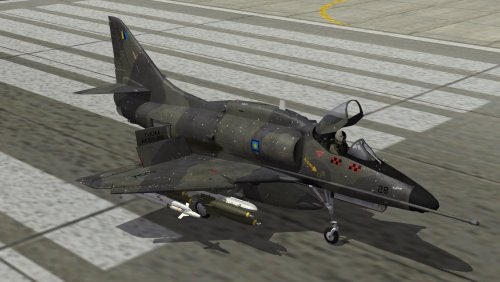
Malaysian Scooters - A-4PTM/TA-4PTM for SF2 - v1.0
==================================================
*** any SF2 that has the A-4F for the cockpit and DLC019 required for the A-4L model ***
The Tentera Udara Diraja Malaysia (TUDM, or Royal Malaysian Air Force) ordered 88 surplus Skyhawks (25 A-4Cs and 63 A-4Ls) in 1980. The TUDM wanted these planes refurbished into 54 single-seaters and 14 two-seaters. However, the US government placed a temporary hold on the sale, and escalating costs due to inflation resulted in a cut in the order to only 40 aircraft.
Grumman Aerospace at St. Augustine, Florida was given the contract to perform the rework on the TUDM Skyhawks. The rework included a complete rewiring, plus two extra underwing hardpoints similar to A-4E and later Skyhawks. A refurbished J65-W-20 engine was fitted. Updated electronics were also fitted, including the AN/ARN-118 TACAN, a SAAB RGS-2A lead computing weapons sight, a Lear Siegler altitude heading reference system, and an AN/ARC-164 UHF transceiver. The A-4Cs were fitted with the dorsal avionics hump. aswell as wing spoilers. A drag chute was installed below the tailpipe. A new canopy was fitted, which was slightly bulged at the sides. Some of the aircraft received preparations for the Hughes AN/ASB-19 Angles Rate Bombing System, aswell as provisions for AGM-65 Maverick missiles, but both were actually never used with these planes. Provisions for the use of AIM-9 Sidewinders were incorporated on the outer wing pylons. In the end, Grumman modified 34 aircraft. They were assigned the designation A-4PTM (where PTM stood for Peculiar to Malaysia, other sources say Persekutan Tanah Melayu - Federation of Malay States). The A-4PTM flew for the first time on April 12, 1984 and modified planes were assigned the TUDM serials of M32-07 to M32-40.
Six A-4C/A-4L airframes were converted into two-place Skyhawks. This was done by inserting a 28-inch plug into the fuselage. Canopy and tandem seating arrangements were generally similar to those of the Douglas-built TA-4s. These planes were designated TA-4PTM. The TA-4PTM also featured five underwing pylons. The first TA-4PTM took off on its maiden flight on August 28, 1984. The six TA-4PTMs were given the TUDM serials of M32-01 to M32-06. Since they were based on the earlier A-4C/L, the 6 planes were among the few two-seaters, that used the J65 engine (together with early TA-4S from Singapore).
Deliveries began in 1985 and were completed by February 1986. A-4PTMs served with No 6 and 9 Squadrons, both based at Kuantan AB, while TA-4PTMs served only with No 6 Squadron. Their service with the TUDM was quite brief. In 1989, it was announced that they were going to be withdrawn from service and replaced by British Aerospace Hawk Mk.208s in late 1994. Six Skyhawks were retained as tanker aircraft, using a centerline Douglas D-704 external buddy tank.
By September 1999, the TUDM Skyhawks were no longer operational, and were derelict at the Royal Malaysian Air Force Base at Kuantan.
Little information are available about those planes, so I tried to come as close as possible to the real ones. Cockpit is a heavily modded A-4F-cockpit modded around the fact, that the radarscreen was deleted and many intruments were rearranged to fill the space. According to Lt. Khoo those planes didn't have any countermeasures (no ECM, no Chaff/Flare-Dispensers) and probably no RWR. To add some survivability I deceided to leave RWR in the mod. ECM and Dispenser is commented out in the data.ini, so if you want to add those, just remove the //-bits.
If you now ask, why the hell do we need a mod of this plane, if it barely can survive in the timeframe it was used? We do not, but I made it, because I could :P I like this plane, because it always was one of the lesser known variants of this well-known plane and for me it is one of the best-looking Skyhawks out there. So, I hope you have some fun with the Jungle Scooter. :)
Installation
============
1. unzip to a temporary folder
2. open "Put_Content_In_Your_MOOD_Folder" and do as you were told, if asked to overwrite, say 'yes' :P
3. enjoy!
If the Squadrons are missing in the loadout screen, you should add the following lines in the squadronlist.ini ("<mod>\pilotdata"-folder) with XXX changed to the next free numbers:
[SquadronXXX]
Name=Malaysia_6SQN
DisplayName=6th Squadron
Nation=Malaysia
[SquadronXXX]
Name=Malaysia_9SQN
DisplayName=9th Squadron
Nation=Malaysia
Credits
=======
- Thirdwire and TK for a great game, models and the cockpit-parts I used.
- Fracture - TA-4 model
- Alejandro - Escapac seat
- FastCargo - FakePilot
- OldDiego - VPAF-Pilot-model
- ravenclaw_007 - LAU-3-Rocketpods + Rockets
- myself - all other work, including 3D-models (tanks, pylons, addons, refuelingpod)
If you created the ????-marked items, please contact me, so I can add your name in the credits! If I forgot someone, please PM me too!
Thanks
======
- Crusader for valuable information regarding weaponsstations-arrangement, I found in the forum, aswell as Skyhawk cockpit.ini-tweaks.
- mue for his great LODViewer, which was a big help while creating the camos and placing stuff.
- Lt. Khoo, a former RMAF Skyhawk Pilot, that provided valuable information.
- Paul Ooi from http://www.paulooimodelworks.com/, that brought me in contact with Lt. Khoo.
- cocas for help learning 3D-stuff!
- RussoUK2004 initial conversion of the pylon-models
- denisoliveira infos and help adjusting fakepilots to match the original models look.
P.S.
====
If you have any problems with this skin or have suggestions and hints, feel free to PM me.
Disclaimer
==========
This mod or parts of it may not be used for payware of any kind. If you use something, give proper credit.
25_01_2016 to 01_10_2017

Royal Canadian Air Force Neptune Mod for SFP2 v1.0 (CP-122)
*** This is a mod of the original P-2H (P2V-7) released by Tracker and the Argentine Modders Group ***
This Mod represent the CP-122 Neptune of the RCAF :
You fill find the complete aircraft in this package.
404,405 and 407 Squadrons
Early (AB + 3)
Early (RCAF + 3)
Late (RCAF + 3)
All decals are made by me. I redraw the panel lines and rivets.
Serials are real one's but not squadron specific.
Background :
The Canadian version of the Lockheed Neptune (P2V7) served as an anti-submarine, anti-shipping and maritime reconnaissance aircraft in the RCAF Maritime Air Command from 1955, replacing the Avro Lancaster maritime aircraft. The Canadian P2V7 was fitted with piston engines initially, although, in 1959, the Neptunes had two underwing Westinghouse J34 jet engine pods retrofitted, similar to those fitted to US Navy variants. Armament included two torpedoes, mines, depth charges, bombs carried internally plus unguided rockets mounted externally underwing. A total of 25 Neptunes served with nos. 404, 405 and 407 squadrons until 1960. Upon unification of the Canadian Forces in 1968, the Neptune was retired and retroactively re-designated the CP122, The RCAF Neptune was replaced by the Canadair CP-107 Argus in the same year.
1977Frenchie
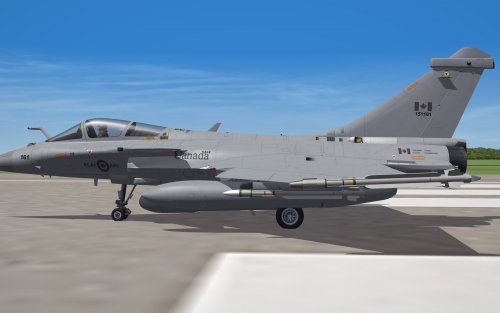
Complete aircraft based on JAT81500 terrific Export Rafale Pack v1.0 :
Fictional Royal Canadian Air Force Rafale Mod for SFP V2 (CF-151)
This addon represent the folowing versions of the Rafale :
- Canada (F3+ version)
*** Same version as India ***
Rafale EH
Changed the roundel on the skins and the decals on this pack are made by me.
Background :
As the original Lockheed Martin F-35 Lighting II Canadian Procurement have been froze by the Liberal government after their 2011 election. It's been long speculated which fighter would replace the aging CF-188's of the RCAF. In 2017, the Liberal government announced the 18 Boeing Super Hornet would be bought as interim aircraft to fill the holes of the current Fleet of CF-188's so operational status can be maintained at 100%. As the tender for the replacement still went on, many manufacturers when on the line to win the replacement aircraft contract.
In the year 2017, Boeing sued Bombardier (Canadian Aerospace Company) over a dispute on aircraft sales (CS-100's below cost) to Delta Airline. Many actors in Canada, USA and even Britain went to defend the Canadian Company that their was nothing wrong by doing so as Boeing did it in the pas itself (like Air Canada Boeing 787). The response by the Canadian Government was to initially re-think the 18 Super Hornet's order. On septembre 25th, the US court stated the Bombardier was at fault and a double 80% sale tax was then charged on every CS-100 sale to the US market. The Canadian response was immediate with cancellation of the Super Hornet buying.
On september 26th, the Liberal's announced that a new fighter have been chosen for the RCAF. The secret have been well kept in the RCAF and government ranks. The announced was the cancellation of the F-35 Lightning II procurement and the buying of 72 Rafale C (same as EH model of the India Air Force) with armament, support and maintenance for a life span of 30 years. The Rafale C under the RCAF would be called CF-151 Rafale-C and would equipped the 6 Tactical Fighter Squadrons (401, 409, 410, 416, 425 and 433).
The 12 first planes (serials 151101 to 151112) were delivered as early of 2018 to the 410 Cougars for training and transition of the CF-18 pilots. Then the other squadrons received their 12 planes each in late 2018- early 2019 time line.
Here is the 12 serials per squadrons :
410 Cougars 151101 - 151112
425 Alouette 151113 - 151124
433 Porc-Épic 151125 - 151136
409 NightHawk 151137 - 151148
416 Lynx 151149 - 151160
401 Ram 151161 - 151172
1977Frenchie
Late 1950´s Breguet's project for a jack of all trades for the upcoming French Carriers, in the end, the project was scrapped wend
the Aeronaval decide to use to buy two single role fighter instead of one multi-role fighter the rest is History!
FM his just copy paste as usual
all weapons are on Gunny weapons pack
model ini edits skins and decals by CAF team
Cockpit by TW
To install just drop the file to your on you savegames etc StrikeFighters folder
enjoy
Cocas
CAF team
PS readme has lots of typos! LOL
A complete SF-2 pack upgrade kit SF-2NA ready
Credits:
- Bunyap for this old but gold plane;
- Hinchinbrooke for original Bulwark CV
- Alex "Spillone104" sound & testings;
- Paolo "Paulopanz" (3) Skins, decals etc.
To Install:
Put all in main mod folder.
Happy carrier take off / landings!
@ paulopanz
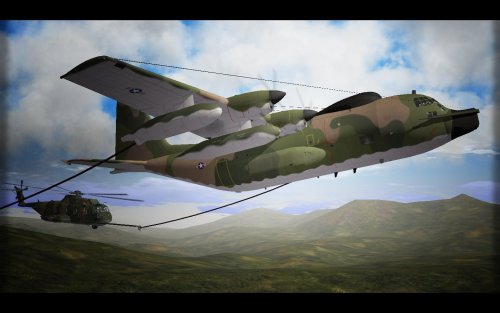
This is extra pack of special versions of C-130 Hercules used by USAF during Vietnam War period.
Pack contains all required models and it is based on Dels great new C-130 Pack + update available here on Combat Ace.
http://combatace.com/files/file/16427-c-130-hercules-superpack/
update here:
http://combatace.com/files/file/16480-c-130-hercules-superpack-add-on-1/
All skins are based on templates by Dels and are done in 2048x2048 format.
Credits:
Original model + pit model: Dels
C-130 fake pilot mods, AQM-drones, Cargo 1800gal fule tank and DC-130 pylons: yakarov
Pack contains:
C-130E(I) Combat Talon I.
In 1965-1966 Big Safari program started programs Skyhook / Stray Goose programs resulting in series of modifications to C-130E airframes as Fulton Recovery System and AN/APQ-115 TF/TA Radar.
On 8 September 1966, Stray Goose deployed 4 aircrafts and personnel to Southeast Asia as Combat Spear unit under PACAF as Detachment 1 314th Troop Carrier Wing. Aircrafts operated from Nha Trang AB in Vietnam. and became first Combat talon aircrafts used in combat.
C-130E(i) Combat Talon I
HC-130P Combat Shadow.
In mid-1966 flight testing began of rescue helicopters equipped with aerial refueling receivers, and 11 HC-130H - the controller aircraft were modified as tankers and redesignated the HC-130P. SAR, Command and Control/vertical lift (helicopter) aerial refueling aircraft, entering service in Southeast Asia in November 1966.
Amid few original ARRS units this set covers painting and decals of 39th ARRS.
DC-130A & DC-130E.
Operations over China and Vietnam could not be succesfulf if not drones operated by 350th SRS . Three C-130As (56-0527, 56-0514 and 57-0461) and three C-130Es (61-2368, 61-2369 and 61-2371) were converted in the 1965-6 timeframe. It is possible that the DC-130As were intended for tactical drone operations and the more powerful and longer ranged DC-130Es were intended for strategic operations with 'big winged' Model 147s over China. The DC-130As generally migrated to test activities after the war and the DC-130Es, after serving with the 432nd TDG, rejoined the transport fleet as C-130Es.
During service in Vietnam all DC-130A were later retrofitted with four bladed Hamilton Standard props.
Ive made all decals for all versions covering years of use in USAF service based on available reference materials.
So all serial numbers are historicaly correct.
National and squadron markings as always in my case are painted on skins.
I did not include any new bump or specular maps. Great stuff for replacment can be found in Kulbit80 pack:
http://combatace.com/files/file/16489-vmgr-152-hi-viz-skin-for-kc-130f/
As weapons AQM-34 - is EOGR missile - can be anything it will not work as drone anyway).
Pylons are set as TLR - to acomodate EOGR -but somehow there is option to load one drone - do not use it. as it will apear somewhere in middle of aircraft.
AQM-34 Drones covers three versions:
G- ECM version equipped with ALE-2 chaff dispening pods.
L-low-altitude photo recce
Q- big wing ELINT version
In HC version refueling drogue is deployed at speed near 120kts. (to simulate refueling helicopters too.)
Note:
In this pack (unlike original Dels C-130) JATO is activated by vector thrust controll (similiar as in latest Tu-22 pack)
report bugs.
Jarek Hereda.
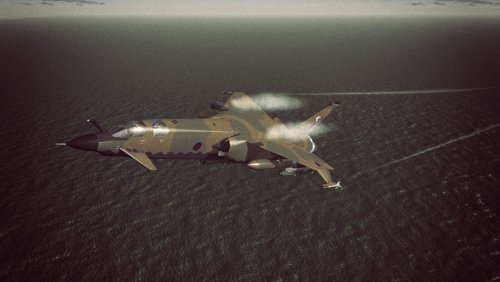
TSR2...........The Alternative Story
6 April 1965 was set to be a sad day for the British aircraft industry, the cancellation of the TSR2 was imminent, the costs were spiralling and the project was slipping further backwards, the project had its supportures but its biggest enenmies were those in power.
But, on the morning of the 5th April something nobody saw coming happened, something that if it turned out to be true could save the entire project and thousands of jobs in the UK avation industry, indeed ministers in parliment were astonished to say the least, if the project was killed off now the British public would be furious , questions would be asked and answeres would be demanded, the government had some serious decisions to make, and quickly for the offer was for 24 hours only !
So what had happened ? Well at 9:45 GMT the British Aircraft Corporation were thrown a lifeline, an American company had stepped in with an offer to see the project through, they were willing to finance all that had been spent on the project so far, this would mean that all the British tax payers money was safe, they were willing to pay back to the British government what they had spent on development costs so far.
In return they wanted the British to basically start again with the project financially, they would work with BAC to carry out further development and testing on a 50/50 cost basis , supplying their own expertise as an aid to the programme.
So, essentially the TSR2 project could be saved, from now on the cost would only be half of the projected costs , somebody wanted in on this venture badly, but who and why ?
April 6th was the day the axe was supposed to fall on the TSR2, government ministers shuffled in their seats as the announcement was due to be made, silence fell , the announcement was short. "The TSR2 Project WILL Continue", there were gasps of amazement amid cheers of joy.
Over the next few hours many questions were asked, some answered, some not, but the main one was WHO ??
Enter onto the scene one of the worlds if not the worlds most famous aircraft manufactures,
Boeing
Yes, Boeing, the company famous for its outstanding range of airliners and bomber aircraft.
Boeing saw the potential of the TSR2 programme and whilst traditionally being a manufacturer of large designs it wanted a smaller tactical bomber/attack aircraft than its previous offerings.
The war in Veitnam was looming and rather than starting from scratch the wise men at the company saw that the combined companies that make up the British Aircraft Corporation had the expertise to pull the project through , they just needed access to more money, money Boeing were willing to commit.
Boeing would not only help financially, they wanted to help solve the current issues and take development further, indeed they wanted to market the project world wide !
The flight testing carried on at quite a pace, problems were found and solved, with there not being as much red tape and politics to go through as previously progress was finally being made.
To get things moving and keep politicions quiet the first batch of the BAC/Boeing Thunderstrike GR1A as it was to be known entered service with the RAF on December 1st 1966 and the RCAF taking its aircraft the following year. Only 100 of this version were produced 60 for the RAF and 40 for the RCAF.
The GR1A was hurried into service so that the BAC/Boeing designers could address some of the types more seroius problems.
From day one the TSR2 had been dogged by the extremely tight fit of its engines, airframes were matched to engines and a single engine removal to take 60+ hours, obviously this could not continue, there was no way the airframe could be widened externally, the only sensible answer was to get rid of the bombay and move the engines slightly closer together, the airframe was strengthened for under fuselage pylons and a fixed 700 gallon tank in its place also doubling up as a heatsink for gearboxes and the like, this was a trade of in all directions but as the original design required a removeable 680 gallon tank in the bombay and an optional 1000 gallon panier tank it was considered the best way forward.
The next issue was with the main gear, right through the testing phase it had proved troublesome and prone to slapping when the first wheel made contact with the runway, numerous fixes had been tried but even now the in service GR1A's were still having issues.
Again Boeing's design team came up with the solution, it was stunningly simple ! They got rid of the tandem swivelling upon retraction complicated system for a more conventual single leg with a pair of wheels attached to it, the same alloys as used on the B52 main gears were used as it was considerably stronger the the British equivalent.
The improvements implemented over time were immense , just about every single part of the aircraft and its systems were changed in someway , only the basic shape of the original TSR2 remained the same.
Even while the original GR1A's were being delivered the next model was starting to enter the production phase, this time the aircraft had gained two 30mm Aden cannon under the nose, the original proposal for a side ways looking radar had been abandoned soon after Boeing got involved [this was now installed into the reconnaisance pod] so the cannons used up the space that had been gained by its removal.
The next design change was probably the most ambitious , Boeing wanted something that was never on the cards for the TSR2 project, they wanted a navalised version , something to compete against the RA-5C Vigilante, the British design team were astounded by this, but Boeing who had several aircraft for evaluation and flight testing had now got their own production line running, with all this extra capacity anything could now be possible !
The modifications to the bombay area and fitting of under fuselage pylons had inherantly strengthened the whole underside of the aircraft, a "full strength" arrestor hook had been installed from day one instead of the original proposal for an "one time" emergency type, the fin was essentially cut in half to make it fold for carrier stowage.
Production of all the navalised versions was to take place at Boeings own plant, initally the US Navy were very reluctant to even trial the idea of a British jet on their carriers, but Boeing's persistance paid off and the Navy placed orders for two versions ; an all out attack variant and a dedicated reconnasiance platform.
For the Marines it was a no brainer, the aircraft was perfect for their "in country" mud moving roll.
It should be noted that all these US aircraft and indeed the Export version that followed all used US built Pratt and Whitney engines, US sourced ECM and countermeasure systems and carried either two Browning 20mm cannon or the 20mm Vulcan "gatling gun"
Export customers for these US built versions included Isreal and Austrailia among others.
Meanwhile back in the UK the RAF versions continued to flourish, changes were generally small and more inline with keeping up with current upgrades to software and such, the biggest problem was with there being so many versions in service at the same time, engines grew ever more powerful even though the design had never been short of power, a dog fighter it was not but down low at high speed nothing came close.
The terrain following radar was a world beater, the ride was stable down low and the wide angle HUD made sure "head down" time was virtually not needed.
South Africa, India, Saudi Arabia and Canada were among the UK spec exports.
Once the Royal Navy accurired its Malta Class carriers it too became users, these carriers and these aircraft being the biggest the Royal Navy had ever operated.
The one thing that did come about from the navalised versions was the fitting of cannards to the nose section , roughly in line with the pilots position. These were fitted to cure a nose down tendancy in certain circumstances when taking off from a carrier, infact several US Navy aircraft were lost and all remaining aircraft were only to be flown by senior pilots with 2000 hours or more.
Two small pitot tubes were positioned in front of each intake to limit the angle of the canard if the airflow became close to intake surge limits.
Pilots reported a general feeling of more stability under weapon launch conditions and the RAF's
GR7 version came with them as standard fitment........if only they had been discovered earlier.
The GR7 was basically the RAF's ultimate Thunderstrike, the original internal ECM fit was very limited in effectiveness and difficult to upgrade so after many years of trying different configurations of US built pods the design team at BAC eventually came up with two purpose built pods which could be installed onto the wingtips replacing the two IRM stations, the pods could be removed in less than one hour making upgrading easier and as a bonus they were more aerodynamic and didnt use up a valuable wing pylon.
The complete number of versions and operators as well as actual combat accounts would be the topic of several volumes, far too much for this brief account of an aircraft which was destined never to be if it was not for a last minute gamble from Boeing.
After a total production run from the two factories of 4500 aircraft I think it is safe to say the gamble paid off.
TSR2_2017
As you've probably already realised the TSR2 is a bit of a favourite of mine,
So.....what's new this time you ask ? More versions, more stuff remapped, more model tweaks, new cockpits and still more to do. Half the fun is seeing if you can find what's changed from the previous releases [if you had them]
This is one aircraft I will probably never stop tweaking so I thought I'd better get what I have so far realeased.
For those of you that already have the older version I can't stress enough that you should move them somewhere safe in case you dont like these.
Just letting them overwrite is NOT a good idea as you will screw up both sets.
Installation is just a case of copying everything FROM the TO_MOD_FOLDER TO your modded game install.
Just remember this is a What If, I'm not really concerned about what would have been feasable and what would'nt, we will never know so I've just gone on what I would like to see.
Enjoy
Sundowner
[Ant]
17/09/2017
.......NOT TO BE USED IN ANY PAYWARE OR RE-RELEASED WITHOUT MY PERMISSION....
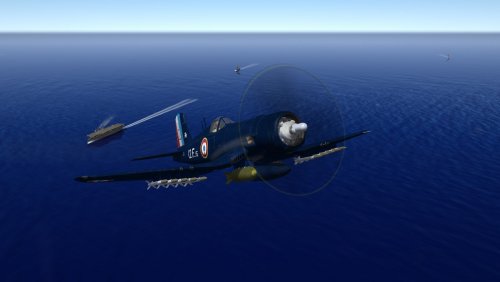
The last production Corsair was the "F4U-7", which was built specifically for the French naval air arm, the Aéronavale.
The XF4U-7 prototype did its test flight on 2 July 1952 with a total of 94 F4U-7s built for the French Navy's Aéronavale
(79 in 1952, 15 in 1953), with the last of the batch, the final Corsair built, rolled out on 31 January 1953.
The F4U-7s were actually purchased by the U.S. Navy and passed on to the Aéronavale through the U.S. Military Assistance Program (MAP).
The French Navy used its F4U-7s during the second half of the First Indochina War in the 1950s (12.F, 14.F, 15.F Flotillas)
WHAT's IN:
- the original plane;
- 13 new, upgraded jpg skins;
- Historical decalset
- pilot, weapons, sound;
- wingfold fixed;
OPERATIONS:
- Key 0 canopy
- Key 9 wingfold
All autoclosing on take off
CREDITS:
- all credits to TMF The Mirage Factory;
- Wrench or upgrades and temps;
- paulopanz skin, reskin, decals, repack
INSTALL:
- all in your mod folder and overwrite.
That's all
Yours
@paulopanz
PS: I started this upgrade for myself as I always loved this plane model. When finished I decided to share.

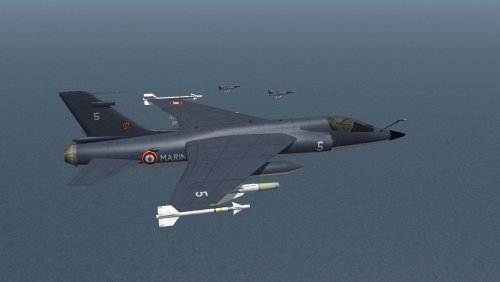 Late 1950´s Breguet's project for a jack of all trades for the upcoming French Carriers, in the end, the project was scrapped wend
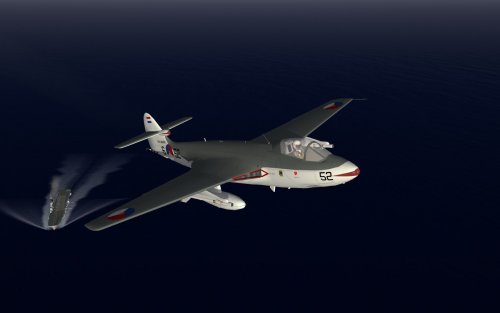 A complete SF-2 pack upgrade kit SF-2NA ready