
Erik
-
Posts
7,244 -
Joined
-
Days Won
42
Content Type
Profiles
Forums
Gallery
Downloads
Store
Everything posted by Erik
-
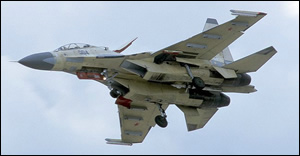
Sukhoi Su-30M2 fighters complete test flights UPI - 28/09/2010 MOSCOW -- Russia's Sukhoi aeronautical firm has completed its factory flight tests for its multi-role double seater Su-30M2 fighters. The tests occurred at the flight test station of the Komsomolsk-on-Amur aircraft production association named after Yuri Gagarin, Itar-Tass reported Tuesday. After receiving certification the Su-30M2 will be posted to units of the Russian air force. Russia's Ministry of Defense signed contracts for four Su-30M2 aircraft at the international aerospace show MAKS-2009. During the air show, the Russian Ministry of Defense also signed contracts for 48 Su-35S fighters and 12 upgraded Su-27SM fighter jets. The Su-30M2 is an upgraded strike aircraft, based on the Su-30 fighter design. The fighter was designed as a single-seat, twin-engine, long-range, air defense fighter to counter the U.S. F-15 Eagle and NATO fighter aircraft. The Su-30 aircraft has proven a valuable export. China has purchased about 72 Su-30MKs, Su-30MKK or J-11s, which are now being delivered. A licensed production joint agreement has also been agreed signed by Russia and China under which 250 Su-30MKKs will be constructed by China's Shenyang Aircraft Corp. UPI
-
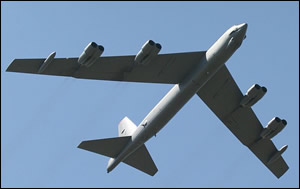
Boeing Statement on Award of B-52 Modernization Contract Boeing -- 29/09/2010 WICHITA, Kansas -- The Boeing Company today received an indefinite delivery/indefinite quantity contract from the U.S. Air Force for B-52 Stratofortress weapon system modernization. The company released the following statement: "This B-52 modernization contract will include several delivery orders over an eight-year period. The Air Force announced a contract ceiling of $11.9 billion. This is a contracting vehicle that will allow engineering sustaining contracts, studies, production and other activities to occur in support of the B-52. No funds were committed with this contract announcement. We expect our first delivery order to be awarded on Sept. 30." Boeing has been maintaining and modernizing the B-52 bomber for 55 years -- including engineering services and upgrades to communication technology -- allowing the B-52 to remain a relevant weapon system in support of military missions around the world. Boeing
-
 Russian Navy to get fifth generation carrier fighter after 2020 RIA Novosti -- Alexei Druzhinin -- 28/09/2010 The appearance of a fifth generation fighter in Russian naval aviation will not happen before 2020, the outgoing head of the air forces and air defense forces of the Russian Navy, Lt. General Valery Uvarov told RIA Novosti on Tuesday. Previously, representatives of the armed forces command and Defense Ministry had said a new naval fighter based on the Sukhoi T.50 design could enter service around 2016. "It's difficult to say when this aircraft will enter naval service. First it will go into service with the air force, and then be 'navalised.' To build a new aircraft from scratch costs huge money, it's irrational and not competent. Conditions might be suitable by 2020," he said. Uvarov stressed, however, that any new naval fighter would enter service only following a competition in which other designs would participate, including from the MiG, Yakovlev and Sukhoi design bureaus. A new generation carrier fighter should enter service with the fleet not long before any new aircraft carrier on which it would be based, Uvarov said, so pilots would be ready. "The aircraft should come before a ship entering service, so pilots can train first on land, then on a special training area, then on deck," he said. He stressed that the service was still waiting to take delivery of the naval MiG-29K, which is being exported to India. "The first two MiG-29Ks will soon be purchased in order to carry out development of their functions," he said. "I think there should be two squadrons, that is 24 MiG-29Ks and one squadron of Su-33s." The Russian navy is currently reforming its structure, with naval air forces and naval air defense being merged into one branch. Lt. General Uvarov is leaving his post as commander of both branches. MOSCOW September 28, RIA Novosti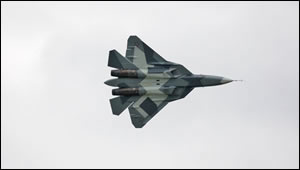
-
Boeing Receives Multi-Year Contract from US Navy for 124 F/A-18 and EA-18 Aircraft Boeing - September 28, 2010 ST. LOUIS -- The Boeing Company [NYSE: BA] has been awarded a new multi-year procurement (MYP) contract from the U.S. Navy for 124 F/A-18E/F Super Hornet and EA-18G Growler aircraft. The new contract is valued at $5.297 billion. Under the terms of the agreement, Boeing will deliver 66 Super Hornets and 58 Growlers to the Navy from 2012 through 2015. "The men and women of Boeing are honored to provide the Super Hornet's advanced, combat-proven multirole capability and the EA-18G's unmatched airborne electronic attack capability to the American warfighters serving their nation around the world each day," said Boeing F/A-18 and EA-18 Programs Vice President Kory Mathews. "Procurement of these 124 aircraft through a multi-year contract takes advantage of the full efficiencies of Boeing’s production and supplier operations, which will generate more than $600 million in cost savings for U.S. taxpayers." The new contract is the third multi-year agreement between Boeing and the Navy for production of the F/A-18E/F, the Navy's frontline strike fighter, which delivers forward-deployed air combat capability around the world from the decks of 11 Navy aircraft carriers, including ongoing missions in Afghanistan. The EA-18G, the United States' newest combat aircraft, conducts advanced airborne electronic attack (AEA) missions to support Navy and joint force requirements. The EA-18G is scheduled for its first combat deployment later this year. "Boeing and its Hornet Industry Team suppliers have delivered every Super Hornet and Growler on schedule to the warfighter and on budget for the taxpayer from the first Super Hornet delivery,” said Mathews. “The first two F/A-18E/F multi-year contracts generated more than $1.7 billion in savings for the United States. We look forward to continuing to provide unmatched capability and value through this contract." Boeing delivered 210 Super Hornets to the Navy during the initial F/A-18E/F MYP, which spanned fiscal years 2000 through 2004. Boeing was then awarded a second MYP that included aircraft procurement during fiscal years 2005 through 2009. Aircraft deliveries under that contract continue through 2011 and total 257 aircraft. The Boeing F/A-18E/F Super Hornet is a multirole aircraft, able to perform virtually every mission in the tactical spectrum, including air superiority, day/night strike with precision-guided weapons, fighter escort, close air support, suppression of enemy air defenses, maritime strike, reconnaissance, forward air control and tanker missions. Boeing has delivered more than 430 F/A-18E/Fs to the U.S. Navy. The Boeing EA-18G Growler is the only air combat platform that delivers full-spectrum AEA capability along with the targeting and self-defense capabilities derived from the Navy's frontline fighter, the F/A-18E/F Block II Super Hornet. A derivative of the two-seat F/A-18F Block II, the EA-18G's highly flexible design enables warfighters to operate either from the deck of an aircraft carrier or from land-based airfields. It is replacing the Navy's current AEA platform, the EA-6B Prowler, which has been in service since 1971. The EA-18G joined the Navy's aircraft fleet in 2008, when it was introduced to fleet training squadron VAQ-129. A unit of The Boeing Company, Boeing Defense, Space & Security is one of the world's largest defense, space and security businesses specializing in innovative and capabilities-driven customer solutions, and the world's largest and most versatile manufacturer of military aircraft. Headquartered in St. Louis, Boeing Defense, Space & Security is a $34 billion business with 68,000 employees worldwide. Boeing
-
The subscription system isn't very advanced. I apologize for that. Subscriptions can be purchased and renewed. Those are the two options available. By upgrading I meant in comparison to the list I provided above. Sorry for the confusion. Erik
-
View New Content not there any more...?
Erik replied to malibu43's topic in Site Support / Bug Reports / Suggestions
Look in the upper right corner of our pages to find the icons as shown above.
-
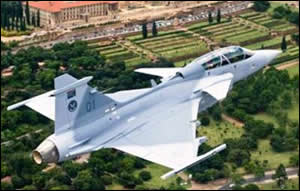
Gripens do half of 51 World Cup intercepts DefenceWeb -- Written by Leon Engelbrecht Saturday, 25 September 2010 16:19 The South African Air Force's (SAAF) growing fleet of SAAB Gripen fighters conducted about half the 51 aircraft intercepts conducted during the June/July soccer world cup. The SAAF deployed 11 of the available 15 Gripen during the month-long tournament as well as 12 of 24 BAE Systems Hawk lead-in fighter trainers. Also deployed on interception duties were 12 unarmed Pilatus PC7 Mk II Astra trainers, 14 AgustaWestland A109M and some Eurocopter BK117 light utility helicopters. Air Force director fighters, Brigadier General John Bayne, told a Gripen briefing at the SAAB chalet at Africa Aerospace & Defence 2010 exhibition that ends today that some 347 combat air patrols (CAP) were flown to secure all 64 games. In a similar briefing in August, Major General Les Lombard, the General Officer Commanding te Air Force Command Post said with “that grouping of aircraft we could cater for various threats, be it from paragliders right up to the possibility of hijacked airliners.” Bayne says some 2214 SAAF personnel were deployed for Operation Kgwele as the endeavour was known. Lombard noted it was the “largest air defence operation the SAAF has ever conducted. It was over an extended period of time and all 64 games were secured by air defence assets.” He added that it “is a massive operation securing the airspace of an entire country and you need the close cooperation of all the roleplayers... the Airports Company SA, the Department of Transport's Air Traffic Navigation Service (ATNS) an the police. Lombard noted command-and-control required the establishment of six sector control centres (SCC): South Africa normally only has two. The permanent installations at the Lowveld Airspace Control Sector at Hoedspruit in Mpumalanga and the Bushveld Airspace Control Centre in Pretoria were augmented by two mobile sector control stations from 140 Squadron, deployed to Bloemfontein and Cape Town. “And there our resources came to an end. So with a lot of initiative and hard work from within the SAAF, two temporary sector control stations were created at Port Elizabeth and Durban with great cooperation from ATNS who supported us with facilities and allowed integration into their systems at those venues. “The development of the sectors in a very short time and the close cooperation with the ATNS was really a winner. Then in terms of the sector control centres from where all the military aircraft was controlled, we had very lose coordination with the ATNS with regard to deploying the necessary sensors such as radars to develop an integrated air picture. “We deployed four Tellumat-supported Umlindi radars from 140 Squadron, three tactical mobile radars (TMR) from 142 Squadron and integrated these with our static radars, ATNS and SAAF long range, which allowed us a very good tactical integration...,” Lombard said. “In terms of radar sensor information, the CAF (chief of the air force, Lieutenant General Carlo Gagiano, who spoke before Lombard) alluded to the effectiveness of the Gripen radar, it was really marvellous to see the effectiveness of that and many low flying aircraft were considerably surprised by our ability to detect them in areas where they thought they could fly under radar coverage. The Gripen could pass on the data – via Link ZA – to the SCC so that intercepts could be vectored onto them. This opens up a whole new concept of operations within the SAAF and is something we will pursue down the line. “We also had the ability to integrate the radars of the navy frigates and the SA Army Thutlhwa... ...these obviously are force multipliers … the frigates were just off the coast, to give us the coverage we so badly needed for low flying aircraft [at coastal venues].” In addition, said Lombard, the SA Army deployed 29 observation posts (OP's) at various venues and these were in direct communication with the SCC “in order to supply us with visual input of very low flying aircraft or aircraft with very low radar cross section. The SA Navy supplied five further OP's in the Cape area. Bayne noted that the air defence system recorded detected 65 non-compliant aircraft, including airliners, which led to the 51 intercepts. Nine aircraft were diverted. Police waiting at airfields took unspecified action against 43 pilots. Bayne praised the availability of the SAAF's new fighter fleet, noting that seven Gripen and four Hawk were deployed to AFB Waterkloof to provide CAP over the northern matches (Polokwane, Pretoria, Nelspruit, Johannesburg, Rustenburg, Durban and Bloemfontein) and four of each to AFB Overberg to CAP Cape Town and Port Elizabeth. For this purpose the Gripen were allocated 276 flying hours and the Hawks 279. Bayne says the five two-seat Gripen D were 98% reliable and the six single-seat Gripen C 89%. The Hawk was 98% reliable. At any given time 8.95 of the 11 Gripen were available and 11.6 of the Hawk. Maintainability was 89% for Gripen and 92% for Hawk. Bayne observed that the figures for Gripen would have been higher had it been an operation system. The platform, being acquired under Project Ukhozi, is still in the project phase. DefenceWeb
-
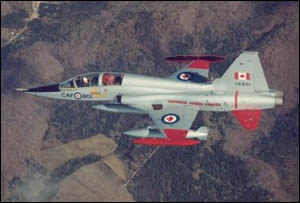
Tactical Air Defense Services Acquires Option to Purchase Canadian CF-5 Fighter Jets TADS-USA -- 23/09/2010 CARSON CITY, Nev., Sep 23, 2010 (GlobeNewswire via COMTEX) -- Tactical Air Defense Services, Inc., an Aerospace/Defense Services contractor that offers tactical aviation services, aerial refueling, aircraft maintenance, disaster relief services, and other Aerospace/Defense services to the United States and foreign militaries and agencies, is pleased to announce that it is has acquired the exclusive contractual right to purchase six Canadian CF-5 Fighter Jets and related assets (the "CAD Assets") from Crown Asset Distribution, Minister of Public Works and Government Services, Canada. The CAD Assets have a market value of greater than $69 million, and include: -- 6 CF-5 Aircraft -- Spare Parts Lots -- 45 General Electric J85-15 Jet Engines The total cost to TADF to purchase, import and refurbish the CAD Assets, including the acquisition cost of the contractual right to purchase the CAD Assets, is less than $6 million. The CF-5 aircraft is the Canadair licensed version of the American Northrop F-5 Freedom Fighter aircraft built primarily for the Canadian Armed Forces. The CF-5 is a low-cost, low-maintenance, and extremely versatile fighter jet that can be used to provide a tactical support role, as a light attack strike fighter and a reconnaissance platform, and for dissimilar air combat training, lead-in tactical fighter training, and in an adversary role, in support of tactical aviation contracts. TADF intends to use the CAD Assets to capture new tactical aviation service contracts and maintenance contracts, with the U.S. Department of Defense and foreign militaries: -- CF-5 Aircraft: -- CF-5 Aircraft: Support existing TADS/Tac-Air tactical aviation service contracts -- Capture new tactical aviation service contracts -- Minimum of 200 hours per aircraft per year -- Hourly rate to government of approximately $7,500 per flight hour -- CF-5 Parts: -- Support TADS CF-5 aircraft for 20 years -- Surplus sold in conjunction with international aircraft maintenance contracts -- Manufacturing template for CF-5 parts supply business to ensure ongoing supply -- CF-5 Engines: -- Support TADS CF-5 aircraft for 20 years -- Surplus sold either as whole units or in parts TADF is currently pursuing a collateralized loan of $6 million secured by the CAD Assets with an over-collateralization ratio of greater than ten times. TADF believes but cannot guarantee that it will receive the funds necessary to purchase all of the CAD Assets. Alexis C. Korybut, Chief Executive Officer of TADF, stated, "We are very pleased that after more than a year of working on this very important transaction, we have finally accomplished what may prove to be a watershed event for TADF. The acquisition of the CF-5 Fighter Jets will enable TADF to bid on larger and more profitable tactical aviation contracts and aircraft maintenance contracts, and the sale of surplus spare parts and engines may provide a significant source of income to TADF for years to come, in addition to materially increasing the assets on our balance sheet." Make sure you are first to receive timely information on Tactical Air Defense Services when it hits the newswire. Sign up for TADF's email news alert system today at: http://ir.stockpr.co...sa/email-alerts Further information about TADS is available on our website: www.tads-usa.com. Forward Looking Statement Disclosure This release contains forward-looking statements within the meaning of Section 27A of the Securities Act of 1933 and Section 21E of the Securities Act of 1934 that are based upon current expectations or beliefs, as well as a number of assumptions about future events. Although we believe that the expectations and assumptions upon which they are based are reasonable, we can give no assurance that such expectations and assumptions will prove to have been correct. Some of these uncertainties include, without limitation, the company's ability to perform under existing contracts or to procure future contracts. The reader is cautioned not to put undue reliance on these forward-looking statements, as these statements are subject to numerous factors and uncertainties, including without limitation, successful implementation of our business strategy and competition, any of which may cause actual results to differ materially from those described in the statements. We undertake no obligation and do not intend to update, revise or otherwise publicly release any revisions to these forward-looking statements to reflect events or circumstances after the date hereof or to reflect the occurrence of any unanticipated events. Although we believe that our expectations are based on reasonable assumptions, we can give no assurance that our expectations will materialize. Many factors could cause actual results to differ materially from our forward-looking statements. SOURCE: Tactical Air Defense Services, Inc.
-
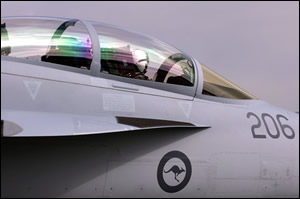
F/A18 Hornets Join Australian Aerospace Service Support List Defence Professionals -- 26/09/2010 Leading Australian defence contractor, Australian Aerospace Limited, has welcomed the addition of the F/A18 Hornet fighter to the inventory of Royal Australian Air Force (RAAF) combat aircraft which the company supports through maintenance and service agreements with the Australian Defence Force (ADF). The company has successfully teamed with the world’s largest tyre manufacturer, Michelin, to win a Defence Materiel Organisation (DMO) contract to manufacture and supply tyres for the F/A18 (Classic) Hornets, and the AP-3C Orion patrol and reconnaissance aircraft. Australian Aerospace, which already provides Through-Life-Support to the Orion fleet under its P3 Program, and Michelin Australia, have signed a five-year Deed of Agreement for the supply of tyres and the management of tyre inventories for the FA/18s and P3s. In addition to supplying new tyres, the partners will also be responsible for retread-overhaul, inventory management and tyre storage, distribution and disposal. Welcoming the Agreement, Dr Jens Goennemann, Chief Executive Officer Australian Aerospace said: “Winning the P3 tyres business is a natural extension of the Through-Life-Support services that Australian Aerospace provides the DMO under the AP-3C Orion Platform Systems Support Contract. However, the addition of the FA/18 Hornets is an exciting and welcome addition to our customer support base.” As well as the F/A18s and P3 Orions, Australian Aerospace also supports the C-130J Hercules transport aircraft, the new Airbus A330-based KC-30 MRTT multi-role tanker-transports and, until recently, the now retired Caribou medium transports. Currently it is assembling and delivering 22 Tiger ARH armed reconnaissance helicopters to the Australian Army and 46 MRH90 multi-role helicopters to the Army and Navy. Mr Rob Hunter, Vice President Fixed Wing / Operations Australian Aerospace said the Deed of Agreement also had scope to include future Australian Defence Force weapons systems. “Our teaming with Michelin Australia is an excellent example of how, having identified an opportunity, our P3 Program team then went out and found the right partner to deliver an accountable and effective solution to Defence,” he said. “As a result, Australian Aerospace brings to the table its proven defence contract management, supply chain and authorised maintenance organisation skills, and Michelin contributes new product and retread capabilities and specialised tyre storage and distribution systems”. Mr Hunter said the Deed of Agreement also provided for multiple extensions of the contract and he had no doubt that Australian Aerospace’s long-demonstrated good service delivery to the ADF would ensure that it would ultimately prove to be a life-of-type arrangement for both the F/A18 Hornets and the P3 Orions. Defence Professionals
-
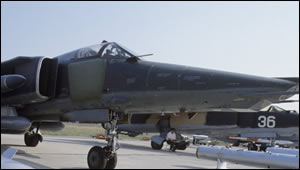
MiG-27 crashes in India, pilot survives RIA Novosti. Sergei Subbotin -- 10:15 24/09/2010 A MiG-27 Flogger ground attack aircraft of the Indian Air Force (IAF) has crashed in the country's east, the third crash of a plane of this type in India this year, a spokesman for the Indian Army Eastern Command said. The crash took place at 08:25 am local time (02:25 GMT) some 40 kilometers (25 miles) east of the Kalaikunda air base in West Bengal state. "The pilot managed to eject and is unharmed. The crash did not cause casualties or destruction on the ground," Mahesh Upasani said, adding that investigation into the crash was under way. An MiG-27 aircraft crashed in West Bengal in February near the Hashimara military base, killing the pilot and causing all MiG-27 flights to be suspended for a short period of time. Another MiG-27 plane crashed into a village in the region in July during a routine training flight, killing a local resident and injuring 10 others. The MiG-27 aircraft was originally built in the former Soviet Union in the mid-1970s before it was licensed to be produced in India. India has about 150 MiG-27 planes, known as the Bahadhur (Brave) in the IAF. According to the military, a current upgrade program will keep the MiG-27 operational for another 10 years. NEW DELHI, September 24 RIA Novosti
-
If I remembered half the stuff I'm sure I haven't explained my head would explode. It's good to relieve the pressure a few kilobytes at a time.
-
Upgrades can't be done until your current subscription expires then you can elect an upgrade. Renewals aren't allowed unless you're in the renewal period which is 48 hours prior to expiration. I think that's what you're asking.
-
As to your original question regarding tags. There are two general types of tags; staff and member. Under each of those types there are sub-types which indicate an involvement in our community. Shown below in top / down. MEMBER - Premier Member (Subscription) - Prime Member (Subscription) - Choice Member (Subscription) - Modder (Involvement Status) - Military Veteran (Thank you benefit qualified applicants only) - Elite Member (Post count perk) - Senior Member (Post count perk) - Valued Member (Post count perk) - Junior Member (Post count perk) - New Member (Post count perk) STAFF - Owner - Founder - Admin - Moderator - WC Admin - WC Controller
-
Changing from a paid member to a non-paid member will result in a downgrade of your account. You may want to wait until you roll off your subscription to change groups. After you've changed if you want to re-up your subscription then it's no problem the system will understand upgrades but at this time it doesn't understand downgrades. FYI but whatever you decide is fine we can sort the mess out later just be advised there may be some adverse affects to changing while in a subscription plan. E
-
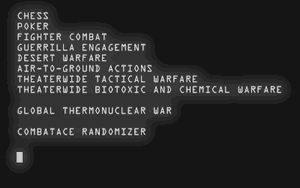
CombatACE Facebook Contest Winner Week 1 - Ivan Adamek Meet Ivan Adamek. Ivan is our Facebook contest winner for week 1. Congratulations! We dusted off the CombatACE Randomizer and carefully plugged it in. Using the punch card reader I input the value list from number 1 through 157. At about card 58 I swore I heard what sounded like, "Would you like to play a game?" but that is a story for another day. I finished with the cards then I stepped back just far enough to touch the [ENTER] key. You could almost feel the raw processing power as the whir of the fans started drawing power from the local grid. Behind the dull gray exterior illuminated by rows of red and amber glowing glass indicators some raw number crunching was taking place. In what seemed like an instant but was actually 13 minutes 24 seconds the all familiar egg timer "ding - fries are done" sound could be heard. I rushed to the output tray listening to the dot matrix printer churning away in a ritttta.... ritttta ..... ritttta .... zip sound of excitement. I waited. A few minutes later and as the puff of light smoke cleared there in the tray appeared the product of all the festivities. Printed in double strike fashion, the number 111 could be seen as our winner. I admit we haven't used the CA Randomizer in a while so it might be just a bit out of alignment but there's still nothing better than that crisp burning electronics smell in the morning. With the results in hand I moved on to the the CA list of fans on Facebook where we find number 111 is Ivan. So let's hear it for our Argentinian friend and winner of this weeks prize, a shiny new CA Subscription Plan courtesy of CombatACE. Ivan drop us a message on Facebook and let us know what your username is here on CombatACE and we'll get your account upgraded. Join us next week to see if our randomizer is working or not. Don't forget to join our Facebook page if you haven't done so already to be eligible for next weeks drawing.

-
I had a civilian dentist when I was a kid in college, (Reed I think his name was), who was an ex-navy dentist. I absolutely miss that guy he was phenomenal. I went to him on a referral being on a limited budget in college for the same exact thing impacted wisdom teeth one lower on the right side and one upper left side and I very clearly remember the horrible pain. So anyway I'm not really looking forward to this as I had then heard horror stories about people having wisdom teeth pulled. He sits me down and hovers over my mouth a couple minutes and says he can see the two inflamed teeth clearly as they've started to crown but the other two aren't anything to worry about yet. He then goes on to tell me that I have two options. Do the procedure twice at different sittings or have him pull them all now which might result in a little more discomfort for the two not visibly crowned. He then says don't worry I've done this same procedure on 40 foot seas and in forward triage, he was very matter of fact and calm. Trusting him I said just pull them all then. He numbed me up and went to work. Four shots, two upper and two lower, and 30 minutes and he had all four teeth and I didn't feel a thing other than some pulling but very minor. Not a single suture and to this day when I see my current dentist he's always amazed I had the teeth pulled conventionally and not by an oral specialist. So I'm not sure what happened S&E but I'd have to say you definitely had an odd turn of events. From my experience I'd say you just got someone who wasn't experienced whether military or not.
-
TrackIR 5 Review Thinking about a TrackIR 5 for OFF? Wanting to experience OFF in total immersion? Read the review and you'll be looking for parking space for your crate at the order desk. Enjoy. READ THE REVIEW
-
TrackIR 5 Review September 21, 2010 Ruggbutt puts the TrackIR 5 through its paces with some great outcome and performance news. The TrackIR 5 was everything it was expected to be and then some. Awarded "Best of the Year 2010" the TrackIR 5 is a great addition for any flight, racing, or combat rig where nothing short of total immersion is the ultimate desire. Read the TrackIR 5 review you'll be racing your way to order yours today. READ THE REVIEW
-
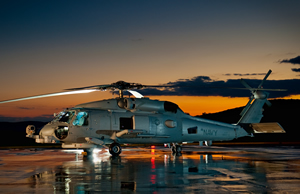
Lockheed Martin Receives $10 Million to Migrate MH-60 Helicopters to the Joint Mission Planning System Lockheed Martin OWEGO, N.Y., September 21st, 2010 -- The U.S. Navy awarded Lockheed Martin [NYSE: LMT] a $10 million contract to develop software that will enable MH-60R and MH-60S multi-mission helicopter aircrews the latest technology to pre-plan their missions for maximum success. The U.S. military’s Joint Mission Planning System (JMPS) was developed by the U.S. Navy and Air Force based on a commercial-off-the-shelf architecture that standardizes how aircrews file their mission flight plans. JMPS will replace other legacy mission planning systems. Lockheed Martin will develop a software module configured to JMPS containing the newest mission characteristics unique to MH-60R and MH-60S multi-mission helicopters. Those missions include anti-submarine warfare, anti-surface warfare, airborne mine countermeasures, search and rescue and ship-to-ship cargo resupply. “The MH-60 module will give Navy SEAHAWK® pilots access to the military’s most advanced mission planning tool, allowing pilots to easily capture and load pre-planned data in a format compatible between both helicopter types,” said George Barton, director of Lockheed Martin naval helicopter programs. “Once airborne, the aircraft’s avionics will know what mission to prosecute, the intended route and navigation waypoints to use, the communications frequencies, weapons and, sensors it will employ, as well as other critical information.” The software modules will be loaded onto a planning system laptop that allows MH-60 pilots to select preconfigured mission plans, compile weather data, maps, navigational routes, targeting data and the types of weapons and sensors their aircraft will use for a mission. The finished mission profile is transferred to a memory card and uploaded to Lockheed Martin’s Common Cockpit™ avionics suite — the digital cockpit aboard both helicopter models. During the next 30 months, Lockheed Martin will develop and test software for the MH-60 module, also known as a unique planning component, in Owego, N.Y. Subsequent tests will be conducted at Naval Air Weapons Station, Point Mugu, Calif., and the Naval Air Station, Patuxent River, Md. JMPS-based mission planning computers with the MH-60 unique planning component will be available for deployment in 2012. MH-60 SEAHAWK multi-mission helicopters are designed and manufactured by Sikorsky Aircraft Corporation. Lockheed Martin provides the digital cockpit for all MH-60 helicopters, and is the prime systems integrator for the MH-60R. The Navy plans to buy 300 MH-60R and 275 MH-60S aircraft. Headquartered in Bethesda, Md., Lockheed Martin is a global security company that employs about 136,000 people worldwide and is principally engaged in the research, design, development, manufacture, integration and sustainment of advanced technology systems, products and services. The Corporation reported 2009 sales of $44.5 billion. Lockheed Martin <h1></h1>
-
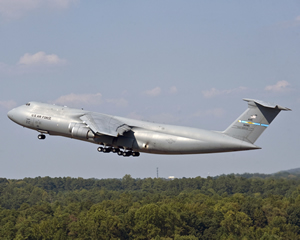
First Production C-5M Super Galaxy Takes Flight Lockheed Martin MARIETTA, Ga., September 21st, 2010 -- Lockheed Martin’s [NYSE: LMT] first production C-5M Super Galaxy made its first flight here Sept. 19 sporting the new “Super Galaxy” tail flash and nose art. It is set to be delivered Sept. 30 and will arrive for duty at Dover Air Force Base, Del., in November. Lockheed Martin
-
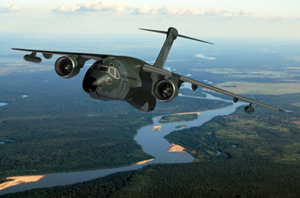
AERO Vodochody plan a new project Aero Prague: Ministries of Defence of the Czech Republic and Brazil yesterday signed an agreement in terms of which Aero Vodochody will cooperate with the third global most important aircraft manufacturer a company Embraer on development and production of a new military multipurpose transport aircraft KC-390. „Aero very much appreciate an opportunity to cooperate with such a company as is Embraer, which successfully contribute to global aerospace production. Aero is honoured to be able to enter the new Embraer´s project and consider this as an acknowledgement of our qualities. It is a great message for development and prestige of aerospace industry of the Czech Republic and Aero presume cooperation with Czech companies. I believe it is a way how to succeed in today´s global competition,“ said President and chairman of the board of directors of Aero Vodochody Ladislav Šimek. Negotiations of Aero with Embraer on cooperation for KC-390 project should be closed down in the fourth quarter of 2010. Embraer KC-390 Tactical multipurpose military transport aircraft. Twin-engine jet-powered aircraft with 23,6-tonne payload rating. First flight of this aircraft is scheduled in 2014 and first delivery to the customer at the end of 2015. Aero
-
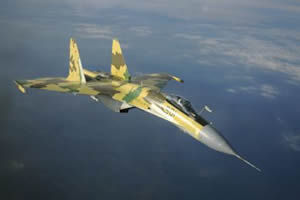
Sberbank to Finance SU-35 Fighter Production Air Force News — By Sukhoi on September 21, 2010 at 4:56 am MOSCOW: The Komsomolsk-na-Amure-based Yuri Gagarin Aviation Industrial Concern (KnAAPO), incorporated by the Sukhoi Holding Company, and Sberbank (the Savings Bank of Russia) concluded today a general agreement to build the Su-35S multi-role fighter. The document was signed by Alexander Pekarsh, KnAAPO director general, and Olga Bukhankova, head of the Savings Bank central division in Komsomolsk-na-Amure. The signing of this agreement will provide long-term funding for one of Russia’s largest aviation enterprises and ensure the series production of aircraft on time. The state’s contract under which Sukhoi must supply, by the year 2015, the Defense Ministry with 48 super-maneuverable Su-35S fighters was signed in August last year, at the MAKS-2009 aerospace show. The series production of the aircraft, the first of which [will be] handed over to the Defense Ministry late this year, was organized at Sukhoi’s facility in Komsomolsk. The fighter is also intended for the foreign market. Talks are underway for the supply of aircraft to customers in Southeast Asia, Middle East, and South America for re-equipment of their air forces. The Su-35 is a thoroughly modernized super-maneuverable multi-role fighter of the 4++ generation. It employs the fifth-generation technologies giving it an edge over the same class fighters. The special feature of the aircraft is a new avionics suite based on a digital information control system, integrating onboard instrumentation, a new radar with a phased antenna array capable of detecting a larger number of air targets with their simultaneous tracking and engagement (tracking of 30 and engagement of 8 air targets along with tracking of 4 and engagement of 2 ground targets), and new increased and vectored thrust engines. The Su-35 features a wide array of long-, middle- and short-range weapons. It carries guided munitions for resisting radar systems and fighting ships, general purpose weapons, guided aerial bombs and unguided missiles. The radar signature of the fighter, as compared to that of the fourth-generation, has been reduced by several times thanks to the current-conducting coating of the cockpit, application of radio absorptive surface materials and reduced number of protruding sensors. The aircraft’s service life is 6,000 flight hours, the life cycle is 30 years, and the designed operating life of the adjustable nozzle engines is 4,000 hours. Defence Talk
-
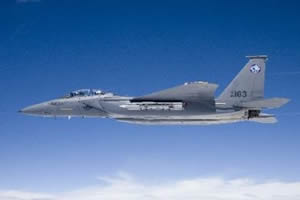
F-15 engine tested on tri-fuel blend Air Force News — By Air Force News Agency on September 21, 2010 at 8:26 am ARNOLD AIR FORCE BASE, Tenn.: Continuing the march toward certifying the entire Air Force fleet on alternative fuels, an F-15 Eagle engine is undergoing performance testing here using a unique blend of three different fuel types. The F100 engine is being tested with a combination of JP-8 conventional aviation fuel; a biofuel derived from tallow, which is an animal fat; and a synthetic fuel derived from coal through a process commonly known as Fisher-Tropsch. The fuels testing is being conducted to ensure the different fuels, in varying combinations, are suitable for an upcoming series of F-15 flight tests tentatively scheduled for October at Eglin Air Force Base, Fla., said Brian Knack, the Aerospace Testing Alliance's program engineer for the test. ATA is the operating contractor at the Arnold Engineering Development Center. "This (first phase of the test) evaluated a 50 percent (by volume) tallow-derived fuel, while the final phase is bringing Fischer-Tropsch-derived fuel together with the bio-fuel forming yet another new and unique blend," he said. Testing has simulated the overall engine conditions experienced at near sea-level conditions. A baseline test using JP-8 was performed in the first phase of the test program. Then, a blend of 50 percent tallow-derived fuel and 50 percent JP-8 was evaluated. Finally, a blend of 25 percent tallow-derived fuel and 25 percent synthetic fuel and 50 percent JP-8 was evaluated. "They've engineered these alternative fuel blends, both the tallow and FT, to meet the existing JP-8 (specifications) requirements," Mr. Knack said. "So, we're just verifying that, although it's within the same specification chemically, that it doesn't adversely affect engine performance." Second Lt. Drew Miller, the AEDC's project manager for the test, pointed out that this entry is not a certification test series per se, nor is it intended to include an analysis of "wear and tear" on the engine. "We're just demonstrating that the engine can successfully perform on the biofuels that we're testing," he said. Engineers from the Air Force Alternative Fuels Certification Office at Wright-Patterson AFB, Ohio, noted that the hydro-treated renewable jet biofuels -- currently only available in research and development quantities -- are expensive. The expectation is that once they are certified for use by the Air Force and by airlines participating in the Commercial Aviation Alternative Fuels Initiative, industry producers will respond to the market demand and prices will fall in line with conventional jet fuel. Lieutenant Miller said it's important to view this test from a wider perspective. "The Secretary of the Air Force has an initiative to reduce our dependence on oil (by) 50 percent by 2016, and this is just leading the way to make that happen," he said. "The Air Force is the largest oil consumer in the Department of Defense, and this is a major step towards increasing our independence." Mr. Knack said he is already looking toward the future of bio-fuels. "This is the next step of biofuel evolution, and a couple years from now we could be running algae-based fuels or whatever is deemed to be the most efficient, economically produced on a mass production level," he said. "Then we will probably see it here." Defence Talk
-
Have you added CombatACE to your Facebook? We're giving away a file subscription each week to a random person signed up to our Facebook page. If you haven't already done so, add us. <a href="http://www.facebook.com/pages/CombatACE/108447789190660" target="_TOP" title="CombatACE"><img src="http://badge.facebook.com/badge/108447789190660.756.2093546578.png" width="120" height="174" style="border: 0px;" /></a> Winners announced Saturday mornings.
-
I circled some things that you might want to remove because they are either not working or have never been used.