

Erik
-
Posts
7,244 -
Joined
-
Days Won
42
Content Type
Profiles
Forums
Gallery
Downloads
Store
Everything posted by Erik
-
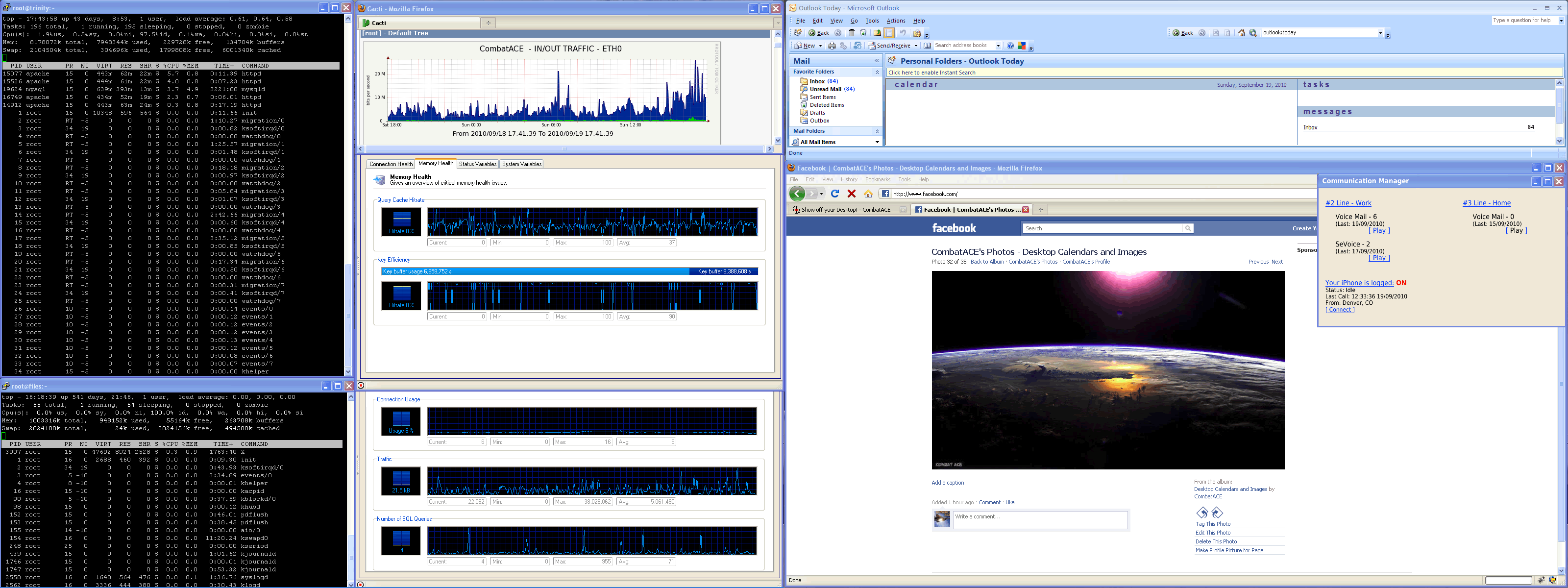
Messy? You're kidding right? When your desktop tool pops up, you know the one that usually says, "you have unused icons on your desktop," your's just says "ah screw it he knows." You need a desktop for your desktop. God help you! E
-
I found your problem and circled it in red. Seriously though, I think it's because the image is linked to site we don't have whitelisted. I'll check those settings in a bit.

-
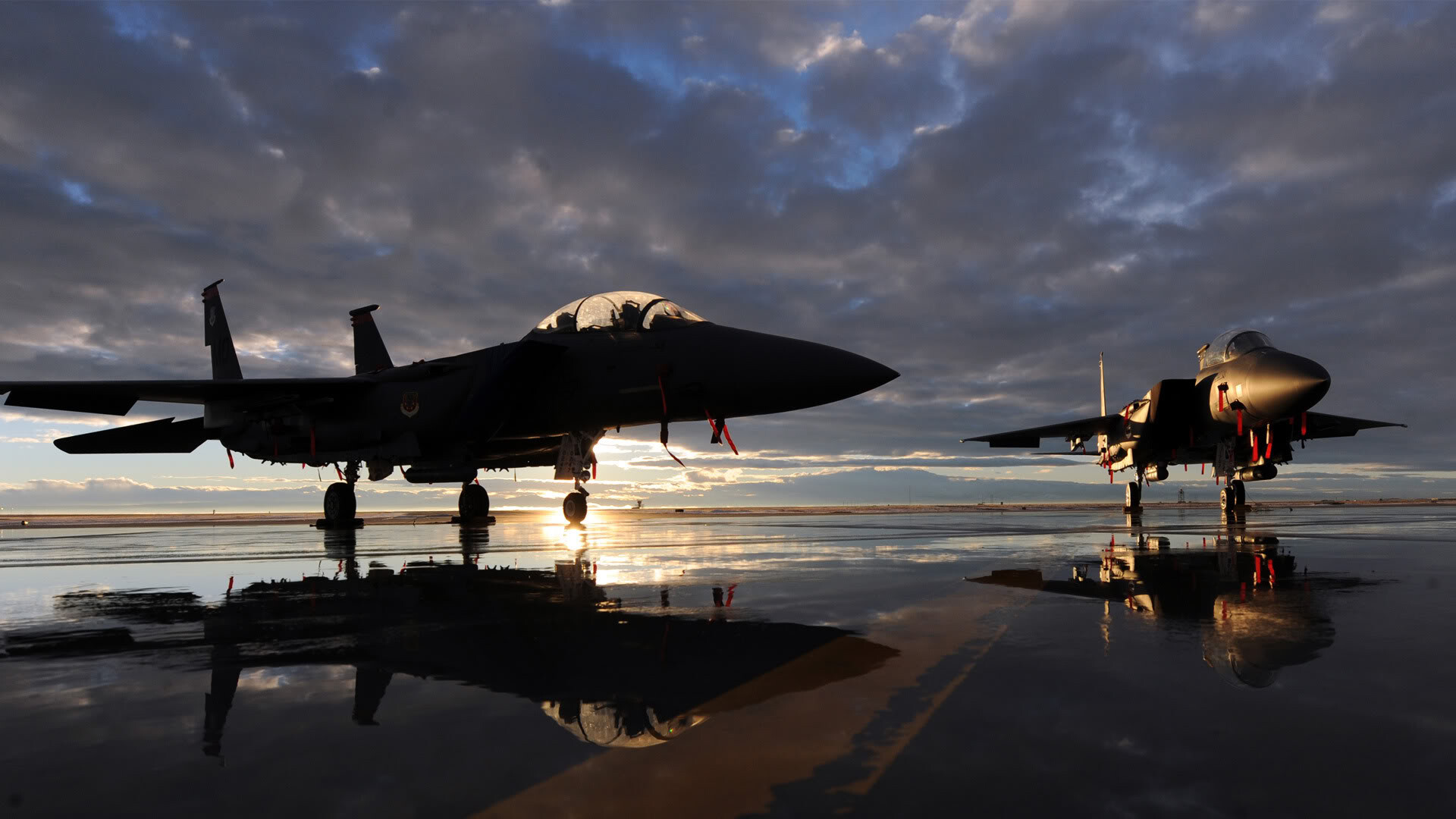
I haven't seen my desktop in so long that I forgot how to get to it. It's nice to see all your great screens! Hope you enjoy a view from my side.
-
From the album: Images
-

From the album: Images
-
From the album: Images
-
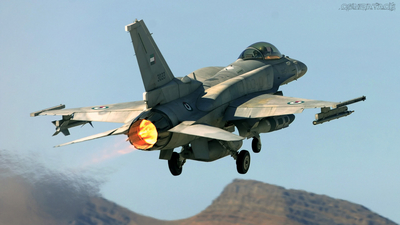
From the album: Images
-
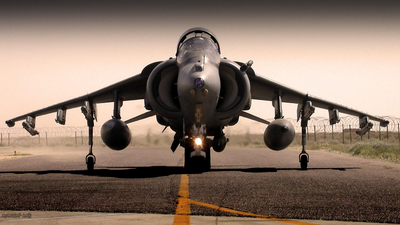
From the album: Images
-
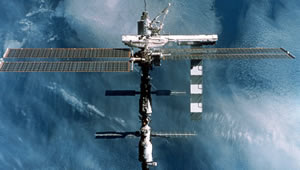
Russia's Mission Control set to readjust ISS orbit The thrusters will be turned on for 526 seconds and move the ISS to a new orbit at a distance of 356 km (221 miles) from Earth. RIA Novosti The orbit of the International Space Station (ISS) will be raised on Wednesday by about 2 kilometers (1.2 miles), Russia's Mission Control official said. "The aim of this operation is to ensure optimal conditions for the return of [three] astronauts [to Earth] on board the Soyuz TMA-18 spacecraft on September 24, and for the docking with a new manned Soyuz TMA-01M spacecraft, which is scheduled for launch on October 8," the official said. The readjustment will be carried out with the help of eight thrusters of the Progress M-07M space freighter, which is currently docked with the station's Zvezda module. The thrusters will be turned on for 526 seconds and move the ISS to a new orbit at a distance of 356 km (221 miles) from Earth, the source said. Corrections to the space station's orbit are conducted periodically before launches of Russian spacecraft and U.S. shuttles to compensate for Earth's gravity and to safeguard successful dockings. MOSCOW, September 15 RIA Novosti
-
 Indonesia confirms plans to buy six more Su fighters from Russia RIA Novosti -- by Maya Mashatina -- 07:57 17/09/2010 Indonesia's Air Force chief of staff Marshal Imam Sufaat said on Friday his country planned to buy six more Sukhoi fighter jets from Russia, the Jakarta Post reported. He said the purchase would be on the Defense Ministry's long-term agenda, but was not sure when the plan would be implemented. "The existing squadron of Sukhois remains insufficient to give a deterrent effect given our vast territory," Imam told the Antara news agency. He said the proposal was already approved by the country's president, President Susilo Bambang Yudhoyono. Indonesia bought three Russian fighter jets in 2003. The $300 million contract signed in August 2007 stipulated the delivery of six Su-30MK fighter planes. Three aircraft were delivered in February 2009, another two were handed over to Indonesia on September 10, and one was taken to Indonesia on Thursday. JAKARTA, September 17 Image: The $300 million contract signed in August 2007 stipulated the delivery of six Su-30MK fighter planes. Ria Novosti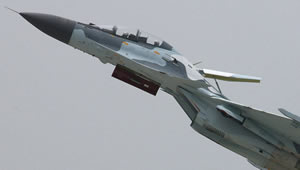
-
Fruit picker jailed for shining laser pen into RAF fighter pilot's eyes RAF Leuchars Tornado jet was flying over Fife when the migrant worker directed the laser at the cockpit. STV - 16 September 2010 12:52 GMT A Romanian fruit picker who admitted endangering an RAF fighter jet by shining a laser into the pilot's eyes was jailed for four months. The RAF Leuchars Tornado jet was flying low over Fife when the migrant worker shined a green laser beam into the cockpit. On one occasion, when the cockpit had a green glow inside, the pilot was almost at stall speed and required high concentration for his task. Romanian Radu Moldovan, 28,was jailed for four months at Cupar sheriff court. Moldovan, a works supervisor at Cairnie Fruit Farm, near Cupar, Fife, had admitted that he culpably and recklessly endangered the safety of an aircraft by directing a laser device into the cockpit of a military aircraft. In sentencing the migrant worker, Sheriff Charles Macnair told him that the UK courts "cannot tolerate such abuses". The sheriff said: "The use of laser pens is soaring. Happily, to date, there has never been a crash caused by a laser pen but that seems to be as a result of luck rather than anything else. "Distracting the attention of any pilot, in particular a pilot flying a fast jet, is an accident waiting to happen. "The consequences of a Tornado crashing at or near Leuchars air base raises the most horrific prospect of death and injury to the pilot, the navigator, and anyone else who happens to be under the aircraft when it comes down. "In my view, it must be made abundantly clear to anyone who uses or is tempted to use or misuse a laser pen of this sort, the courts of the United Kingdom will not tolerate such abuses." He added: "I take into account your personal circumstances and that you have been of good behaviour and that you are generally living a useful life. "But in your case I consider that there is no alternative to a custodial sentence." Depute fiscal Laura Wright earlier told the court the Tornado had been heading towards Leuchars at around 9.40pm on Monday, August 16. The pilot and navigator had been directed to a precision radar approach with the intention of overshooting the runway. But as they prepared for the action, the pilot told his navigator that a laser light had been shone at the jet, and the light had penetrated the canopy. It appeared the light had originated from the ground, and the crew contacted air traffic control to alert them to the situation. At that point, the depute fiscal said, the plane had been five miles from the runway at a height of 1,200-feet and had overshot as planned. The pilot had then been directed to conduct another approach and as he flew towards Cupar, he was again distracted by the laser beam entering his field of vision. On this occasion, there was a flickering effect as though an attempt was being made to adjust the laser towards the Tornado. The navigator had on this occasion been able to identify the source, and had marked its coordinates using the Tornado's on-board navigation system. As the plane was positioning, it was again hit by the green beam of light but the pilot continued and landed the aircraft successfully. The depute fiscal said that the coordinates had been passed to Fife Constabulary to investigate. Officers visited Cairnie Fruit Farm and Moldovan admitted that he had tried to hit the underside of the plane when it passed. His solicitor Hilary Eldridge said that her client had bought the laser on eBay for £4 and had not intended to cause any danger. She said: "Mr Moldovan is a law-abiding, hardworking citizen with no previous convictions who came to this country to better and improve the life of himself and his family. "He had been attending a BBQ at the fields outside and he tried to see whether the pen was powerful enough to reach the plane. He did this on two occasions, with no comprehension of the potential dangers it posed to the crew on board." Image Credit: Jail term: Radu Moldovan sentenced for laser pen crime Pic: © Alan Richardson STV

-
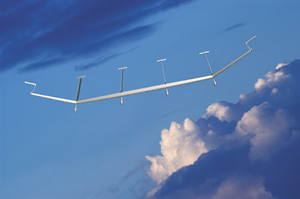
Boeing Wins DARPA Vulture II Program Boeing - by Chris Haddox Boeing Phantom Works ST. LOUIS, Sept. 16, 2010 -- The Boeing Company [NYSE: BA] on Sept. 14 signed an agreement with the U.S. Defense Advanced Research Projects Agency (DARPA) to develop and fly the SolarEagle unmanned aircraft for the Vulture II demonstration program. Under the terms of the $89 million contract, SolarEagle will make its first demonstration flight in 2014. "SolarEagle is a uniquely configured, large unmanned aircraft designed to eventually remain on station at stratospheric altitudes for at least five years," said Pat O'Neil, Boeing Phantom Works program manager for Vulture II. "That's a daunting task, but Boeing has a highly reliable solar-electric design that will meet the challenge in order to perform persistent communications, intelligence, surveillance and reconnaissance missions from altitudes above 60,000 feet." Under the Vulture II agreement, Boeing will develop a full-scale flight demonstrator, including maturation of the critical power system and structures technologies. Key suppliers for the program include Versa Power Systems and QinetiQ. During testing, the SolarEagle demonstrator will remain in the upper atmosphere for 30 days, harvesting solar energy during the day that will be stored in fuel cells and used to provide power through the night. The aircraft will have highly efficient electric motors and propellers and a high-aspect-ratio, 400-foot wing for increased solar power and aerodynamic performance. SolarEagle is one of Phantom Works' rapid prototyping efforts, which also include Phantom Ray, a fighter-sized, unmanned, advanced technology demonstrator scheduled to make its first flight in early 2011, and the hydrogen-powered Phantom Eye demonstrator, a High Altitude Long Endurance aircraft designed to stay aloft for up to four days, also scheduled to make its first flight in 2011. A unit of The Boeing Company, Boeing Defense, Space & Security is one of the world's largest defense, space and security businesses specializing in innovative and capabilities-driven customer solutions, and the world’s largest and most versatile manufacturer of military aircraft. Headquartered in St. Louis, Boeing Defense, Space & Security is a $34 billion business with 68,000 employees worldwide. Boeing
-
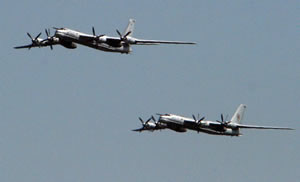
Four Russian strategic bombers complete patrol in Far East RIA Novosti - by Ivan Rudnev -- 18:23 16/09/2010 Four Russian Tu-95MS Bear H strategic bombers have successfully completed an air-patrol mission in Russia's Far East, a Defense Ministry spokesman said on Thursday. The mission, spanning neutral water areas in the Sea of Japan, the Pacific and the Arctic Ocean, lasted around 14 hours, Vladimir Drik said. He did not specify whether the planes flew in formation or separately. The mission included midair refueling and flying over featureless terrain where the pilots were completely reliant on the planes' instruments. MOSCOW, September 16 RIA Novosti
-
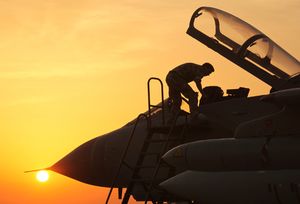
RAF under fire as battle for shrinking defence budget turns vicious The Independent -- by Kim Sengupta, Defence Editor -- Tuesday, 14 September 2010 The official start of commemorations of the 70th anniversary of the Battle of Britain yesterday was an occasion of poignancy and pride with the Prime Minister meeting the pilots who saved Britain in her darkest hour. But even as the celebrations got under way the RAF faces a struggle for survival in the face of savage military cuts. As the Strategic Defence and Security Review plans to implement massive economies demanded by the Government, and the fierce competition for dwindling resources heats up, there are calls for the RAF to be disbanded and its role subsumed by the Army and the Navy. The Defence Secretary, Liam Fox, has said that the RAF will continue as a service and defence analysts point out that Air Force personnel and warplanes are playing a key role in the Afghan conflict. But there is also a feeling in defence circles that the service should be in the front line when the axe starts to fall, as savings of 20 per cent are demanded from the MoD's £38bn budget over the next four years. The Army and the Navy, while also fighting each other for resources, both say that the UK does not need so many highly expensive fast jets now that Soviet and Warsaw Pact air power is no longer a threat. Some within the Army and Navy claim that the RAF has been living on past glories for too long. "They have been dining out on the Battle of Britain for 70 years now and it's time to move on," said one officer. The Army also claims that the counter-insurgency mission being undertaken in Afghanistan, with soldiers fighting lightly armed enemies, represents the shape of wars to come, and that there is no need to spend millions of pounds on state-of-the-art warplanes. The RAF has already endured the biggest staffing cuts of the three services in recent times, with its forces now standing at 40,000 – less than half the strength at the end of the Cold War. The numbers of its warplanes have also fallen drastically, as its role has changed. (It is, for example, no longer needed to deliver nuclear bombs or expected to take part in air-to-air combat.) At the same time, the RAF also has new commitments, including the air defence of the UK since the terrorist attacks of 9/11 and continuous deployments in Afghanistan and Iraq and before that the Balkans. But former senior officers from rival services are now insisting that the role the RAF used to play in the past no longer exists, and that there is thus no need to have a separate Air Force. Major General Julian Thompson, who used to lead the Royal Marines, maintained: "There is no reason why the RAF cannot merge with the other two services, with the [Navy's] Fleet Air Arm taking over maritime duties and the Army Air Corps providing other operational roles. The fact is that the only enemy aircraft shot down since the end of the Second World War has been by the Fleet Arm and not the RAF. There will be huge savings in headquarters and you can have three services for the price of two. "We are not advocating that all RAF personnel should be sacked. There is no reason for example why a senior RAF officer should not one day run the Army or the Navy." Commodore Steven Jermy, of the Fleet Air Arm, who had also served with the RAF, said: "I would certainly like to see the maritime role being done by the Navy. We know how to fly out of aircraft carriers; the RAF do not. I do not think what is being provided on aircraft carriers now is satisfactory. We must also recognise that the RAF does not deploy abroad on its own unlike the Navy and the Army, so in that sense it is not an independent force." Other senior defence figures disagreed. General Sir Mike Jackson, the former head of the Army, said: "There are some roles which only the RAF can undertake and the three services operate in very different environments. I have given it some thought and I don't think the case for a merger is made. "On the other hand, far too much had been spent on fast jets when with the end of the Cold War the focus should have been on things like air surveillance, intelligence and airlift including rotary wings [helicopters]. These things need to be looked at." Supporters of the RAF say that critics ignore what aircraft can provide by their very presence. According to estimates provided by the US military, the current Nato troop strength in Afghanistan of around 100,000 – of which the UK provides 10,000 – would have had to be raised to 400,000 to attempt to carry out operations without air power. Air Chief Marshal Sir Stephen Dalton, the chief of the RAF, has already indicated that he is prepared to reduce to just two types of fast jets coming on stream, the Eurofighter Typhoon and the US F-35 Joint Strike Fighter. According to defence sources the Tornado GR4 may be withdrawn from service by 2020, five years earlier than envisaged and the Harrier GR9 also withdrawn earlier than the planned date of 2018. Air Chief Marshal Dalton said in a recent speech: "We need to continue to challenge the perception that air power is expensive. In fact it's highly cost effective in relation to some other levers of power... In some circumstances it offers the option to influence behaviours and events without the commitment to major land forces." Air Marshal Sir John Walker, the former head of Defence Intelligence, said: "The reason the RAF became a separate entity in the first place was because it was found to be strategically necessary to have a separate service. Talk of merger is just an attempt to turn the clock back and it is something which will not work. "The Canadians tried at one stage to have just one service and then you had situations like an Air Force man who was put on charge of the Atlantic fleet who suffered from chronic sea-sickness. It was an experiment which did not work, and it is a lesson we need to heed. The SDSR should be looking at defence procurement, which is a mess, rather than start experimenting with the RAF." Remembering 'the few' Tomorrow, over 1,000 veterans, senior military figures and dignitaries will gather in London to pay tribute to the sacrifice made by RAF pilots defending the skies against a Nazi onslaught during the Battle of Britain. To mark the 70th anniversary of the turning-point in one of the Second World War's decisive battles, a statue will be unveiled in Waterloo Place of Air Chief Marshal Sir Keith Park, who is widely credited with masterminding the victory, in which 510 RAF pilots died. The UK's armed forces Royal Navy Personnel: 34,230 Reservists: 420 Equipment: 12 Submarines; 2 Aircraft carriers; 6 Destroyers; 17 Frigates; 7 Main amphibious; 23 Patrol; 18 Auxiliary; 13 Sea Harrier and 119 Helicopters Army Personnel: 100,290 Reservists: 37,260 Equipment: 386 Main battle tanks; 3,768 Other armoured vehicles; 877 Artillery and 299 Helicopters Royal Air Force Personnel: 39,750 Reservists: 140 Equipment: 287 Combat capable aircraft (137 Tornado, 58 Eurofighter, 34 Reconnaissance aircraft); 131 Helicopters (40 Chinooks, 28 Merlin and 34 Puma) Image Credit: Getty - An engineer looks in the cockpit of a Royal Air Force Tornado GR4 fighter bomber The Independent
-
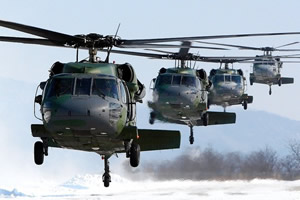
Saudi Arms Deal Advances White House to Notify Congress Soon of $60 Billion Package, Largest Ever for U.S. Source: The Wall Street Journal -- By ADAM ENTOUS The Obama administration is set to notify Congress of plans to offer advanced aircraft to Saudi Arabia worth up to $60 billion, the largest U.S. arms deal ever, and is in talks with the kingdom about potential naval and missile-defense upgrades that could be worth tens of billions of dollars more. The administration plans to tout the $60 billion package as a major job creator—supporting at least 75,000 jobs, according to company estimates—and sees the sale of advanced fighter jets and military helicopters to key Middle Eastern ally Riyadh as part of a broader policy aimed at shoring up Arab allies against Iran. The talks between the U.S. and Saudi Arabia have been widely known for months, but many new details are only now coming into focus. These include the number and type of aircraft involved, how much the Saudis intend to spend in an initial installment, and the ongoing negotiations to also upgrade the kingdom's navy and missile defenses.The $60 billion in fighter jets and helicopters is the top-line amount requested by the Saudis, even though the kingdom is likely to commit initially to buying only about half that amount. In a notification to Congress, expected to be submitted this week or next, the administration will authorize the Saudis to buy as many as 84 new F-15 fighters, upgrade 70 more, and purchase three types of helicopters—70 Apaches, 72 Black Hawks and 36 Little Birds, officials said. The notification triggers a congressional review. Lawmakers could push for changes or seek to impose conditions, and potentially block the deal, though that is not expected. On top of the $60 billion package of fighter jets and helicopters, U.S. officials are discussing a potential $30 billion package to upgrade Saudi Arabia's naval forces. An official described these as "discreet, bilateral conversations" in which no agreement has yet been reached. That deal could include littoral combat ships, surface vessels intended for operations close to shore, the official said. Talks are also underway to expand Saudi Arabia's ballistic-missile defenses. The U.S. is encouraging the Saudis to buy systems known as THAAD—Terminal High Altitude Defense—and to upgrade its Patriot missiles to reduce the threat from Iranian rockets. U.S. officials said it was unclear how much this package would be worth. The U.S. has sought to build up missile defense across the region, and the Saudi package could be similar to one in the United Arab Emirates, officials said. THAAD is built by Lockheed Martin Corp. and Raytheon Co. supplies the system's radar. THAAD is the first system designed to defend against short- and intermediate-range ballistic missiles both inside and outside the Earth's atmosphere. It complements the lower-aimed Patriot missile defense system, providing a layered defense. Lockheed officials have stated that they see serious export potential for the system in the Middle East, where a major concern exists about Iran's ballistic missile development. The prospect for job growth could help build support in Congress for the $60 billion package, officials said. "It's a big economic sale for the U.S. and the argument is that it is better to create jobs here than in Europe," said one person close to the talks. Boeing Co., which makes the F-15s, the Apaches and the Little Birds, believes the Saudi package would directly or indirectly support 77,000 jobs across 44 states. It is unclear how many jobs, if any, would be supported by the Saudi purchase of Black Hawks, made by Sikorsky. Production levels are already high at Sikorsky, which is owned by United Technologies Co. The Saudis in recent years have broadened their acquisitions to include more European- and Russian-made weaponry. That thinking was partially behind Riyadh's 2007 deal to purchase dozens of Eurofighter fighter planes from BAE Systems PLC, Saudi officials said. Pro-Israel lawmakers have voiced concerns in the past about arms sales to Saudi Arabia that they say may undercut Israel's military edge and provide support to a government with a poor human rights record. U.S. officials say the Israelis are increasingly comfortable with the Saudi sale because the planes won't have certain long-range weapons systems. Also, the Israelis are in line to buy a more advanced fighter, the F-35, and should begin to receive them around the same time the Saudis are expected to start getting the F-15s. "We appreciate the administration's efforts to maintain Israel's qualitative military edge, and we expect to continue to discuss our concerns with the administration about the issues," said Michael Oren, the Israeli ambassador to the U.S. The senior U.S. defense official said it was unclear what pieces of equipment in the $60 billion package the Saudis may decide not to purchase, but he described the F-15s as a priority item. "It's conceivable that the Saudis could come back for the whole $60 billion," the official said, but added, "They're balancing their own defense priorities." The $60 billion deal will be stretched out over five to 10 years, depending on production schedules, training, and infrastructure improvements, officials said. Anthony Cordesman, a scholar at the Center for Strategic and International Studies, said the deal is so large and so complex, that changes are inevitable. "The actual contract often is renegotiated because the Saudis are always going to push, we're always going to push, the Congress is going to push, the manufacturer is going to push. This is not the kind of negotiation where you've really agreed on the final details until you actually have put the final contract out," he said. —Nathan Hodge contributed to this article. Source: The Wall Street Journal Image: Associated Press -- Blackhawk UH-60 helicopters, such as these flown in South Korean military exercises last winter, are part of a proposed arms sale to Saudi Arabia.
-
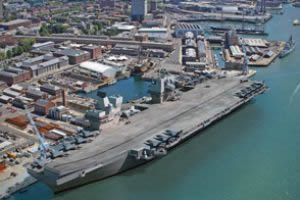
UK May Borrow F-18s For Carriers; F-35Bs May Be Scrapped DOD Buzz --By Colin Clark Tuesday, August 31st, 2010 10:22 am Britain’s Conservative government, faced with enormous deficits, may launch its Queen Elizabeth class carriers without airplanes to put on them as it considers early retirement for its Harrier jump jets. The two 65,000 ton carriers are built into the UK’s defense budget, but new airplanes are not. Scrapping the Harriers early, combined with delays to the Joint Strike Fighter short takeoff version, could leave the UK temporarily dependent on the U.S. for F/A-18s and V-22s. That raises the prospect of one country deploying carriers and then relying on another country to supply the airplanes to fly from them. Although the U.S. and some NATO allies have engaged in exercises flying each others planes from each others carriers such heavy reliance on another country raised eyebrows among analysts the idea was reported in British newspapers. “My first thought after reading the article was that [british Defense Minister Liam] Fox was floating a trail balloon, perhaps hoping the British public might object to the British Empire losing its independent ability to project power on its own. I recognize the UK will seldom deploy without others, including the US. However, it did just that during the Falkland campaign and likely does so periodically to show the UK flag globally. In either case a brand new carrier will lose much of its shine if deployed without a complement of capable combat aircraft,” Frank Cevasco, one of Washington’s top international defense consultants and a former senior Pentagon official responsible for international weapons cooperation, said in an email. “Desperate times require desperate measures,” Cevasco wrote, noting that “only the UK voters and their leaders can decide where the red line is.” The London Daily Mail quoted a senior military source saying that the “U.S. Marines have the aircraft. Their aircraft would fly from the British carriers. Or we could borrow some from them.” To show just how sharp the debate must be within the British government and its Ministry of Defense, the Daily Telegraph has reported that Britain will scrap the F-35B and go with the JSF carrier version, known as the F-35C The Queen Elizabeth carriers, the biggest warships ever built by the U.K., are designed to handle traditional carrier aircraft such as Super Hornets and the carrier version of the Joint Strike Fighter (JSF) or STOVL aircraft such as the Harrier and JSF. While the primary design stresses STOVL, the carriers are designed to be retrofitted with arresting cables, according to U.S. defense industry sources. That would enable the F/A-18 E/Fs and their predecessors to take off and land on the British ships. Also, the ships are designed to be fitted with steam catapults and the UK has also continued work on electro-magnetic catapults. An industry source said Super Hornet and their predecessor models should have no trouble taking off from the British ships as the ships are “extremely capable and are extremely big.” A Super Hornet should be able to “take off with a very significant combat load over deck with a zero wind load,” the source said. And the F/A/-18’s high energy nose gear mean it “is also ideally suited for ramp launches because they can absorb” the enormous energy required for a ramp launch. The British plan to use the STOVL F-35 as the main weapon on the carriers so it would seem reasonable to conclude that any plans to use F-/A-18s instead of the F-35s would pose a threat to Lockheed Martin’s long-planned sale of 138 F-35Bs. However, the industry source dismissed the threat to the F-35Bs, saying that any sharing of Super Hornets with the U.K. would be strictly a “capability gap-filler,” and not a replacement for the more advanced, fifth generation fighter. If Britain hopes to supplement the Super Hornets with MV-22 Ospreys, that would be much more difficult, the industry source said. The Marines are relying on MV-22s in Afghanistan and as key aircraft for their Marine Expeditionary Units. The U.S. would be “hard-pressed” to lend some of those planes, according to the source. Arms export restrictions should not be a problem for sharing any of the aircraft, the industry source said, especially for what he described as perhaps America’s staunchest ally. DOD Buzz
-
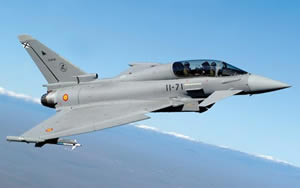
Eurofighter offers Typhoon for Polish air force Flight Global -- By Bartosz Glowacki The Eurofighter consortium has made its debut appearance at Poland’s International Defence Industry Exhibition (MSPO) in Kielce, with the Typhoon being promoted as a potential replacement for the nation’s RSK MiG-29 and Sukhoi Su-22M4 strike aircraft. With sources suggesting that Poland’s defence ministry plans to upgrade some of its current assets, Eurofighter representatives say: “The price of the [Typhoon] aircraft, its servicing and maintenance costs during the next 30-40 years would be not higher than extending the life of ex-Soviet aircraft until 2028.” A campaign to sell the Typhoon to Warsaw would be supported by EADS and Finmeccanica, which would each offer industrial partnerships and technology transfer. Poland could also access the training and logistics lessons learned by Germany, Italy, Spain and the UK, plus export user Austria, sources say. The Polish air force should retire the last of its remaining 48 Su-22s in 2011-12, but there have been suggestions that this could be extended until 2016. Their removal would leave a fighter gap between the service’s current 31 MiG-29s and 48 Lockheed Martin F-16C/Ds, as the defence ministry has outlined a need to retain a strength of eight frontline squadrons equipped with 120 modern combat aircraft. A planned acquisition of 16 advanced jet trainer/lead-in fighter trainers with some combat capabilities would only slightly narrow the capability gap. The Typhoon is also being offered to other central European countries, including the Czech Republic, Hungary and Slovakia. Flight Global
-
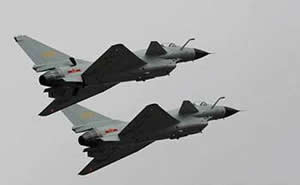
Australia, China inspect fighter jets The Sydney Morning Herald -- September 13, 2010 - 6:29PM Australia and China have played show-and-tell with their jet fighter aircraft ... in a gesture of transparency. Defence head Air Chief Marshal Angus Houston said it underlined the Australian Defence Force's good relationship with China's defence force, the People's Liberation Army (PLA) - one not shared by the Americans. He said it was a reciprocal arrangement. When PLA chief of the general staff General Chen Bingde visited Australia last year, he was allowed to inspect one of our jet aircraft. Just what type of aircraft wasn't specified. "When the chief of the air force went up to China, he was given what I would say reciprocal access to a fighter aircraft in the same way as we had provided access to that fighter aircraft for General Chen Bingde," Air Chief Marshal Houston told reporters on Monday. "We thought that was a very positive step and it's typical of the constructive approach we both share." General Chen was in Australia for the annual Australia-China strategic dialogue and another is to be held soon. Air Chief Marshal Houston said one topic of discussion last year was China's military buildup. "We seek to better understand the reason for that buildup and we impress on our Chinese friends the need to be transparent about their intent in terms of that buildup," he said. Air Chief Marshal Houston said engagement was absolutely the way to go and much of Australia's current prosperity stemmed from China's growth. "We would love to see our American friends who at the moment are having some difficulties with military to military relationship with China, re-establish those vital engagement links between the two militaries. That way the US and Chinese militaries could discuss and negotiate issues of common concern, he said. Air Chief Marshal Houston said it was really up to the US and Chinese militaries to get together and the signs at the moment were quite good. "If we can help with the re-establishment of links, fine," he said. The Sydney Morning Herald
-
In SimGolf you'd play as a course owner, developer, manager. In Greens Keeper you'd play as a more challenging role of support staff. It adds that extra edge needed to make it more alluring.
-
They all miss the boat when it comes to the ultimate simulation game. I thought of this brilliant idea a couple years ago. Greens Keeper - A golf course greens simulation. - Design your own golf course or play from a list of courses from around the world. - Build your skills and equipment inventory to oversee increasingly challenging courses. - Start with a push mower and with course profits purchase upgrades and new mowers. - Timely reseed courses to keep them green and adjust their water and nutrients. - Plants and shrubs mature, die, and need replanting. - Replace course divots, rake the sand traps, and trim the shrubs. - Build your empire and hire support staff to help you. - Course popularity is determined on the job you do and increases profits. - Deal with unruly golf pros, club house staff, and course managers. - Manage your assets to keep the course facilities and grounds clean. - Stock and manage the water hazards or put on SCUBA gear and dive for lost golf balls. - Manage threats from wildlife, patrons, and rodents destroying your course. - Natural disasters from hurricanes, tornadoes, hail, drought, flooding, and insects. - Drive the ball collector on the driving range or watch the golfers by driving the booze cart. - And much more. This documents my idea and creation and I reserve all intellectual and artists rights. I will accept offers to produce this heralding new simulaton. My rights can be licensed for a standard 10% of the net profit.
-
8.523
-
What? What? Thirty-five? Happy Birthday!
-
Hooah! Thank you for your commitment and service, we're all grateful and proud of you. Here's to the next 40 years of success.
-
Homes on fire after explosion reported in California SAN BRUNO, Calif. — A massive fire is roaring through a mostly residential neighborhood in the San Francisco suburb of San Bruno. Firefighters from San Bruno and surrounding cities are battling the blaze that started on a hillside and is now consuming homes in a residential neighborhood. Television live shots show at least a dozen homes destroyed, with flames reaching now as high as 50 to 60 feet into the air. A South San Francisco fire official confirmed earlier that firefighters were responding to a fire, but had no other details. Witnesses say a loud explosion was felt just before the flames erupted around 6 p.m. Thursday. The fire is burning in a mostly residential area a few miles from San Francisco International Air, but the Federal Aviation Administration and a spokesman for the airport say they have no record of a plane crash. THIS IS A BREAKING NEWS UPDATE. Check back soon for further information. AP's earlier story is below. SAN BRUNO, Calif. (AP) — Live television footage is showing flames shooting at least 20 feet high into the air and burning homes in a San Francisco suburb. A South San Francisco fire official confirmed Thursday evening that firefighters were responding to a blaze in San Bruno, but had no other details. Witnesses say a loud explosion was felt just before the flames erupted around 6 p.m. Thursday. The area where the fire is burning is in a mostly residential neighborhood. Chron
-
Eliminate co-pilots to save cash, says Ryanair CEO
Erik replied to Dave's topic in Military and General Aviation
Publicity stunt. Next he'll eliminate all non-essential hardware aka the plane. Tickets will now include a one way sling-shot ride to your destination. The upsides include: No worry, no hassle, anytime use bathrooms. ZIP UR-IN. Guaranteed no extra baggage fees. If the ride doesn't kill you that 200 pound suitcase you are carrying will. No long waits at security check points and scanning. Go ahead bring some C4. Got matches? Oh look fireworks! No charge aerobic workout program included. Want more hang-time, flap harder. RyanAir we spare no expense at finding expenses to spare.