

Erik
-
Posts
7,244 -
Joined
-
Days Won
42
Content Type
Profiles
Forums
Gallery
Downloads
Store
Everything posted by Erik
-
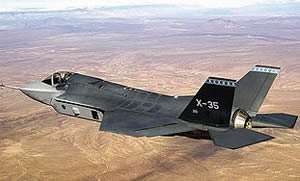
F-35 Lightning II Electro-optical Targeting System (EOTS) Lockheed Martin Conducts First Flight of F-35 Electro-Optical Targeting System on Cooperative Avionics Test Bed ORLANDO, FL, August 16th, 2010 -- Lockheed Martin [NYSE: LMT] has successfully conducted the first flight of the F-35 Electro-Optical Targeting System (EOTS) on the Cooperative Avionics Test Bed (CATBird) platform. EOTS maturation on the CATBird is the final step prior to integration on the BF-4, the first mission systems-equipped F-35 test aircraft. “The CATBird’s dynamic flight environment provides the first opportunity to test and evaluate how EOTS integrates into the F-35’s fused sensor architecture,” said Rich Hinkle, program director of F-35 EOTS at Lockheed Martin Missiles and Fire Control. “After three years of rigorous testing on the Sabreliner aircraft, EOTS is more than ready for CATBird integration and we’re excited to reach this important milestone.” F-35 Lightning II EOTS High-Resolution Imagery The CATBird, a modified 737 aircraft, contains an actual F-35 cockpit and test stations to perform real-time analysis as mission systems are evaluated. The CATBird also provides the capability to fuse sensor information, which mimics how the F-35’s fused sensor architecture will offer pilots higher quality, shared sensor information compared with legacy platforms’ federated sensor architectures. During the current Block 1.0 software system test, EOTS operated in an integrated mode and collected aircraft navigation data for sensor alignment. The low drag, stealthy F-35 EOTS builds upon the success of Lockheed Martin’s Sniper® Advanced Targeting Pod to provide high-resolution imagery, automatic target tracking, infrared-search-and-track, laser designation and range finding, as well as laser spot tracking – all at greatly increased standoff ranges. Modular components allow the F-35 EOTS to be maintained on the flight line for true two-level maintenance. Lockheed Martin


- 1 reply
-
- 2
-

-
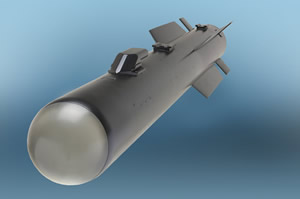
Lockheed Martin Team Completes Major Component Design Reviews on Joint Air-To-Ground Missile Program ORLANDO, FL, August 16th, 2010 -- Lockheed Martin [LMT: NYSE] and teammates Marvin Engineering and Aerojet have completed successful component and system Preliminary Design Reviews (PDRs) on the Joint Air-to-Ground Missile (JAGM) Technology Development (TD) program, further demonstrating the missile’s technological maturity level. The Lockheed Martin-led JAGM team has completed PDRs on the JAGM rocket motor, with test data supporting the single-motor solution, and on the U.S. Navy’s rotary- and fixed-wing launchers, with data supporting successful AH-1Z Viper (Cobra), MH-60R Seahawk and F/A-18E/F Super Hornet platform integration efforts. “These successful PDRs are major milestones in the development of the JAGM missile and provide a high degree of confidence that JAGM will provide greater capabilities than existing weapons and will do so more affordably,” said Frank St. John, director of Close Combat Systems for Tactical Missiles/Combat Maneuver Systems at Lockheed Martin Missiles and Fire Control. “The PDRs confirmed the benefits of rigorous testing and the successful development path the team is taking to deliver this much needed precision, adverse weather, low-collateral-damage weapon.” JAGM Rocket Motor PDR Aerojet, a GenCorp [NYSE: GY] company, and Lockheed Martin have reported major strides in achieving the single-motor solution for JAGM through numerous tests and demonstrations. “The Aerojet propulsion team has confirmed our JAGM single-motor solution,” said Aerojet’s vice president for Tactical Programs, John Myers. “Key to the outstanding propulsion characteristics of our design is Roxel UK’s minimum-smoke propellant grain technology solution, already well proven with other missiles in service.” In addition to the successful PDR completion, two pre-flight readiness tests verified that the JAGM motor is certified for missile flight testing. The team continues to increase the severity of environmental testing to gain valuable reliability data for the current design in preparation for engineering manufacturing development. JAGM Platform Integration PDR Marvin Engineering and Lockheed Martin confirmed the successful development of prototype launcher hardware that meets Super Hornet, Viper and Seahawk platform integration requirements. The quad-rail Navy rotary-wing launcher will carry JAGM on the Viper and the Seahawk, and the triple-rail Navy fixed-wing launcher will carry JAGM on the Super Hornet. “We are very pleased with the results of the PDR on the JAGM launchers,” said Jerry Friedman, CEO at Marvin Engineering. “We have extensive experience in the aircraft interface of launchers like those we are building for Lockheed Martin’s JAGM. This includes U.S. Army, Navy and Marine Corps aircraft, as well as the aircraft of many international customers. We have worked with and understand all the platforms that will be carrying JAGM.” Threshold aviation platforms for JAGM include the U.S. Army’s AH-64D Apache attack helicopter and Extended Range Multi-Purpose Sky Warrior unmanned aerial system, the U.S. Marine Corps’ AH-1Z Cobra attack helicopter, and the U.S. Navy’s MH-60R Seahawk armed reconnaissance helicopter and F/A-18E/F Super Hornet jet fighter. “During the JAGM TD program, we have enjoyed the opportunity to work cooperatively with NAVAIR and Boeing in the wind tunnel test program, integrating JAGM on the Super Hornet,” St. John added. “The same holds true for our longstanding working relationship with Boeing on the Apache and in our proven teamwork with Bell on the Kiowa and Viper, and with Sikorsky on the Seahawk. We are confident in our ability to integrate JAGM on all required platforms.” Lockheed Martin
-
Gulf weapons sales reach $60b. By YAAKOV KATZ The United States has approved a long list of arms sales to friendly Arab countries in the Persian Gulf aimed at countering Iran’s growing influence in the region. The unprecedented sales could reach over $60 billion in pending deals with Saudi Arabia, Kuwait, Oman, the United Arab Emirates and Qatar. The largest deal is the possible sale of 82 F-15 fighter jets to Saudi Arabia for $30 billion. The deal has caused some concern within Israel which is reportedly in a dialogue with the Obama administration regarding its commitment to retain the IDF’s qualitative military edge in the region. For another $30 billion, the Saudis are also interested in purchasing as many as 60 Apache attack helicopters. Another deal, announced over the past week, is the possible sale of the latest Patriot missile defense system to Kuwait for $900 million. The proposed deal would include the sale of 209 missiles. Kuwait is interested in the Patriot system in face of Iran’s growing influence in the region. In its statement to Congress regarding the deal, the Pentagon said: “Kuwait needs these missiles to meet current and future threats of enemy air-to-ground weapons. Kuwait will use the increased capability as a deterrent to regional threats and to strengthen its homeland defense.” Israel is also looking to upgrade its Patriot systems and has held talks with the US about the possible sale of the latest version called the PAC-3. The PAC-3 is believed to be capable of intercepting most of Syria’s missiles. It is an improved version of the PAC- 2 in terms of coverage and lethality. The PAC-3 has an interceptor missile that uses a hit-to-kill system rather than an exploding warhead used by the PAC-2. The PAC-3 missile is also smaller and its launchers can fire 16 instead of just four missiles like the PAC-2. The Pentagon also notified Congress earlier this month about the possible sale of 18 F- 16 fighter jets to Oman for an estimated $3.5 billion. Oman is one of the few countries in the Gulf which maintains strong ties with both Iran and the US. The Pentagon’s approval of the deal is seen as an effort to bolster American influence in the country. Kuwait is also looking to improve its air force and has reportedly expressed interest in purchasing Boeing’s new stealthy F-15 Silent Eagle version. At the same time, Kuwait is also augmenting its mid-air refueling capability and is seeking around 10 new tanker aircraft from the US. In his recent visit to Washington DC, Defense Minister Ehud Barak discussed the pending sale of the F-35 Joint Strike Fighter (JSF) to Israel as the first foreign customer. Under the pending deal, which has yet to be finalized, Israel will receive approximately 20 of the stealth fighter jets starting in 2015 as a first batch based on the American configuration of the aircraft. Later sales will already include the integration of Israeli indigenous systems. The Jerusalem Post
-
The 179th Airlift Wing in Mansfield, Ohio, an Ohio National Guard unit, will be the first unit to convert to C-27J Spartan operations. Image: United States AirForce Ohio Guard unit is first to switch to C-27J By Bruce Rolfsen - Staff writer The Air Force’s adoption of the C-27J Spartan cargo plane reaches a milestone Saturday when the 179th Airlift Wing in Mansfield, Ohio, becomes the first unit to convert to C-27J operations. The 179th, part of the Ohio National Guard, had flown the C-130H Hercules. In anticipation of the switch, crews traveled to the C-27J school house at Robins Air Force Base, Ga., for qualification training. The Air Force is buying 37 C-27Js whose crews will focus on flying airlift missions for Army units and state Guard units. Air Force Times

-
Most of this is all water under the bridge at this point. I'll take responsibility for this as it ultimately was a basic difference of opinion coupled with an inability to fit this into my schedule. While I probably won't win any popularity contests around here I'm responsible for and handle more than most care to even imagine. A full time day job, family, social life, managing upwards of 60 emails a day (just for this site), managing multiple sites affiliated with CombatACE, millions of lines of code base, and a network of equipment that keeps us humming along leaves me little time to deal with long drawn out issues. Coupled with my desire to want to please the masses sans the razor edge dictatorial absolutes I opened Pandora's Box with some decisions about acceptability and posting standards. All in all it culminated in a divide where the decision was binary but not permanent. Whether Al decides to post here again is up to him. Throughout all of this Al's ability was never severed and he's been free to resume posting for some time now. I do with all good faith, and the hopeful support of the community, pray there's some kind of understanding that I'm just human like the rest of you. My sincerest apologies where due. Erik
-

French warships for Russia to be armed with Ka-52 helicopters
Erik replied to Erik's topic in CombatACE News
Our relationship with Russia is strong and getting stronger by the day. I wouldn't read anything into this news that has anything to do with USA and Russia. Respect is mutual here. This is and always will be a touchy situation and it's nothing more than France protecting her interests globally, very wise. Think of it this way. You and your wife have a wonderful marriage. You don't like one of your wife's friends at work and he has crabs. When you come down with crabs the marriage is over. It's always about the third party party favors. :wink2: -
French warships for Russia to be armed with Ka-52 helicopters
Erik replied to Erik's topic in CombatACE News
Nuclear weapons don't have a need to be pointed anywhere. That position is sorta like Swiss Cheese, it has a lot of holes in it. :wink2: When you're talking about an entire platform like an aircraft carrier there's a lot of arms agreements that go into consideration. Most of the times it's not as simply as A sells technology or products to B. More likely it's A sells technology to B who sells it to C who then sells it to D where A and C have no agreements it's impossible to prevent the sale to D if A opposes it. More to the point if B sells something that A doesn't want sold to D by selling it to C then B gets. -
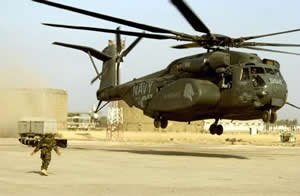
More U.S. Helicopters Arrive in Pakistan to Support Flood Relief Two U.S. Navy MH-53E Sea Dragon helicopters arrived in Pakistan today as part of the continued U.S. humanitarian assistance to Pakistan in support of flood relief from the monsoon floods. The two aircraft are part of the contingent of 19 helicopters urgently ordered to Pakistan on Wednesday by U.S. Secretary of Defense Robert Gates. The incoming aircraft flew into Pakistan today from aboard the USS Peleliu, which is positioned in international waters in the Arabian Sea. They will join the four U.S. Marine Corps CH-53E helicopters and one other MH-53E helicopters which arrived earlier this week at Ghazi Air Base, bringing to seven the total number of aircraft in Pakistan from the USS Peleliu. The remaining aircraft will arrive over the next few days and will include 12 U.S. Marine Corps CH-46 Sea Knight helicopters. The U.S. helicopters will operate in partnership with the Pakistan military throughout the country's flood-affected areas. Since August 5, the U.S. military helicopters have rescued more than 3,500 people and transported more than 412,000 lbs. of emergency relief supplies in spite of bad weather. For more information please visit www.state.gov/pakistanflooding Source: U.S. Department of State
-
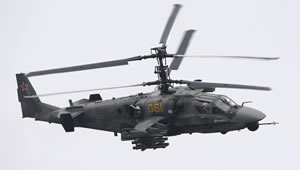
French warships for Russia to be armed with Ka-52 helicopters 14/08/2010 RIA Novosti Anton Denisov Mistral-class helicopter carriers, which Russia plans to buy from France, will be armed with Russian Ka-52 Alligator helicopters, Air Force Commander Colonel General Alexander Zelin told the Ekho Moskvy FM station on Saturday. He emphasized that the Ka-52 Alligator helicopters are very advanced and are equal to best foreign models. The Ka-52 is armed with 30-mm cannon, Vikhr (Whirlwind) laser guided missiles, rockets, including S-24s, as well as bombs. The Ka-52 is a modification of the basic Ka-50 Hokum model. The development of the Ka-52 started in 1994 in Russia, but its serial production began only in 2008. The helicopter is also equipped with two radars, one for ground and one for aerial targets and a Samshite nighttime-daytime thermal sighting system. Russia is negotiating the purchase of at least one French-built Mistral-class amphibious assault ship and plans to build three more vessels of the same class in partnership with the French naval shipbuilder DCNS. A Mistral-class ship is capable of transporting and deploying 16 helicopters, four landing barges, up to 70 armored vehicles including 13 battle tanks, and 450 personnel. The Russian military has said it plans to use Mistral ships in its Northern and Pacific fleets. Many Russian military and industry experts have questioned the financial and military sense of the purchase, and some believe that Russia simply wants to gain access to advanced naval technology that could be used in the future in potential conflicts with NATO and its allies. In April, the head of the Federal Service for Military and Technical Cooperation, Mikhail Dmitriev, said the Mistral deal would be concluded by the end of the year. MOSCOW, August 14 RIA Novosti
-
In the ROF options under graphic settings make sure the settings are optimal for your card. The artifact rendering is related to how your card handles and processes rendering like OpenGL and the like.
-
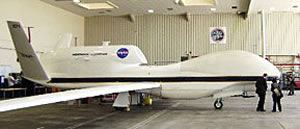
New to the data collection effort this year is the Global Hawk, a high-altitude, jet-powered unmanned surveillance drone about the size of a corporate jet. AP FILE Government to use drones to study how hurricanes intensify By TONY WINTON Associated Press The U.S. government is preparing to launch a study to solve one of the most vexing questions about hurricanes: Why do some storm systems rapidly intensify into destructive cyclones, while most remain weak? Starting this week, a squadron of manned and unmanned aircraft is poised to investigate an intriguing theory that one leading researcher has likened to a kangaroo's pouch -- the pocket where the animal's offspring develop. Michael Montgomery, the lead investigator and a meteorology professor at the U.S. Naval Post Graduate School, said researchers believe there are pockets or ``pouches'' within a storm system that somehow nurture a hurricane's development. If it exists, the pouch, or column of air, would be hidden from space-based weather satellites, which take visual and heat readings, but cannot see deep inside a storm. Where nine out of 10 thunderstorm systems never coalesce into a hurricane, those pockets may help answer why the 10th storm becomes a monster. ``We basically invoke an analogy from biology,'' Montgomery said as he flashed an image of a kangaroo on a screen Wednesday at NOAA's Atlantic Oceanographic and Meteorological Laboratory. The theory suggests that such regions, or pouches, can be detected by sampling areas that otherwise wouldn't ever be scanned by hurricane hunter planes, or by technology that weather satellites lack, Montgomery said. The combined fleet of manned aircraft and unmanned high-altitude surveillance drones, able to drop probes deep into the clouds, will be able to send back a real-time, wide-ranging image of an entire storm system, not just observations from a single plane or distant satellite. ``The reason we're sampling the whole domain with this many aircraft is that we can get a better idea of what these embryonic systems look like, said Frank Marks, the director of NOAA's Hurricane Research Division. The research is being driven by forecasters' inability to make good predictions about when storms will rapidly strengthen. ``Ninety percent of the time, we simply don't catch the rapid intensification,'' said Bill Read, director of NOAA's National Hurricane Center. ``You miss the fact that it goes up 40 or 50 miles per hour in a 24-hour time frame.'' Forecasters have made steady progress on predicting where a storm will go, but it's critical for the public and emergency managers to know how likely a storm is to intensify, Read said. New to the data collection effort this year is the Global Hawk, a high-altitude, jet-powered unmanned surveillance drone about the size of a corporate jet. It's used by the military to do reconnaissance in Afghanistan and Iraq. The aircraft -- given to NASA by the Air Force -- will launch missions from Dryden, Calif., fly over the U.S.-Mexico border, and then into the Gulf of Mexico. Unlike a piloted craft, which must return to land so the crew can rest, it can spend 24 hours on station, Marks said. While forecasters are hoping to catch a storm in formation, they know that most won't. ``We're going to sample a lot of duds,'' he said. Still, researchers believe that even knowing what weather systems are ``duds'' is worthwhile, if it leads to more accurate forecasts. Miami Herald
-
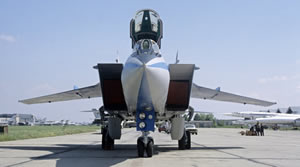
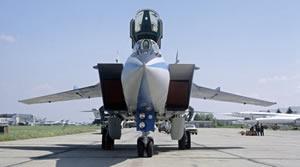
Russian air force completing MiG-31BM modernization program 13/08/2010 RIA Novosti. Skrynnikov The Russian air force is completing a modification program for its MiG-31 interceptor aircraft to the MiG-31BM standard, the force's commander Col.Gen. Alexander Zelin said on Friday. "The air force is currently carrying out the vital task of deep modification of the MiG-31 aircraft to MiG-31BM standard. This task is being successfully carried out," he said. The MiG-31BM is fitted with upgraded avionics and digital datalinks, a new multimode radar, color multi-function cockpit displays, a new, more powerful computer and ability to carry new air-to-air and possibly air-to-surface missiles such as the AS-17 Krypton anti-radar missile. Information on display next to a MiG-31BM in 2009 associated the aircraft with air-to-air missiles including the Vympel R-73 (AA-11 Archer), R-77 (AA-12 Adder), and R-33S (upgraded AA-9 Amos) and the K-37M (AA-X-13 Arrow). The air force is also accepting other new aircraft, including the Su-34 strike aircraft, the forthcoming Su-35, the Yak-130 advanced trainer, and Ka-52 and Mi-28 helicopters, he said. Manufacturer's tests are also underway on the Sukhoi T-50 fifth generation fighter prototype. Zarya (Moscow Region), August 13 RIA Novosti
-
If you have another video card I'd try swapping it out. The artifacts you're seeing can be caused by a bad video card, driver, or memory.
-
Indra’s Electronic Defense Systems for Italian U212 Submarines
Erik posted a topic in CombatACE News
Indra’s Electronic Defense Systems for Italian U212 Submarines By Indra on August 13, 2010 Indra will implement its electronic defence systems in two new U212 submarines to be acquired by the Italian Navy after signing an agreement with Fincantieri - Cantieri Navali Italiani. The system will allow this traditional submarine, which is one of the most noiseless and hard to detect, to notice any active radar within a certain range. The analysis capacity of the system enables detection of nearly 100% of the signals, not only the weakest but also those with low probability of detection. The solution will also facilitate followup of the signal transmitter and identification. The analysis of the radio electric spectrum takes place in real time which offers an advantage for the submarine crew over other platforms. This is possible thanks to the high information processing capacity of the system and its intelligence since it is capable of recognising the electronic finger print which distinguishes radar types. Besides this, it offers the possibility to record all the data for further analysis. Another distinguishing feature of the solution is its high integration capacity with other systems, either command and control systems and communications or with other transmitters embarked on the U212. Already into service for the German Navy One of the key aspects which made this contract possible was the successful implementation of the system for the German Navy's U212. In addition to this, the solution meets NATO requirements for international missions. All this offers a significant advantage over competitors and has granted Indra this important international reference. The company is also broadly experienced in the sector of electronic defence and is the supplier of this type of systems for the Spanish fleet. The system has been implemented in the new F100 frigates, the Strategic Projection ship or the future S80 submarines. Indra's equipment is also present in cutting edge platforms such as Eurofighter or the A400M, among others. Indra is the premier Information Technology company in Spain and a leading IT multinational in Europe and Latin America. It is ranked as the first European company in its sector according to investment in R&D and is the second Spanish company in absolute value investments in R&D. In 2009 revenues reached EUR 2,513 M of which a 40% came from the international market. The company employs more than 29,000 professionals and has clients in more than 100 countries. Defense Talk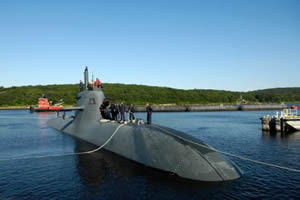
-
Logistics system release transforms combat support By Air Force News Agency on August 13, 2010 WRIGHT-PATTERSON AFB, Ohio: A new age for Air Force logisticians began when a pilot version of the Expeditionary Combat Support System went live July 31 at Hanscom Air Force Base, Mass. The Expeditionary Combat Support System will transform business processes, alter management and control systems, and affect personnel roles and organizational structures across the entire logistics arena. "Developing and fielding ECSS is a monumental task that requires transformational changes in the way the Air Force does business," said Col. Stefan Dosedel, an ECSS Release One program manager. The previously used, stove-piped systems often resulted in duplicated efforts, non-standardized reporting and data integrity issues. When fully implemented, ECSS will provide standardized business processes, an enterprise view of the supply chain and efficiencies across the Air Force, while also impacting personnel roles and organizational structures. "The end result is to have one, single database, no matter what Air Force location you are at, that has consistent processes and data," said Scott Argo of Computer Sciences Corporation, the system integrator. "It moves the Air Force from base-centric, standalone systems to an enterprise approach." The ECSS program, managed by the Electronic Systems Center's Enterprise Logistics Systems Program Executive Office at Wright-Patterson AFB, Ohio, is an integrated data environment that combines financial, manufacturing, distribution and other business processes into a single, commercial off-the-shelf, Oracle-based technology solution hosted on the Air Force Global Combat Support System. It replaces more than 240 Cold War-era standalone, or stove-piped, systems being used today. Hanscom AFB was chosen as the pilot base for implementing ECSS because of its small size and relatively low number of impacted users. Planned for release in increments, this first phase, known as Release One-Pilot A, focuses on vehicle maintenance and involves about 40 to 50 Hanscom AFB users. Pilot B will expand to equipment custodians at Hanscom AFB, and Pilot C, which will involve supply functions, will bring the potential number of Hanscom AFB ECSS users to between 75 to 100 people. Hanscom AFB will continue to be the ECSS pilot base until 2011, when the program enters Initial Operational Test and Evaluation at MacDill AFB, Fla., and Ellsworth AFB, S.D. The first work order for Pilot A was opened Aug. 2 when mechanic Bruce Trainer of the 66th Logistics Squadron opened the "Scheduling Workbench" on his computer screen. From the workbench, he accessed ECSS and scheduled the first job of the day: replacing a faulty light bulb on a base fire truck. Shortly thereafter, Rick Lord, also of the 66th LRS, started the maintenance operations, recorded the use of the replacement part, recorded his time and completed the work order. Since ECSS standardizes processes, the same job will be done the same way at Air Force bases around the world, Mr. Argo said. It also transfers the process from a paper-based system to an electronic one. "While Pilot A is primarily being conducted by the 13 vehicle maintenance workers at Hanscom (AFB), there are 300-plus people at the Program Management Office at Wright-Patterson (AFB) and more than 500 CSC employees in Beavercreek, Ohio, working to implement the system across the Air Force," Mr. Argo said. "Engineers at Robins Air Force Base, Ga., are also working the related vehicle engineering bill of materials and routings so that maintenance activities have a standard set of activities, tools and parts." Robins AFB engineers essentially will build the processes used Air Force-wide, and load them into ECSS, Mr. Argo said. Aug. 2, the ECSS Logistics Management and Support Office hosted a gathering at Wright-Patterson AFB to mark the Air Force's first ECSS implementation. Lynn Moad, the Systems Integration Division chief and Air Force Materiel Command ECSS champion, said she was thrilled with the progress of the system. "Everyone at Hanscom (AFB) and Warner Robins (AFB) is so enthused," she said. "Each person has worked so hard to make this happen, and is so excited." While this release signals a big stride in Air Force logistics, the ECSS program executive officer said that more program developments are on the horizon. "Today is a big day for ECSS, but it marks just another step in a long journey to delivering the full promise of ECSS," said Brig. Gen. Kenneth J. Moran, the director and Air Force program executive officer of Enterprise Logistics Systems. "We can, and should be, immensely proud of what's been achieved; but we must remain diligent and focused on the work ahead." Defense Talk

-
Persistent Wireless Broadband Communications Network for the Battlefield By Lockheed Martin on August 13, 2010 Private Military Network Brings Secure Smartphone Technology to Warfighter VALLEY FORGE, Pa.: Warfighters on the battlefield will have a persistent wireless broadband network available for tactical use with a new MONAX™ communications system from Lockheed Martin [NYSE: LMT] that combines the convenience of smartphone technology with the power and flexibility of a secure, highly portable network infrastructure. “With the MONAX system, we’ll be able to place smartphone technology in the hands of warfighters with a private network they can take anywhere,” said Gerry Fasano, President of Lockheed Martin Information Systems and Global Solutions-Defense. “This affordable system will reduce time spent searching for information, improve battlefield communications and situational awareness, and increase mission effectiveness through more informed decision making.” The MONAX communications system connects a commercial off-the-shelf smartphone to a ground or airborne 3G base station with a MONAX Lynx portable sleeve, enabling the warfighter’s use of a single, convenient, touch screen device for mission success at “the first tactical mile.” The system is frequency flexible, connects hundreds of users to a single base station, and delivers superior range and link performance in voice, video and data transmission. The network uses a secure RF link, protected through exportable encryption for joint and coalition operations. Lockheed Martin also offers a rich set of applications and governance, leveraging smartphone application development and application store model. Applications are available for mission reporting, situational awareness, command and control, facial recognition for checkpoint use, cyber security situational awareness and protection, and enterprise intelligence, surveillance and reconnaissance (ISR) data access. Defense Talk

-
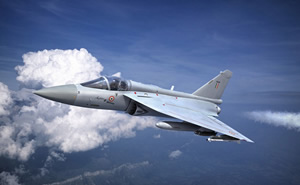
IAF going in for massive upgrade of airfields, helipads Rajat Pandit, TNN, Aug 13, 2010, 02.07am IST NEW DELHI: From new Sukhoi-30MKI bases at Chabua (Assam), Halwara (Punjab) and Jodhpur (Rajasthan) to one for Tejas fighters in Sulur (Tamil Nadu), IAF is going in for a massive upgrade of its airfield and helipad infrastructure across the country. This will not only bolster operational logistics and flexibility on both the eastern and western fronts with China and Pakistan, apart from plugging existing gaps over central and peninsular India, but also make IAF airbases more accessible to civilian aircraft. This is in tune with IAF's aim to have 42 fighter squadrons by 2022, up from the existing 32, with progressive induction of 270 Sukhois, 126 multi-role combat aircraft, 120 indigenous Tejas Light Combat aircraft and the first lot of the fifth-generation fighter aircraft to be developed with Russia. A major endeavour in all this is the soon-to-be-launched MAFI (modernisation of airfield infrastructure) programme, under which 30 of IAF's 51 operational airbases will be upgraded in Phase-I over 42 months. "Commercial negotiations with the Tata Power-led consortium for MAFI Phase-I, at a cost of around Rs 1,300 crore, is in the final stages now. Bhatinda airbase will be taken up as the pilot project,'' said a source. Under Phase-II, remaining IAF, Army, Navy and Coast Guard airfields will be modernised. The upgrade includes resurfacing, expansion and lighting of runways for night operations as well as installation of new tactical navigational (TACAN), instrument landing (Cat-2 ILS), air traffic management and air-to-ground radio communication (RCAG) systems. The North-East is a major thrust area, with upgrade of airbases in Chabua, Dibrugarh, Jorhat, Mohanbari, Hasimara, Guwahati and Bagdogra, among others. The Tezpur airbase already houses Sukhois after it underwent an upgrade last year. Then, after reactivating western sector ALGs (advanced landing grounds) like Daulat Beg Oldi, Fukche and Nyama in eastern Ladakh, IAF is now concentrating on upgrading eastern sector ALGs like Pasighat, Mechuka, Walong, Tuting, Ziro and Vijaynagar as well as several helipads in Arunachal. This is meant to strategically counter China's massive build-up of military infrastructure all along the 4,057-km Line of Actual Control, which includes 14 airbases directed against India in Tibet. The focus on the western front, of course, remains as sharp as before. The Phalodi airbase in Rajasthan, just 102 km away from the Pakistan border, for instance, began fighter operations earlier this year. "The aim is to make all the bases capable of operating all kinds of aircraft. This will, for instance, allow our IL-78 mid-air refuellers to support fighters from virtually anywhere in the country,'' said the source. The Times of India
-
Mock military combat and falsely claiming to be a service veteran are two very different things. Go out have fun and get a few notches in your man card, then see your local recruiter.
-
The only resolve that would satisfy me personally is to have him earn each and every badge, ribbon, star, and uniform he disgraced. If he can't then he should be deported and stripped of his citizenship. If he can I can guarantee he'll have the respect needed to wear them and he'll definitely be 300 lbs thinner or at least have a BMI less than 20.
-
Some of those links in the original post are from back in 2003. I wonder if this isn't one of those recirculated incidents.
-
First GPS IIF satellite on station By Air Force News Agency on August 11, 2010 LOS ANGELES AIR FORCE BASE, Calif.: Officials from the Air Space Command's Global Positioning Systems Wing at the Space and Missile Systems Center here have announced the first GPS IIF satellite arrived on station Aug. 1. This indicates the satellite is in its designated orbital position and ready for its final phase of on-orbit checkout and testing, to be completed before September. The satellite then will be cleared to serve navigation and timing users as part of the operational GPS constellation. The next-generation GPS IIF satellites will provide improved accuracy through advanced atomic clocks, a longer design life than legacy GPS satellites and a new operational L5 civil signal that benefits civil aviation and other safety-of-life applications. It also will continue to deploy the modernized capabilities that began with the eight modernized GPS IIR satellites, including a more robust military signal. GPS IIF satellites will provide improved signals that will enhance the precise global positioning, navigation and timing services supporting both the warfighter and the growing civilian needs of the global economy. The GPS constellation remains the most robust and capable system in the history of space. Air Force Space Command and Space and Missile Systems Center personnel are charged with developing, acquiring, fielding and sustaining the world's best space and missile capabilities for warfighting forces and for the nation. Air Force specialists are committed to providing uninterrupted GPS service at or above our performance commitments for decades to come. Defense Talk

-
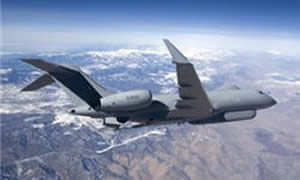
U.K. Eyes Improved Counter-IED Capabilities By Robert Wall London The U.K.’s effort to upgrade the Astor ground-surveillance aircraft to enhance detection of improvised explosive devices (IED) is one in a series of equipment upgrades European militaries plan to bolster their military presence in Afghanistan. The effort comes as the debate over the course ahead in Afghanistan continues in many European countries, signaled most starkly by the formal end of the Dutch participation in the operation on Aug. 1. The U.K. has been operating the R1 Sentinel Airborne Standoff Radar (Astor) and supporting ground forces by monitoring routes that logistics convoys have to pass through, in some cases augmenting their own sensors with unmanned aircraft. U.K. military officials note that includes forensic analysis to determine where insurgents have come from or headed after an attack. The ground moving target indicator capability also has been used to help alert ground personnel to the potential presence of IEDs. So far, however, that has concentrated on monitoring ground movements and, when locals notably avoid an area, alert troops on the ground about a potential threat at that location. But further, more sophisticated technical steps are in the works, including using the synthetic aperture radar (SAR) to conduct change detection analysis on the fly. Under such a system, Astor would be used to detect small changes in the ground to alert troops about the potential emplacement of an IED. The Royal Air Force recently conducted trials of this capability at the Salisbury Training Area. The initial SAR system could not perform that function, but with software advances, change detection “is developing,” says a ground operations officer who had deployed with the R1 Sentinel in support of Afghanistan operations. The U.K. also has been flying unmanned aircraft in the hunt for IEDs, with indications that advanced payloads are being quietly operated in the theater. On a visit last week to RAF Waddington, where the R1 Sentinels are based, U.K. Defense Minister Liam Fox noted that “highly detailed imagery provides our ground forces with the incredibly accurate information they need to detect insurgent activity and spot potential IEDs.” Providing ground forces improved airborne intelligence collection also is on the agenda in Germany, where there has been controversy much of the year over concerns that deployed forces are under-equipped. The German parliament’s military ombudsman, Hellmut Konigshaus, has repeatedly urged that known shortcomings be rectified. Most of those concerns have focused on ground equipment, which Berlin is trying to take great strides to improve, benefiting other materiel along the way. For instance, the German air force this month expects to field a third Heron-1 unmanned aircraft in Mazar-e-Sharif. The Heron-1s are providing direct tactical support to ground forces, while the reconnaissance Tornados, now equipped with a real-time imaging pod, support headquarters functions. Germany acquired four real-time digital RecceLite reconnaissance pods for the Tornados, and in 2012 expects to field four more. The imagery from those sensors is also helping detect IEDs using change detection algorithms. The German mission to Afghanistan will require parliamentary renewal in the coming months. The current mandate expires Dec. 13, but equipment planners are betting that troops will remain in country in 2011, when a raft of upgrades to ground equipment are due to hit the field. Meanwhile, the Afghan National Army Air Force has begun live-fire training launching rockets from its Mi-17 helicopters for ground attack. The helos, used for troop transport, eventually also are to supplant the Mi-35s in a ground support capacity. Credit: High G Technologies Aviation Week
-
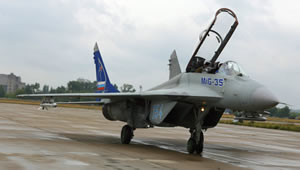
MiG-35 stalls in Indian fighter tender contract 10/08/2010 © RIA Novosti. Ilya Pitalev Russia's MiG-35 multirole fighter aircraft has failed to make the short-list in a $10 billion international tender for 126 combat aircraft for the Indian air force, according to Indian media reports quoted by Kommersant daily. The favorites to win the tender are the French Dassault Rafale and the Eurofighter Typhoon, Indian media say. Russia's United Aircraft Corporation (UAC), the holding company for most of the Russian aircraft industry, and its fighter subsidiary MiG, have not officially confirmed the reports. "The official results of the tender have not yet been announced," said UAC's Press Secretary Konstantin Lantratov. "The MiG-35 is not leaving the tender, and I have no official information about this," said UAC First Vice-President Mikhail Pogosyan. A MiG source quoted by Kommersant said it was too early to say what the Indians had decided. "The envelopes with the commercial proposals should be studied by the tender commission only this week," the source said. Several sources quoted by the paper listed a raft of problems around the MiG-35 program, including a lack of financing to support it. One source said the lack of state funding to support the program had been noted by UAC President Aleksei Fyodorov as long ago as the end of 2008, but the issue was not resolved. The MiG-35 is said to be a cheaper aircraft than its rivals but is said to have problems with engine life. "Time between overhauls should be at least 2000 hours and overall life 4000 hours, but the RD-33 doesn't meet these parameters now," said one source. India already operates the early model MiG-29A fighter aircraft and is taking delivery of the MiG-29K naval fighter, which it will operate from a Russian-built aircraft carrier which is currently under refit. The selection of two favored aircraft for the Indian tender follows a long trials process, which also involved Sweden's SAAB Gripen, America's Lockheed Martin with the F-16, and Boeing's F-18 Super Hornet, as well as the Russian MiG-35. MOSCOW, August 10 RIA Novosti
-
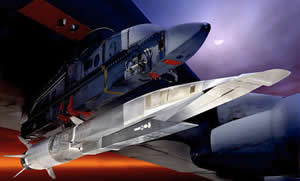
Lockheed Martin Hypersonic ATACMS Motor Boosts Experimental Scramjet in First Flight DALLAS, TX and SACRAMENTO, CA, August 10th, 2010 -- Lockheed Martin [NYSE: LMT] announced today that its Army Tactical Missile System (ATACMS) rocket motor successfully boosted the experimental X-51A WaveRider beyond Mach 4.5, the speed at which a scramjet will start and begin to provide thrust. The successful boost helped the X-51 hypersonic scramjet engine to accelerate to a historic Mach 5, a first for the vehicle. The X-51 WaveRider is an unmanned aerial vehicle designed for extended hypersonic flight durations. The successful boost with the ATACMS rocket motor will allow for future advancements in hypersonic flight. In this test, the modified ATACMS motor was air-launched from a B-52 aircraft at 50,000 feet, and data collected validates its performance well beyond the original design specifications. This was the first time an ATACMS rocket motor has been used as a booster for an air-launched vehicle. More tests using the ATACMS motor are planned. The modified motor included a Boeing designed lightweight, high performance exit cone which was produced by Aerojet, a GenCorp [NYSE:GY] company, for Lockheed Martin. The program is managed by a Boeing and Pratt & Whitney Rocketdyne team for the U.S. Air Force and DARPA. “The ATACMS rocket motor has proved its power in combat, and now we’re happy to see it performing a mission that advances hypervelocity flight technology,” said Scott Arnold, vice president of Precision Fires at Lockheed Martin Missiles and Fire Control. “We are proud to have played a part in this new milestone in hypersonic flight and to have been given the opportunity to demonstrate our ability to modify existing motor designs for future applications,” said John Myers, vice president of Tactical Programs for Aerojet. Aerojet is a world-recognized aerospace and defense leader principally serving the missile and space propulsion, defense and armaments markets. GenCorp is a leading technology-based manufacturer of aerospace and defense products and systems with a real estate segment that includes activities related to the entitlement, sale, and leasing of the company’s excess real estate assets. Headquartered in Bethesda, Md., Lockheed Martin is a global security company that employs about 136,000 people worldwide and is principally engaged in the research, design, development, manufacture, integration and sustainment of advanced technology systems, products and services. The Corporation’s 2009 sales from continuing operations were $44.5 billion. Lockheed Martin
-
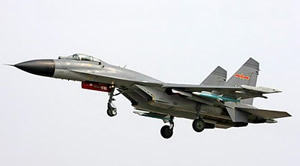
Chinese fighter jets train over Tibet (TibetanReview.net, Aug08, 2010) J-11 planes, the most modern Chinese jet fighters said to be pirated copies of Russia’s Su-27, have for the first time been shown in training over the Tibetan Plateau recently. While the Chinese media only showed a picture of some of these planes in the air, with a caption referring to the training flight, Strategy Page online Aug 6 said, reporting on it, that China had no combat aircraft stationed in Tibet, saying there were logistical and attitude problems in doing so. However, it said, J-7s (cloned from older, MiG-21 Russian jets) had been flying in regularly for temporary duty at major commercial airports in Tibet. The report said the J-11 jets had been appearing in more unexpected places (like the Chinese naval air force), although fewer than 150 had been built since they were introduced in the late 1990s. 1995 China paid $2.5 billion for the right to build 200 Su-27s. Russia was to supply the engines and electronics, with China building the other components according to Russian plans and specifications. But after China built 95 of these aircrafts Russia cancelled the agreement, saying the former was copying Su-27 to build their own aircraft, the J-11. The report said the main reason for not stationing fighter squadrons in Tibet had probably to do with the high altitude of the area, and the expense of moving large quantities of fuel and other supplies needed to maintain air units. It pointed out that there was only one rail line into Tibet (recently built) and few heavy duty truck roads. China also has a serious problem in Tibet with altitude sickness among its troops. The report said the Chinese military was spending a lot of time, effort and money trying to solve this problem. It said currently, most of the troops in the Chinese Chengdu Military Region were in the eastern, lowland half. In the western portion (Tibet), they had stationed the 52nd and 53rd Mountain Brigades, and were struggling to keep these 5,000 troops fit for duty. In case of an emergency, as there was two years ago, the nearby 13th and 14th Group Armies can send troops from their lowland bases, the report said. Over 20 percent of these troops will be hampered by altitude sickness once they reach the highlands, and commanders are trained to deal with that, it added. It said that given the alertness required of aircraft maintenance personnel, and pilots preparing for flights, plus the logistical problems, the Chinese air force had declared Tibet fit to visit, but not to base aircraft units in. However, because the Chinese air force may one day have to fight in the air space over Tibet, training up there was necessary. Tibetan Review