

Dave
-
Posts
23,823 -
Joined
-
Last visited
-
Days Won
99
Content Type
Profiles
Forums
Gallery
Downloads
Store
Everything posted by Dave
-
I have a 2020 mod Sundowner did with a nice skin and other refinements to the model. Let me ask if it can be released.
-
Try here http://home.att.net/~jbaugher1/f5.html http://home.att.net/~jbaugher1/f4.html
-
You didnt say anything wrong. I was clarifing because I could see how someone could come to that conclusion like you did based on my post. Relax man. Es todo bueno...
-
Engine: One Pratt & Whitney J57-P-21/21A turbojet, 10,200 lb.st. dry and 16,000 lb.st. with afterburning. Dimensions: Wingspan 38 feet 9 inches, length 50 feet 0 inches, height 16 feet 2 3/4 inches, wing area 400 square feet. Performance: Maximum speed 770 mph at sea level (clean), 864 mph (Mach 1.3) at 36,000 feet (clean). Initial climb rate 19,000 feet/minute. An altitude of 35,000 feet could be attained in 2.3 minutes. Service ceiling 36,100 feet, combat ceiling 47,700 feet, absolute ceiling 50,000 feet. Normal range 534 miles, maximum range 1995 miles. Fuel capacity 1739 US gallons internally, total of 2139 gallons if maximum external fuel is carried. Weights: 21,000 pounds empty, 28,847 pounds gross, 34,832 pounds maximum takeoff. Armament: Four 20-mm Pontaic M-39 cannon. Six underwing pylons for up to 7040 pounds of bombs, fuel tanks, or rockets. A MK-28 or Mk-43/57/61 nuclear weapon could be carried. In later versions, four AIM-9B/E/J Sidewinder air-to-air infrared homing missiles could be carried. North American F-100 Super Sabre, David A. Anderton, Osprey, 1987 The North American F-100 Super Sabre, Ray Wagner, Aircraft in Profile, 1965. The Illustrated Encyclopedia of Aircraft Armament, Bill Gunston, Orion, 1988. United States Military Aircraft Since 1909, Gordon Swanborough and Peter M. Bowers, Smithsonian, 1989. The American Fighter, Enzo Angelucci and Peter Bowers, Orion, 1987. Fighters of the United States Air Force, Robert F. Dorr and David Donald, Temple Press Aerospace, 1990. American Combat Planes, Third Enlarged Edition, Ray Wagner, Doubleday, 1982. Post-World War II Fighters, 1945-1973, Marcelle Size Knaack, Office of Air Force History, 1986. E-mail from Jack Daub, who flew MiG CAPs in Vietnam. E-mail from Michael Stover on F-100D being with 163rd TFS, Indiana ANG. E-mail from Larry on F-100 experiences. All info taken from Joe Baughers website.
-
I like the way you think. Cluster bombs are the only way to say, I love you.
-
Snoopy needs a new plane I think? I wonder why he took it out?
-
Don't read into it, I am merely speculating based on how he has added improvements in the past. I am not making a statement that I am in the know on that because I am not.
-
Because TK hasnt coded it that way....yet.
-
Malibu I got a great book on the Hun at home. If you can wait I can look that stuff up when I get off duty later. http://home.att.net/~jbaugher1/f100_6.html Here is some good info on it.
-
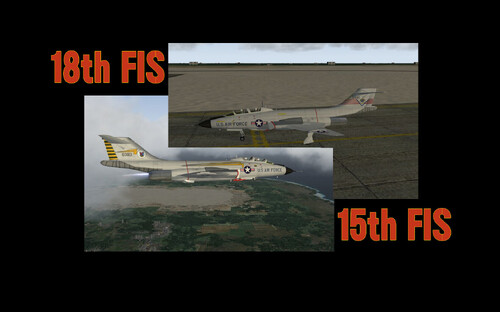
View File 18th FIS and 15th FIS F-101B Skins The 18th FIS was based out of Grand Forks AFB, North Dakota The 15th FIS was based out of Davis-Monthan AFB, Arizona Both were active duty squadrons. Read the readme. Submitter Dave Submitted 12/31/2008 Category F-100/F-101/F-102/F-104/F-105/F-106 Skins
-
241 downloads
The 18th FIS was based out of Grand Forks AFB, North Dakota The 15th FIS was based out of Davis-Monthan AFB, Arizona Both were active duty squadrons. Read the readme. -
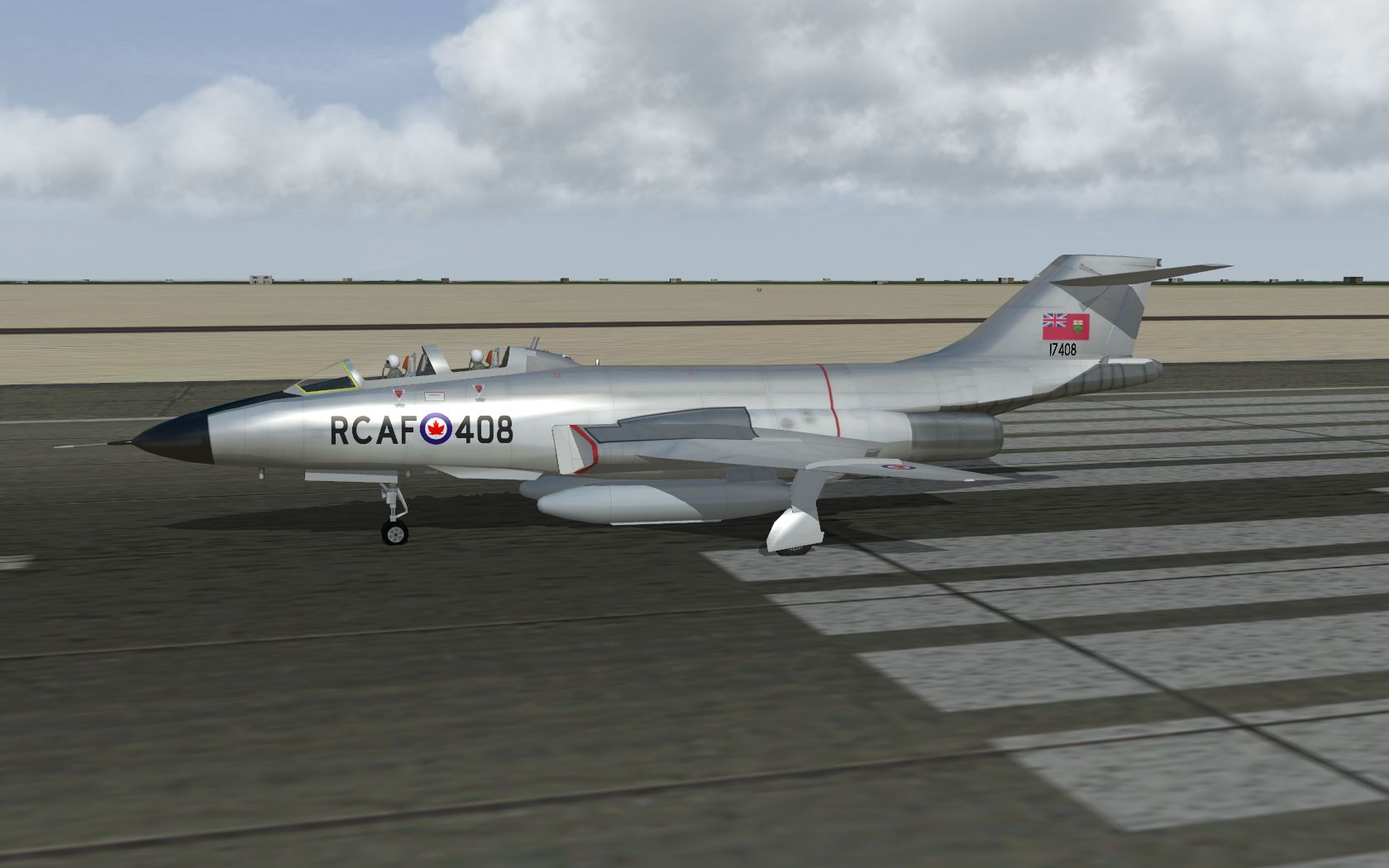
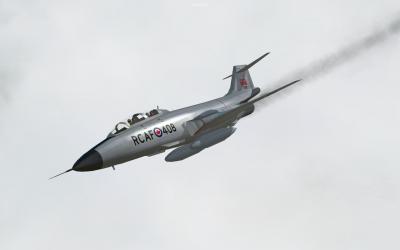
Erikgen I am sending you this early RCAF scheme for use with the early F-101B.
-
Now if the skin is not your work then of course, then you have a point. But if it is, skins are fair game for all.
-
We can't accurately simulate an AESA radar in this sim. Lord knows we have tried. I think Fubar512 came up with a method of getting one close but he would have to verify that.
-
The tireless maker of campaigns..... I hope you have a good one. With it being New Years Eve and your birthday, I can for see yo having a monumental hangover.
-
BS, we got tons of skins of their aircraft here. You can upload it here for others to enjoy. Mppd for example just released a Hurricane skin pack. http://forum.combatace.com/index.php?autoc...p;showfile=7940 So don't worry about that.
-
Not sure if they were from KI or not. I saw a few from a number of units. I sure do miss that base.
-
We were stationed at Wurtsmith from 1981 to 1983 then from 1988 to 1991. Wurtsmith is where I met my wife. (in high school) I can tell you my dad took me out many times to the flight line to see what birds were sitting on the ramps. It where I saw my first 101s and 106s. My in laws still live in Oscoda.
-
I got my info from actual Voodoo manuals at the USAF Museum.
-
Its the MG-13 FCR which replaced the MG-11 FCR (which totally sucked and wasnt SAGE capable). Further improvements gave the MG-13 a max range of 60 miles. The problem with this is that not all of them got the update at the same time. So the B model you were tasked to fly might have the weaker -13.
-
Same thing.
-
I guess what irritates me is the fact, people seem to think we don't research these things. AHHHHH I swear sometimes I should just give up.
-
I was thinking the same thing.
-
http://forum.combatace.com/index.php?autoc...p;showfile=2762 Also this F-4 series...
-
Put your right foot in, take your right foot out, put your right foot in and shake it all about....