

MigBuster
-
Posts
9,165 -
Joined
-
Last visited
-
Days Won
27
Content Type
Profiles
Forums
Gallery
Downloads
Store
Everything posted by MigBuster
-
The film adaptations were very good I thought - RIP to the guy - big loss for military fiction writing
-
http://www.youtube.com/watch?feature=player_embedded&v=103kHGjdy9w
-
http://www.youtube.com/watch?v=tj9UwKQKE3A&feature=player_embedded#t=15
-
The IAI Kfir, (“Lion Cub” in Hebrew) has just received an upgrade program to extend its life for another 40 years (possibly). During the late 1960′s the Israel Aircraft Industries were forced to look inwardly after France had imposed an arms embargo on Isreal (which lasted 42 years) after Israel had paid for development work by Dassault on the Mirage V, a fair weather ground attack aircraft to replace the Israeli Mirage III’s in that role. In short, avionics were removed from behind the cockpit to increase the fuel capacity and to lower maintenance costs and, in response to the arms embargo, Israel produced an unlicensed copy of the Mirage V and called it the Nesher, after it is thought that the blueprints for the engine and air frame had been acquired from third party Mirage producers. After the Six Day war, supplies of Mirage III were pretty low so producing a domestic version made sense and got around the embargo completely. The Kfir program began whens the need to enhance the Nesher became apparent due to the improving Soviet era jets that Israel’s neighbours were acquiring at the time. The first thing the Kfir designers were to look at was an engine; two engines were looked at: the Rolls Royce Spey Turbofan (which had been used in the Blackburn Buccaneer, F-4K Phantom in UK use and by the AMX project in Italy) and the General Electric J79 Turbojet, the same as in the McDonnell Douglas F-4 Phantom of which the Israeli Air Force (IAF) were just starting to take delivery of, which was selected and produced locally. Due to the need for increased cooling of the J79, the Israeli engineers shortened the Mirage III rear fuselage and widened it to accommodate wider air intakes and an additional air intake was also introduced to the bottom of the vertical stabilizer. A modified two seat Mirage IIIc took to the skies in 1970 powered by the new J79 engine shortly followed thereafter by a J79 powered Nesher during September 1971. But it was June 1973 when a highly modified Nesher powered by the J79 took to the skies for the first time, along with the Israeli avionics on board and re-arranged fuel tanks to improve range. The finished article entered IAF service during 1975 and saw its first combat during an air strike into Lebanon during 1977 and even got its first kill, a Syrian Mig-21, in 1979 the same day as the F-15 took its first air to air kill. By 1982 the Kfir was used mostly in the ground attack role, leaving the F-15′s & F-16′s to take on the air superiority role. The Kfir was retired from IAF service in 1996 but is still used by several export customers. Due to the J79 being a U.S design it meant that Israel had to gain permission from the U.S State Department to export the Kfir which did limit the export potential but was bought by Colombia, Ecuador and Sri Lanka and have been used extensively by those nations. Twenty five examples were also used by the U.S Navy as aggressor aircraft operating out of NAS Fallon and were given the name of F-21A. Israel has recently announced a new upgrade program to extend the life of the existing export examples named “Block 60.” The upgrade basically strips the aircraft back to its fuselage and then performs a nuts and bolts rebuilt, upgrading avionics and other systems including a new data-link system, something the Kfir never had being a third generation aircraft. IAI state that the improvements bring the Kfir up to a fourth generation aircraft and something that is suitable for the 21st Century. All of Colombia’s Kfir jets have gone through this program as well as the further twelve examples that were acquired; IAI is hoping that it can sell the Block 60 upgrade to the other two operators. http://theaviationist.com/2013/09/30/kfir-upgrade/
-
Would need to compare all the data inis for each missile as a start to see if there is a parameter in there
-
http://www.youtube.com/watch?feature=player_embedded&v=G3QrhdfLCO8
-
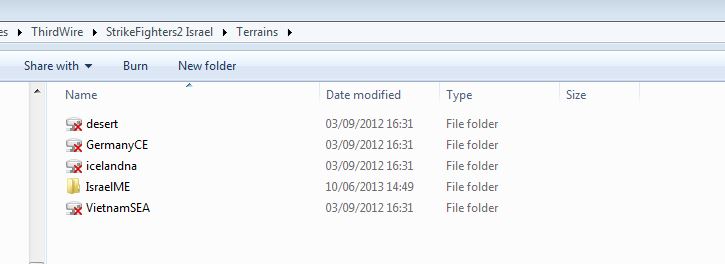
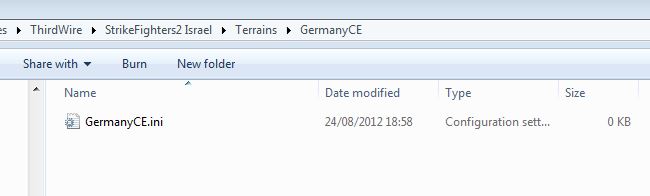
An easier way is to create folders for every terrain in each of your separate mod folders for each game So in the SF2I Terrains folder: Then in GermanyCE, VietnameSEA, icelandna, desert place a single ini file only - the ini file must be named properly but must be EMPTY. When you start up SF2I it will be as if it were standalone - all the terrains, missions, campaigns will be for SF2I only. And in a new install just copy over those folders into terrains again
-
You got a lock on tone before firing?
-
Pull 8 Gs with a can of beer in one hand................ "Most pilots come from the F-16, F-15 and A-10 legacy aircraft. Sensors on the front of the F-35 allow us to have that 360-degree awareness. That was the big leap forward. Computer technology that is 30 years or more advanced than the legacy aircraft is what makes the F-35 so advanced." Lt. Col. Anthony Pelkington is the 33rd FW chief of safety and was one of the first of the legacy pilots selected for the F-35 program. He said that for pilots transitioning from those legacy systems, the F-35 is a huge deal. "For 10 years in the F-16, I dealt with essentially monochrome cathode ray displays - approximately 6 inch square - and I've got two of them. Now I move up to a contiguous 8 x 20- inch color display that is a huge step forward for the pilot's situational awareness. Plus, there's a lot more capability in the display itself. "In the F-16, I had a radar display with a selectable, like turning pages in a book, something that would show my ordnances like I had a stick figure map with monochrome lines on a black background. It would try to give us a semblance of where we were to maybe a weapons system. But I had to choose. Every one of those displays was limited to the confines of that small 6-inch to 8-inch screen. "In the F-35, we now have this massive amount of screen real estate. I can now see multiple sensors at once, which is great because I don't have to pick and choose. I don't have to take away my situational awareness with what the radar is telling me in terms of traffic to bring up situational awareness and what the target pod looks like. It's all there available for me." Pelkington added that one of the best aspects of the fifth generation fighter is its ability to communicate with all aspects of the aircraft, as well as customize information to fit each pilot's needs. "The displays talk to each other, the sensors talk to each other, and a lot of information is displayed in sensible formats with other sensors in one combined picture. Now I can bring up large formats on displays so I can see things easier - I can even bring up many formats if I want with a different orientation on how the displays will look. Whatever I want to do to aid my situational awareness I can do and the reality, as a pilot, is that I can customize that setup quite easily to a format that best suits how a pilot understands." The wing's safety chief said that one of the biggest advantages to the F-35 over legacy aircraft is the growth in options. "Choosing between a pilot's eye and 'god's eye are all in the system now and weren't in the F-16. I had one particular display option for radar format for the F-16 - I couldn't choose anything else. I had to learn to read it in that manner. Which didn't necessarily match how somebody looking out on a battlefield could see the picture. So you always had to do that conversion in your mind. With the F-35 you can choose the display format that best suits your ability, and there are multiple options to allow you to see things from a 'god's eye' perspective. It allows me to see from a much greater perspective than the F-16 ever allowed." The equipment Tech. Sgt. Andre Baskin is the wing's aircrew flight equipment NCOIC, responsible for equipping pilots with the specialized gear required to fly the world's most state-of-the-art aircraft. He and his small staff of specialists agree that the differences between the F-35 helmet and the rest are many. "One of the biggest differences the F-35 helmet has over the others is that the new helmet encompasses multiple gadgets such as night vision goggles, and for that function you would have to modify the pilot's flying helmet and add the components on there," said Baskin. "With the F-35, it's all encompassed in the helmet. The cameras on the jet work in sync with the helmet and whatever the jet picks up visually will be displayed on the visor in the helmet." From a pilot's point of view, Renbarger agrees that the nicest part of the new helmet is that everything is self-contained. "The best thing about the F-35 helmet is that it has a big visor with a big display, and we can display a night vision camera visual on the visor and then a distributor aperture system that is basically a set of cameras that are all over the airplane and work in the infrared spectrum. That can be displayed on our visor as well. "When we get our helmet fit, there is actually a complicated scan process that takes an image of our heads and provides a laser cut-out foam insert for the helmet that is molded to our heads. Then there's ear cups that close the helmet around our head and a custom nape strap in the back that basically locks the helmet down on our heads. There's very little, if any, motion in the helmet when we move our head around. Very well balanced, a very well fit and it feels great wearing the helmet. It's very specific to each individual pilot." Pelkington also talked about the difference between the traditional G-suit, which offers pilots about a G and a half of protection, to the one used by F-35 pilots. "Some pilots acclimate to the Gs by genetic makeup, some by experience and can develop a tolerance for 5-ish Gs. With the new suit you can now go up to 7 or 8 Gs without ever having to strain. When you're focused on pulling Gs -- on making sure your eyesight doesn't gray out - your mind isn't thinking about the adversary or the situation or the awareness of the battlespace. When you can pull 7 or 8 Gs without having to think about it, combined with the fusion of all the systems and the display on the glass set up the way you want to see it...it's an amazing reduction in pilot workload." http://www.f-16.net/news_article4789.html
-
There are 3rd party jets like the ones you mentioned being worked on for DCS World yes How I read it was that back in the 90s flight sims were one of the biggest selling types of games - and the decline has been partly blamed on sims getting to difficult to play (there are probably other issues) . He compares hardcore flight sims with some other games that are difficult to learn today but actually still have many players. I would see most 90s games as being of a difficulty like SF2 but with more features and gameplay included - due to larger budgets. SF2 may have suffered due to poor marketing really. Ilya mentions that to survive they have to evolve. TK has had to evolve and gone to the mobile platform - otherwise he would have been out of business by now that's a fact - so any future changes to SF2 will be based on what makes money above anything else. Good luck to Ilya hope they do well - but I'm not convinced Hard Core sims will ever have a massive following - and I'm surprised there isn't a bigger Russian or Chinese market for his game tbh where they could make more money.
-
Will down load and have a look
-
The flight model also may vary on the game difficulty set in options btw
-
You sure? - I've shot one down with an AIM-9 before - you have to be in the right place at the right time - the main problem is that normally I'm no where near parameters for a missile shot What angle are you trying to down them from and with what weapon?
-
Placed with coordinates? What are you using to generate the lights?
-
in SF2NA they always seem to launch if given the chance - are you talking about the same setup?
-
http://www.youtube.com/watch?feature=player_embedded&v=CYy5MgFd7ME#t=687
-
Any unhappy customers from Austin Texas yet
-
Nightmare - you on the ground floor I hope!
-
http://www.youtube.com/watch?v=8o6zOuvhY-k&feature=youtu.be
-
http://video.boeing.com/services/player/bcpid1173939806001?bckey=AQ~~,AAAAukPAlqE~,oAVq1qtdRjwBrIkHYj2MSytJiEK9s5fy&bctid=2684464741001
-
Wicked!
-
Man to sit inside Helicopter while we fire at it. http://www.youtube.com/watch?v=_Fj9hdmEeBY
-
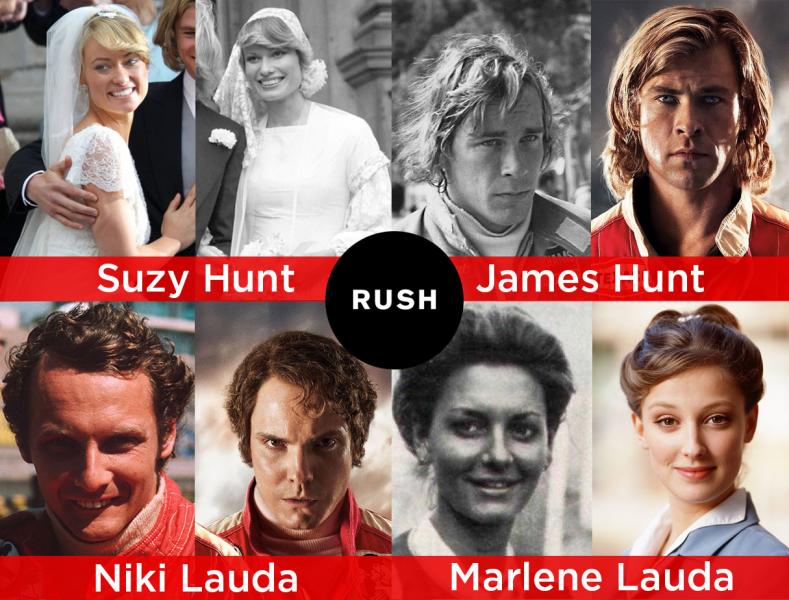
Looking at footage of the actual crash and the events of that season it seems they have been pretty accurate - even the bit about Hesketh racing - just a bunch of rich toffs - hilarious!!! The casting wasnt far off either
-
Kickstarter success and new stretch goals for ME-262
MigBuster replied to MigBuster's topic in General Discussion
I assume it would be fully clickable on everything