


Spinners
-
Posts
9,300 -
Joined
-
Last visited
-
Days Won
497
Content Type
Profiles
Forums
Gallery
Downloads
Store
Everything posted by Spinners
-
BAC Lightning F.51 - No.119 Squadron, IDF/AF, 1967
-
I bet they wished for something like the F-4G in 1973!
-
As the F-4G is a Mirage Factory product and ravenclaw_007 is bringing us a new F-4G real soon then I'll politely decline. However, I'm attaching sundowner's Kurnass skin which has been renamed and tweeked by me. 69.7z
-
McDonnell Douglas F-4G Phantom - No.69 Squadron, Israeli Air Force, 1982 Skin Credit: sundowner (adapted to fit the F-4G)
- 6 replies
-
- 10
-

-
BAC Canberra B.65 - No.1124 Squadron, Libyan Arab Republic Air Force, 1970
-
BAC Lightning F.57 - Libyan Arab Republic Air Force, 1978
-
BAC Strikemaster Mk.85 - Royal Libyan Air Force, 1968
-
BAC Strikemaster FGA.1 - No.208 Squadron, RAF Middle East Command, 1966 In the so-called 'Aden Protectorate' (today part of Yemen) during the early 1960's various disparate anti-British guerrilla groups slowly formed into two larger organisations consisting of the Egyptian-supported National Liberation Front and the Front for the Liberation of Occupied South Yemen. Attacks against the British began at a relatively low level but suddenly escalated on December 14th, 1963 with an National Liberation Front grenade attack at Khormaksar Airport that killed two people and injured another fifty including the British High Commissioner. Later on the same day a state of emergency was declared in Aden. Attacks against British forces by the National Liberation Front and the Front for the Liberation of Occupied South Yemen continued and relied mainly on grenade attacks largely focused on killing off-duty British officers and policemen. In 1964 the British 24th Infantry Brigade arrived to conduct land operations and the RAF station at Khormaksar was quickly expanded, eventually operating nine squadrons including the Hawker Hunter fighter-bombers of No.208 Squadron who had been previously based at RAF Muharraq in Bahrain. Air strikes by fighter-bombers against the mobile guerilla forces were often ineffective and Army commanders considered that with complete air superiority then perhaps a slower aircraft with an observer assisting the pilot might be a more accurate combination in supporting British ground forces and attacking the rebels. BAC had already been proposing an armed version of the Jet Provost to the RAF for weapons training without success but tried again towards the end of 1964 and were rewarded with a production contract for 50 armed Jet Provost trainers in January 1965. With the Jet Provost T.5 still on the BAC production line and BAC already developing the private venture BAC 167 Strikemaster then the new aircraft was developed very quickly. Essentially an armed version of the Jet Provost T.5, the Strikemaster FGA.1 featured an uprated Rolls-Royce Viper turbojet engine, four underwing hardpoints, two machine guns under the intakes and new communication and navigation gear. Entering service in February 1966 with No.208 squadron at RAF Khormaksar the Strikemaster force was expanded when No.8 Squadron re-equipped with the type in April 1966. Both units flew armed reconnaissance sorties in the Radfan and Dhala areas a difficult task as the rugged terrain aided concealment and camouflage. The Hunter FR.10's of No. 1417 Flight and the Shackleton MR.3's of No.37 Squadron helped with pre-strike and post-strike photographs and during the Autumn of 1966 the rebel forces in the Radfan area increasingly used caves to store arms and ammunition. These difficult targets were successfuly attacked by both the Strikemaster ground-attack squadrons often under FAC control. However, repeated guerrilla attacks against British forces by the National Liberation Front continued (and subsequently increased after the 1967 Six-Day war) causing the British to leave Aden by the end of November 1967. Following the British departure, the National Liberation Front managed to seize power and establish the People's Republic of South Yemen. The Radfan Strikefighter wing returned to the UK to form a new Tactical Weapons Unit at RAF Brawdy operating the type until 1991. Skin Credit: allenjb42
- 1 reply
-
- 11
-
-

-
Vickers Vedette Mk.I - No. 77 Squadron, RAF Bomber Command, 1937
-
Panther on the prowl
-
Red 58
-
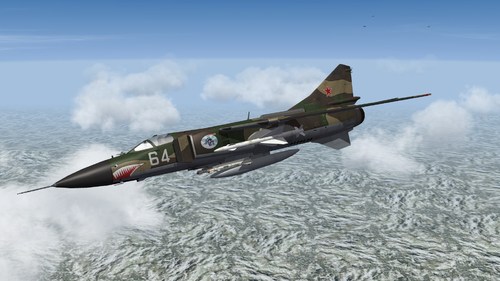 Great mod and a very immersive cockpit view.
 -
Slightly OT but I've just finished reading the Robert Jackson book on the F-86 and probably my favourite chapter was the one covering the PAF's use of the F-86 in 1965 and 1971. Respect.
-
Northrop Talon T.2 - No.79 Squadron, RAF
-
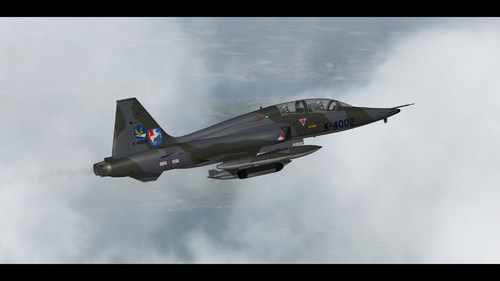 Top notch.
 -
Regarding the gun muzzle area I guess that's real 'rhinoplasty' Great work!
-
Great work paulopanz!
-
Helwan Ha-2000 'Khopesh' - 76th Squadron, 222nd Tactical Fighter Brigade, Egyptian Air Force, 2002 The abandonment of the Helwan HA-300 single-seat jet fighter in 1969 seemed to have brought an end any hope of Egypt fielding an indigenous combat aircraft but in the aftermath of the short 1977 Libyan-Egyptian War the Egyptian Air Force issued a requirement for a single-seat multi-role fighter to replace the Su-7's and MiG-21's and also supplement the newly introduced MiG-23's. The Camp David Accords of 1978 saw a sudden lurch in Egyptian foreign policy towards the West and away from Egypt's Arab backers including Saudi Arabia who abruptly cancelled it's previous agreement to purchase a batch of 50 Northrop F-5E's and transfer them to Egypt. Whilst the US State Department had agreed to supply Egypt with 35 ex-USAF F-4E Phantom's (under the project name of Peace Pharaoh) Egypt's President Anwar Sadat was anxious not to become totally reliant upon one political block and authorised several project studies for indigenous weapons for the Egyptian Armed Forces including a new main battle tank and a new single-seat multi-role fighter. The German engineers who had assisted the Egyptian General Aero Organisation in the design and production of the Helwan HA-300 had gone back to Messerschmitt-Bölkow-Blohm (MBB) in Ottobrun in 1969 and had continued to work on various project studies including the TKF-90 single-seat delta wing twin-jet fighter aircraft being developed for the Luftwaffe. However, this could be seen as being slightly too big and also too expensive for Egypt's requirements so MBB assembled a new project design team led by Günter Ludwig Bölkow tasked with designing a small multi-role lightweight fighter for the Egyptian Air Force with a planned in-service date of 1990. Bölkow's team produced the innovative ECA90 (Egyptian Combat Aircraft for 1990 a small, single-engined design with a delta-wing having 50 degrees of sweepback at the wing root leading edge but with 63 degrees of sweepback on the outer wing leading edge providing better high-alpha performance characteristics than conventional wing designs. MBB needed to look no further than the excellent Turbo-Union RB199 afterburning turbofan that was ideally sized for the ECA90 and had been running since 1972 under the test Vulcan bomber and had accummulated plenty of flight hours in the Panavia Tornado test programme. By early 1981 the ECA90 design had met with the approval of the Egyptian Air Force and at the insistence of President Anwar Sedat the design was re-designated as the Helwan HA-2000 'Khopesh' with orders placed with the Helwan Aircraft Factory (a division of the Egyptian General Aero Organisation) for 90 aircraft. The assassination of President Anwar Sedat in October 1981 might have created a hiatus in the HA-2000 programme but incoming President Hosni Mubarak was previously a career officer in the Egyptian Air Force (indeed, a former air chief marshal) and was a keen supporter of the HA-2000 programme. Whilst Mubarak's support for the programme was solid he did allow for a slight stretching out of the programme calling for a first flight in March 1987 and a service entry date of April 1992. Mubarak considered that this would give the Helwan Aircraft Factory sufficient time to better marshal it's industrial resources, recruit personnel, create infrastructure and understand which advanced technologies could be developed locally and which advanced technologies would need to be imported. Undoubtedly, the MBB team imbedded into Helwan's Factory 36 facility helped smooth out any difficulties and Helwan and MBB worked miracles to meet the prototype first flight deadline but some slippage crept in to the flight test programme to delay the entry into service. The HA-2000 'Khopesh' entered service with the 76th Squadron of the 222nd Tactical Fighter Brigade based at Cairo-West Air Base in May 1993 and eventually equipped six tactical fighter brigades and also the 'Silver Stars' aerobatic team who performed a flypast at the funeral service of former President Hosni Mubarak in late February 2020. 3D Model: Ale Ducat Skin Credit: Torno (Banidos Team) Decals.ini attached Decals.ini
-
- 11
-
-
 Belated thanks for this one!
 -
Into Action
-
Egyptian Fishbed-J's
-
Hawker Hunter F.6B - No.74 (Reserve) Squadron, RAF Strike Command, 1979
-
Israel Aircraft Industries 'Yeger' - Hunter Aggressor Flight, Israeli Air Force In the aftermath of the 1973 Yom Kippur War the Israeli Air Force examined it's aircraft losses (officially 102 aircraft but considered by many to have been higher) and in very much the same way as the USAF and USN had done they decided to embark upon an improved air combat training programme. In early 1974 four unmarked Hawker Hunter fighters in standard RAF camo arrived at Be'er Sheva Airfield where the Israeli Air Force had constructed a small temporary hangar adjacent to the Israel Aircraft Industries facility at Be'er Sheva. Whilst the UK Government consistently denied the supply of the four Hunter aircraft it would later be revealed that the aircraft were drawn from the Hunter wing at RAF Wittering and flown by civilian contractor pilots normally attached to BAC. The Hunter aircraft were quickly refurbished to emerge as the IAI 'Yeger' (Hunter) and equipped the Israeli Air Force's Hunter Aggressor Flight based at the nearby Hatzerim Airbase providing dissimilar air combat training for the Israeli Air Force. In 1976 the Hunter Aggressor Flight was boosted by the arrival of two ex-Kuwaiti Hunter FGA.57's and operated the type until 1991 when the unit disbanded.
-
IAI 'Yeger' - Hunter Aggressor Flight, Israeli Air Force, 1982
-
Mikoyan-Gurevich MiG-15 'Fagot-A' - No. 921 Fighter Regiment, Vietnamese People's Air Force, 1958 Skin Credit: paulopanz
- 1 reply
-
- 4
-