


MigBuster
-
Posts
9,165 -
Joined
-
Last visited
-
Days Won
27
Content Type
Profiles
Forums
Gallery
Downloads
Store
Everything posted by MigBuster
-
Lt. Col. Fred "Spanky" Clifton is one of the most experienced aggressor pilots ever, having flown the F-15, F-5, F-16 and the notorious MiG-29. He's been in dogfights with pretty much every fighter out there and he's an instructor at the prestigious Fighter Weapons School. Now he's here to share his expertise with you. http://foxtrotalpha.jalopnik.com/how-to-win-in-a-dogfight-stories-from-a-pilot-who-flew-1682723379
-
That is the reworked Launchvipers by JANHAS - I haven't seen any new model releases regarding the F-16 he was working on
-
https://www.youtube.com/watch?x-yt-cl=85114404&v=6-w9B2uWCg4&x-yt-ts=1422579428
-
- 1
-

-
Any use? .................................................................. I want to share my X52 Pro profile for BMS 4.3x with the community. My idea for this profile was to try to make a copy of the real F16 flightcontrols, and also consider what would work when considering the BMS simulator in general. The result is what you can see in the picture, a semi real, semi clean profile, which only uses 1 mode and 1 shift state. I think you will not drown in too much buttons with this one , but you DO have the room to add two more modes and shift states if you prefer. Just use it as you see fit! Another plus is that my profile solves commonly reported bugs with certain functions too, by programming functions a little differently. Installation: Download the package (.rar) here: http://bit.ly/scubyflying Import the .pr0 file into your Saitek SST software. Import the .key file into BMS. In BMS Setup, select your X52 Pro flightstick. In BMS Setup, set your throttle Afterburner detent. In BMS Setup, under advanced controls, make sure you setup the following axis, rotaries and slider: -Rudder = z rotation -Throttle = z axis -Pitch axis = y axis -Roll axis = x axis -Radar Antenna Elevation = x rotation -Range Knob = y rotation (check box REVERSED!). If some of your rotaries behave are a little switchy, go into you SST software, find the rotaries and set a tiny deadzone for them. *screenshots are added in the download to help with the above steps. Recommended Shared keys to setup: -Teamspeak Whisper = HOME (using HOME solves simultaneous key conflicts in BMS) -Teamspeak Push-to-talk = SCROLL LOCK (using SCROLL LOCK solves simultaneous key conflicts in BMS) -VAC TOGGLE = NUMPAD - (if applicable, set this key in your DWVAC software and set the "Arm" activation option) -TrackIR Center = NUMPAD + (set this key in your TrackIR software) -Teamspeak Mute = PAUSE BREAK (using PAUSE BREAK solves simultaneous key conflicts in BMS). Remarks: > This X52 Pro Profile is intended for TrackIR users -------------------------- > My profile relies on usage of the Missle override mode and Dogfight override mode for AA engagements! However, the AA Mode/WPN button is still there on the flightstick for who is not comfortable with override modes (and using the MSL step button to switch between AA weapons). Second reason is that it might feel consistent for you too, when also having AG Mode/WPN and NAV Mode under your thumb. I never use the AAMode/WPN button. -------------------------- > I have chosen to compromise the CMS, by only using CMS Up in conjunction with EWS PGRM +/- to cycle through my personal four pre-defined chaff/flare programs. By doing so, always set the EWS Mode Selector Switch to "Manual" (MAN) mode during your ramp start or flight. -------------------------- > I did not setup "shifted buttons" for where UHF and VHF are programmed (Up and Down), because on many occasions you might want to UHF'ing or VHF'ing simultaneously when shifting another button. Though, Left and Right in shift state are setup to Voice Commands toggle (VAC) and TrackIR re-centering. -------------------------- > The "S1 Press: Right OSB#1" is intended to be used to switch HSD topview when HSD page is active on the right MFD. Also only in AG Mode it is intended to quickly switch to guns when SMS page is active on the right MFD. Thus, make sure you have programmed the HSD and SMS page to the Right MFD and especially the SMS page to the right MFD in AG Mode! The HSD or SMS page need to made active on the right MFD before using the OSB#1 button: use your DMS Right button to cycle through the pages on the right MFD until HSD or SMS is displayed. -------------------------- > Especially during "wheel braking" release trigger first, and then the shift button. If you release shift first, it will keep braking until you press shift again. This unfortunately is a hardware limitation of the X52. Same applies for trimming in flight. -------------------------- > If you also assigned the HOME and SCROLL LOCK keys for Whisper/PTT in Teamspeak, don't forget the following option in Teamspeak: under Options, Hotkeys, find and set "Keyboard & Mouse Only" in the bottom right dropdown menu. This option will circumvent any joystick button issues when Teamspeak is used! -------------------------- > If you also assigned the HOME and SCROLL LOCK keys for Whisper/PTT in Teamspeak, don't forget to mute Teamspeak if you plan to fly with IVC! Use your keyboard for that, because the PAUSE BREAK key is not part of your X52 Pro Profile. Scub
-
Depends on the type of stick I use CH equipment and create profiles and map each button using DX assignments via CH Manager which I then get to load on Windows startup. There are other ways of doing it
-
Thats a better example than calculating Calibrated airspeeds! ~636 Kts Indicated as the second screenshot
-
At Sea Level 750 Kts IAS = ~750Kts TAS (M1.13) At 35,000 ft 750 Kts IAS = ~1067Kts TAS (M1.85) With no stores or pylons? In level flight (not the best way) a clean F-104A with GE-3 engine takes 4+ minutes to go from M0.9 to M2.0 at 35,000 ft as an example.
-
Which aircraft ??? - it probably already does go that speed but you are not reading the speed correctly The ingame speed is usually in Indicated Airspeed in Knots for example at 35,000ft 1300 kts (True Airspeed) = 971 kts (Indicated Airspeed ) or M2.25
-
SF2 Israel- campaign ends with one Death?
MigBuster replied to kenportner's topic in General Discussion
See the answers in your other thread http://combatace.com/topic/85254-campaign-ends-after-one-deathloss/ -
Which particular aircraft does 2500kts in real life? at 35000 ft 2500KTAS = Mach 4.34!!
-
Cure for Cancer (more simple than we thought?)
MigBuster replied to UK_Widowmaker's topic in The Pub
They did - but we keep being told that due to widespread use of antibiotics they are not as effective as they once were. Still if they can remedy Cancer that's a good thing -
https://www.youtube.com/watch?v=hZm_uNacqe0
-
Absolute Ceilings for the Century Series Fighters
MigBuster replied to hawker111's topic in General Discussion
Also some info here on the GE-19 F-104 http://www.916-starfighter.de/Zipping%20at%20FL%20730.htm -
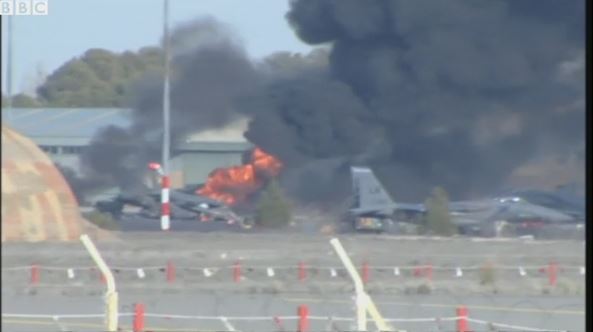
10 + dead - looks bad - RIP http://www.bbc.co.uk/news/world-europe-30990332 http://www.f-16.net/f-16-news-article4919.html
-
What Enemy Skill Level setting do most play at?
MigBuster replied to Dillon's topic in General Discussion
I think that applies to single missions - in a campaign the VPAF have noticeably poorly trained pilots on the top settings - this is defined by the experience and morale of the squadron I believe. Your wingmen do also improve if you keep them alive long enough to get their stats up. -
Portugese P-3 Orion gets intercepted by Su-27 https://www.youtube.com/watch?v=X_cVp-xZXg0
-
Ramp space was limited in late September 2014 at an undisclosed operating base in Southwest Asia as the F-15E Strike Eagle and F-22 squadrons located there prepared to change out. In fact, group and wing leaders at the undisclosed base had "asked and received permission" to let the F-22s head home to the 1st Fighter Wing at JB Langley-Eustis, Va., a week early to help ease the congestion on the ramp. The aircraft were configured for the long trip, complete with two extra fuel tanks, the normal configuration to fly across the ocean, when word came from the combined air operations center that the jets were needed for combat. Maintenance immediately got to work, and within 24 hours airmen had downloaded and reconfigured the Raptors with two 1,000-pound Joint Direct Attack Munitions and everything else the pilots might need to face either an air-to-air or surface-to-air threat. Up until that point, no one expected the F-22 unit, which was in the Middle East for strategic deterrence and as a safeguard for possible contingency operations, would make its combat debut against ISIS. The brutal-but-primitive terrorist organization lacked an air force for the predominantly air-to-air Raptor to destroy. "It was awesome to see them work and get the jets reconfigured, and then we kind of sat in that mode, not sure if we were going to execute or not," one of the pilots involved in the operation told Air Force Magazine. The unit received notice a day or two later that the operation would take place late on Sept. 22 through the early morning hours of Sept. 23 local time, he said. The F-22 was part of the initial US-led air campaign against ISIS in Syria, which was conducted in three waves. The US did not know, at first, what Syria's response would be to the presence of American combat aircraft in its airspace. Although ISIS lacks an air force, the Syrians certainly have one—and a fairly advanced integrated air defense system as well. The USAF crews started doing some generic planning, mapping out the closest airfields and coming up with a basic fuel plan, but the real planning couldn't begin until the airmen received their targets about 24 hours before takeoff. They were tasked with hitting an ISIS command and control facility about 50 miles from Aleppo. There is a "joint team that looks at those targets and then says what's going to be the best resources to put against that target," said Maj. Gen. Jeffrey L. Harrigian, assistant deputy chief of staff for operations, plans, and requirements on the Air Staff. It made sense to use the F-22s "in the areas where they're concerned about being highly defended, and originally, the first couple nights that was a concern until we understood how the Syrian integrated air defenses would work." Although the F-22, as a platform, didn't have any combat experience, the crews "had been preparing since Day One," said the pilot, who asked not to be identified because of security concerns. Early in the deployment, the F-22s trained with the F-15E Strike Eagles based in the area, until President Obama authorized the use of force against ISIS in Iraq in early August and the Strike Eagles' operational tempo significantly ramped up. Heating Up "They were busy all through August and in to September, so [the F-22 unit] stopped participating. We were doing a lot of training with them prior to this time and we basically were on our own at that point, doing our own training in-house with the limited number of aircraft we had," added the pilot. The aircrews also had spent some six months leading up to the initial air campaign studying Syria's surface-to-air missiles and aircraft. "We would try to generate all of our scenarios around those specific mission sets. … A lot of our training when we got in theater was focused specifically on countries we were concerned with: Iran and Syria," he said. Around June or July, "as things started heating up," the F-22s also shifted from a daytime training schedule to a night flying schedule. "We weren't sure what would happen, [and] it made sense for us to at least start preparing," said the pilot. The F-22s were one of three cells scheduled to launch around 9 p.m. Eastern Standard Time Sept. 22. The lead group included F-15Es, the second group consisted of partner aircraft, and the third included the Raptors, all from an undisclosed base in the region. Each cell was made up of four fighters and a tanker, said the pilot. Anticipation was high and everyone wanted to be part of the historic event. "The weapons folks don't often get a chance to load live munitions on the F-22, so those guys were out there, very excited," said the pilot. "We had four weapons crews total and three of the four were out there on the line. All of them wanted to be out there." There was supposed to be a five-minute separation between each of the cells, but the first F-15E had an engine malfunction on takeoff and had to execute a high-speed abort that ended up closing the runway for about 20 minutes, said the pilot. "It's a 1,200-mile drive to get from where we were to the target. It took a little over two hours to drive direct … to the target area and we had planned about 30 minutes of slop to allow for contingencies and various other things," he said. "So we lost almost all of that [flexibility] on the ground before we even got airborne. … That was our biggest challenge out the door on the F-22 side, being the back end of the train as the front end is starting to have problems." At that point, the flight plan was still on track, but the time line was compressed. Everybody was rushed to make up time and that caused some problems for air traffic control, which was trying to deconflict the aircraft and reconnect the three cells of fighters with the tankers. The F-22s were held low and slow, delaying the mission another four to six minutes. Once the Raptors climbed to their cruising altitude of 28,000 feet, they were met with another challenge: The winds were "significantly higher" than they had expected, said the pilot. "We had been flying there for six months and there had been virtually no wind at altitude the entire six months, then once we got to altitude the winds were about 60 to 80 knots [70 to 92 mph], which is not a big deal for short distances, but when you are flying 1,200 miles and you've got a two-hour drive, that creates a significant difference in your flight plan route." The unexpected wind speeds added another five or 10 minutes, making it more challenging to meet the planned time on target. Avoiding an "incident" "To make matters worse," Iraqi air traffic controllers "started vectoring us toward Iran instead of toward Syria," said the pilot, who said the Iraqis were not organized to deal with that many aircraft simultaneously operating in their airspace. The US pilots had to figure out a way to meet the mission objectives without causing an international incident by blatantly ignoring host nation directives. "Fortunately, we managed to get going in the direction I needed to go and I didn't need to ignore their direction. It just took another minute here, another minute there, but it's all cumulative, and it all adds up, and it all gets us much further behind than what we can afford," he said. The original plan was for the F-22s to fly toward the northern "two-thirds" of Iraq where they would hit an air-refueling track, then flow in to the west and hold on the western border of Syria. However, once they passed Baghdad it became clear that wasn't going to work. "Even going direct [to the target], I wasn't going to make it unless I started going much, much faster," said the pilot. The four-ship of F-22s got as much fuel as possible from a KC-10 circling midway through Iraq, then peeled off and started to climb directly toward the target area. About 200 miles from the Syrian border, the F-22s went to afterburner, accelerating to Mach 1.5, and started the climb up to 40,000 feet—the intended cruising altitude for the 15-minute flight into Syria. "We were pulling the power back to try to keep the jet from accelerating past 1.5 because 1.5 was actually the sweet spot for us to hit the time on target exactly on time," said the pilot. The CAOC did not want the F-22s to get there early. Although it was not "overly crucial" for all three cells to simultaneously hit their targets, that was definitely the "desired impact," the pilot said. Despite all the delays early on, things were starting to come together. The timing was actually looking good and the F-22s had enough fuel to strike the target and get out of Syria before they had to hit up another tanker. The plan was for two Raptors to go in and take out a command and control center while the second two provided air cover. All four were configured the same way and could switch roles if necessary. "My two-ship was the first in the country and the farthest into the country at that point. We were the leading edge, making sure there was no air threat for the follow-on package," said the pilot. "Then my three and four would follow up in that max-range airspeed … and they would hang out as long as possible to ensure we have actors on station in case Syria launched any airplanes." With the F-22's advanced integrated avionics, the pilots had "very good situational awareness" and "we were not ever worried about being attacked [by] the Syrians," said the pilot. "It was obvious when we got about halfway through Syria that [their air force was] not going to respond to us," the pilot said. He "wasn't convinced" that air defenses would stay dark, though, until the mission aircraft actually got to the target area and didn't see any air or surface threat become active. Despite Syria's passive defenses, the F-22 pilots kept their guard up throughout the entire operation, keeping an eye out for threats not only to themselves, but also to the F-15Es, F-16s, and B-1s operating nearby. Around 4 a.m. local time, within five seconds of the desired time-on-target, the JDAMS hit the target, an impressive feat given the distance and repeated delays the F-22s encountered. During a Sept. 23 briefing at the Pentagon, Army Lt. Gen. William C. Mayville Jr., director of operations on the Joint Staff, showed before and after pictures of the command and control facility. He noted that the GPS guided munitions hit only the right side of the building, where the command center was located. That area was completely destroyed. In a Sept. 25 press conference, Pentagon spokesman Rear Adm. John Kirby said the F-22s did "very, very well the other night, very well." Raptor Eyes on Site Adrenaline was still running high as the first two F-22s quickly left Syria and headed to a tanker to fill up. The third and fourth F-22s stayed on station for about 60 minutes and continued to provide offensive counterair for the remainder of the strikes. The assumption was that because of the long drive back to the tanker, the first two Raptors would top off just before the third and fourth F-22s would start running out of fuel and had to head to the tanker themselves. That way there were always Raptor eyes on site, said the pilot. "It was a relatively uneventful night. We saw a lot of flashes with [night vision goggles] as the bombs were going off in various target areas, but we didn't see a whole lot of action from Syria or their ground forces," said the pilot. "It looked like the vast majority of the action was coming from the coalition bombs." With the sun just starting to rise in the east, the Raptors had successfully made it out of Syria and Iraq and were heading back toward the Persian Gulf when they got a call from an AWACS saying the CAOC needed them to turn around. Although they didn't immediately know why, a B-1 needed an escort as it went in for a reattack, but at this point the F-22s had just enough fuel to get back to their home station. The tankers they had launched with were in the same boat. "Gas is always my biggest concern. We had looked at the fuel plan early on and we knew that there was extra gas available for contingencies, but we were completely off the script now … so I had no idea where the tankers were," he said. They quickly determined that only two F-22s were needed for the B-1 escort follow-on mission, so the third and fourth jets headed back without the tanker. The remaining two pilots started running through a list of nearby airfields in case they had to divert. Though there were plenty to choose from, there weren't many where the pilots felt comfortable landing an F-22, given the security concerns associated with the aircraft. "A lot of that is going through my mind as we turn north, not really knowing where to go, knowing that I have to support the mission, … but then may very well be going to a divert someplace where I don't want to go," he said. After flying north for about 10 minutes, the AWACS controller informed the pilots there was a KC-135 "over on the Iranian border" with enough fuel for them to top off. It wasn't until they got to the tanker that the two pilots learned the details of their new mission: Escort a B-1 to the western side of Syria so it can reattack some targets missed during the initial bombing campaign. The new target was the farthest point west so far for the pilot. The first of the initial air campaign's three waves was mostly unmanned and included more than 40 Tomahawk Land Attack Missiles fired collectively from USS Arleigh Burke and USS Philippine Sea, striking targets in the vicinity of Aleppo. The F-22s participated in the second wave along with F-15Es, B-1s, and F-16s, striking ISIS headquarters, "training camps, barracks, and combat vehicles," said Mayville in September. Carrier-based aircraft from the Persian Gulf and partner F-16s made up the third wave and focused on "targets in eastern Syria, to include [iSIS] training camps and combat vehicles" in the area around Dayr az-Zawr," stated Mayville. By the time the F-22s left the KC-135 along the Iranian border, the third wave was just kicking off, said the pilot. Deconfliction was not a problem for the F-22s, which were operating solely in an air-to-air capacity now, because they could climb higher than the other aircraft, but the B-1 had to worry about the other aircraft taking off. The Raptors provided air coverage for the B-1 for another 30 to 45 minutes before refueling for a third time and then heading home. "There was a lot going on in the mission, a lot to deal with, a lot of changes and contingencies that I didn't have to deal with in my previous combat experience, as limited as it was," said the pilot, who previously flew F-15s. "It was a great experience all in all." As of Dec. 10, 2014, F-22s had flown less than 100 total combat sorties from their undisclosed operating base, including about a dozen strikes in which multiple weapons were employed, said Air Forces Central Command spokesman Lt. Col. Edward T. Sholtis. Though it took nearly a decade for the fifth generation aircraft to see combat, the pilot said he doesn't think the Air Force will suddenly start using the aircraft more freely. The fact is the Raptor is still intended primarily to respond to threats in the air, not on the ground. "I don't think it's going to change the perspective. When there is a threat that requires the F-22, whether it's an air threat or a surface-to-air missile threat, they will continue to use it. That's my guess," he said. "I don't think it will be as big of a deal [next time it participates in a contingency], but I don't think that means we're just going to start using F-22s for any mission, and I think that's held true in the time since I left." http://www.airforcemag.com/MagazineArchive/Pages/2015/February%202015/With-the-Raptors-Over-Syria.aspx
-
Cool - will be interesting to see the initial reviews
-
-
The required A-G avionics code will come with the FA-18C - it is mentioned in the new video from Froogle/Matt Wagner Building the DCS terrains appears to be a colossal job - and any pay ones would likely take years. It's good that effort to put infrastructure in for multiple years is being considered - dodging SA-18s in a P-51 is not my thing I'm sure I have seen a post from Skate stating he doesn't have the time to finish the F-100 - would need to find it. The guy that did the BMS flight model has offered to help do a DCS flight model - but didn't sound like that went well. This has been discussed on the BMS forums - the underpinning implementation is so vastly different its not a simple case of porting anything and they are committed to improving F4. The pay campaigns is a good idea - I would buy all for the A-10C - but yeah probably might not buy any trainers myself.


