

stephenmcparlin
-
Posts
35 -
Joined
-
Last visited
Content Type
Profiles
Forums
Gallery
Downloads
Store
Everything posted by stephenmcparlin
-
A good match for the Hunter in A-A?
stephenmcparlin replied to Stratos's topic in Mission & Campaign Building Discussion
The Hunter mixes good lethality with excellent handling and a high thrust/weight ratio. From the Mk 6 onwards it has twice as much installed thrust as a J47-powered Sabre, and still significantly more than the Canadian or Australian Sabres, both of which would have been re-engined. It always lacked internal fuel though, and while most export customers (starting with the Dutch) fitted them with AIM-9s, this was never a standard fit on RAF aircraft. Given that Hunters would have been used in RAF service for air defence long into the 1980s, the retrofit of AIM-9 onto Harrier GR3s that happened in the Falklands would probably have happened to the remaining Mks 6 and 9 in the same time frame. UK fit would probably have wound up being AIM-9B or -9G on the outboard wing pylon, as was the fit on TWU Hawks in the same period. Hawk T Mk 1 vs. Hunter would be an interesting fight. In terms of direct comparison, the Hunter would try to get a supersonic opponent into a turning flght. Woe betide the F-104 or Mirage III pilot who gets slow with a Hunter. The F-100 is an interesting comparator, because, despite nominally supersonic performance, the F-100 has lousy handling characteristics. If you want a contemporary supersonic aircraft that can turn at high subsonic,you have to look at the MiG-19 or, even better, the F-8 Crusader. Other interesting options include the A-4 Skyhawk or even the Gnat or Ajeet, both of which are very agile, but lack firepower. The MiG-17 is probably the most realistic opponent though, and a decent direct match. -
Sea Fury crash landing on Thursday
stephenmcparlin replied to MigBuster's topic in Military and General Aviation
The pilot for the aircraft is Lt Cdr Chris Gotke RN. He's one of the test pilots at Boscombe Down and flies Warbirds on behalf of the Senior Service at weekends. He gained a Queen's Commendation a few years back for a dead-stick landing in the Hawker Sea Hawk after an engine failure. He brought the Sea Hawk down to a perfect landing from a glide, with just the electricity from the ram--air turbine to keep the flight controls going. Quite a pilot, and a very decent chap. Steve -
I'm having issues trying to get the installation to work. I've unpacked and edited the .INI files into /objects and /flight, as suggested, but the new SAM systems are not appearing as ground objects options in the menus. I'm specifically trying to build a scenario for UK Air Defence Region during the Cuban Missile Crisis. In addition to the early model Lightning interceptors, with some residual Hunter and Javelin units protecting the V-bomber bases, there were also Bloodhound SAM systems providing some coverage over the critical areas of the Bomber Command bases. I'd like to try and factor these into the set-up. So far, no luck. Thanks, Steve Found the problem: the red_objects, blue_objects directories were not located correctly in my setup. Now sorted...
-
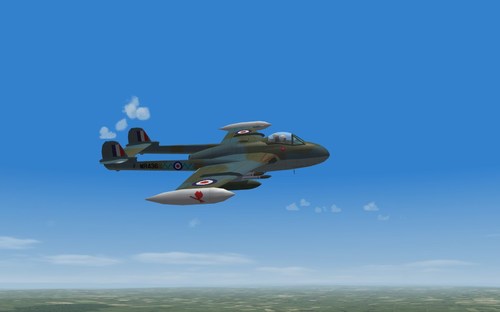 I thoroughly enjoyed this model. The aircraft is significantly stable and well-damped about all axes, particularly in roll, which makes tracking targets relatively easy. The engine spools up rapidly, but it is a little underpowered relative to opposing MiG-17s. Mind you, you have lower wing loading and can make mincemeat of them if they decide to try and turn with you. Staying down at low level improves your chances of survival (and the Venom was used extensively in 2ATAF and during Suez as a tactical fighter-bomber, having better range and payload carrying performance than either the Hunters that succeeded it or the contemporary Canadair Sabres. Worth using in any of the 1956 campaigns, when they made up the mainstream of the RAFG attack wings.
 -
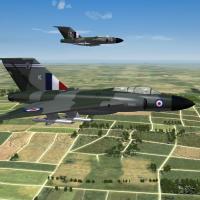 Javelin was an interesting aircraft, having virtually every nasty transonic handling problem known to man, and some invented especially for this aircraft The Mk. 7 was the first with acceptable handling characteristics, largely due to the introduction of a little leading edge camber (a modification inspired by earlier work on the Vulcan). My favourite design faux pas had to be the addition of reheated engines. Because of the relatively bluff base of the fuselage, using reheat generated a throttle-dependent drag increment higher than the additional net thrust. Hence, using reheat at high speed causes the aircraft to *decelerate*, while kicking out extra noise and more than doubling fuel consumption... As a "what-if", bringing the DH 110 into RAF service earlier, as would have happened if Hatfield hadn't had their hands full with the Comet, is an interesting scenario. If effort had been available, the Venom and Javelin would never have been developed, and the DH. 110 would have been entering service in parallel with the Hunter and Swift, probably suffering from the same engine issues as the former. An RAF DH. 110 with dry Sapphires and 4 Aden cannon appearing in service circa 1954 would be a *very* interesting scenario, particularly if the Avon 200 series engines were retrofitted in a timescale comparable with the Hunter F Mk. 6.
 -
SF2 Series Air To Ground Combat School
stephenmcparlin replied to Flanker562's topic in General Discussion
I've been running through some of the stock strike scenarios in SF2NA, where the target set usually consists of a Kiev-class carrier, two air defence destroyers and two Krivak-class ASW frigates. The primary threat systems are SA-N-1 Goa and SA-N-4 Gecko, the latter being particularly effective. The standard strike aircraft available is the A-7E. The default loadout includes Mk 23 Walleye II bombs as the main weapons system. Varying the loadout to include AGM-45 and AGM-78 makes a big difference to strike package survivability. Taking out the platforms with SA-N-1 enables the use of Walleye from altitude and distance, avoiding the SA-N-4 threat. With smaller packages, you do not have enough ARMs to take out all of the escorts first, so a mix of AGM-45 and Mk 82 Snakeyes, delivered from *very* low altitude appear to be reasonably effective. Using CCIP and dumb bombs from altitude does not work, as the targets are steaming at approx. 30 Kts. Using non-standard pieces of kit can help. Loading up the F-4J with Walleye II and delivering weapons from 20k+ altitude and M>0.90 seems to be very effective. Using the F-4B or F-4N is limited by the lack of provision for ARMs and PGMs. One gripe though, when leading formations into attack, avoiding the SA-N-4 implies flying at < 500 ft and > 450 Kts. The AI aircraft seem to stay at 2000ft and slow, thus becoming easy targets for all of the targets in the formation. Not sure how to get AI aircraft to follow down to the deck and stay there... -
The original Top Gun syllabus was heavily influenced by exchange officers from the Royal Navy, who were at that time transitioning from a fleet of Sea Vixens to the F-4K. The original RN equivalent was the Air Warfare Instructor (AWI) qualification, for which flight commanders would routinely be selected for rotation before assuming a role as a senior squadron pilot. The AWI course would involve DACT against a variety of threat aircraft operated by RN or Contract pilots. The typical threat aircraft would be represented by a Hunter GA.11 (not far off the MiG-17 in flight performance), while supersonic threats could be represented by RAF Lightning units, which were typically more capable than the then MiG-21 threat. It would be normal practice to have at least two and possibly three AWI-qualified crews on an F-4K squadron, although as the RN fleet wound down, there was a concentration of very senior experienced aircrew/. 892 NAS in 1978 would have been a very formidable set of men. http://www.telegraph.co.uk/news/obituaries/military-obituaries/naval-obituaries/8873213/Brigadier-General-Dick-Lord.html
-
One of my former colleagues at RAE Farnborough now works for Martin-Baker, who operate two Meteor T. Mk 7.5 aircraft (the front end is a T. 7, the back end is an F.8 tail assembly) for ejection seat trials. I have a standing invitation to come along and see them fly.
-
Capt Eric "Winkle" Brown RN was asked to sit in as an interpreter and interrogator for some of the most notorious SS captives, including Heinrich Himmler. It must have made a huge change from being a test pilot at RAE. Those of us who are lucky enough to have met Captain Brown realise that the expression on his face when he mentions them points at it being one of the most unpleasant duties he ever had to conduct while in the Senior Service. It barely makes a footnote in his career, but the disgust of professional military officers when confronted by what the SS were is memorable.
-
I've seen the Boscombe Down test pilots' reports on the F-101. Unrecoverable pitch-up and nose slice was one of the features of Voodoo handling that made life interesting. You *can* recover the real aircraft by popping the brake chute in the spin, providing the nose is pointing down and you have the option of a relight. The message: treat this aircraft very gently in the pitch axis, The F-104 is a little better, but still has comparable issues at low speeds.
-
F-86 Sabre Pack, Pakistani Air Force
stephenmcparlin replied to Wrench's topic in File Announcements
F-86 Pitch-up with slats retracted is a real issue. The slats made the aircraft handling acceptable at low speed but were unable to help with shock-induced pitch up at transonic manoeuvre conditions. The other major shortcoming of the J-47 powered Sabres was that they were significantly underpowered relative to the later Australian Avon-powered and Canadair Orenda-powered Sabres (An Avon Sabre has about 50% more thrust available than the US versions). Also, the basic US armament of .50" machine guns is pretty inadequate when compared to contemporary MiGs, or even Hispano-cannon armed Spitfires and Sea Furies (The latter were fairly successful against MiG-15s in Korea, whereas the F-86 had to get quite a lot of lead slugs into a MiG to kill it). It would be interesting to compare the F-86E against a Hunter Mk. 6, which has twice the installed thrust and much better firepower.