

Spinners
-
Posts
9,300 -
Joined
-
Last visited
-
Days Won
497
Content Type
Profiles
Forums
Gallery
Downloads
Store
Everything posted by Spinners
-
Vought F-8EB Crusader - Belgian Air Component
Spinners replied to Spinners's topic in Sci-Fi/Anime/What If Forum
-
Vought F-8EB Crusader - No.1 'Osprey' Squadron, Belgian Zeemacht, 1979
-
Vought F-8EB Crusader - Belgian Air Component
Spinners replied to Spinners's topic in Sci-Fi/Anime/What If Forum
Wrench, my dear boy. Please remember what sub-forum we're in -
Cool!
-
-
Great work Paul.
-
Dassault Super Etendard - Belgian Marine Component
-
Not all airplanes show up in single mission list
Spinners replied to DarthRevan's topic in General Discussion
The above should have got you up and running but, lower down the 'no show' troubleshooting hierachy is checking that there is a texture set in the skin folders. -
Sukhoi SU-35IQ Asifat al Turab (Sandstorm)
Spinners replied to ValAstur's topic in Sci-Fi/Anime/What If Forum
Love those fins Mario! -
Thankfully, the word 'proper' doesn't exist in this sub-forum
-
Such was the power and influence of First Sea Lord Earl Mountbatten that when the production order for the Buccaneer S.Mk2 was announced in January 1962 not only was his Royal Navy order for 80 aircraft intact but there was an unexpected RAF order for 100 aircraft as Canberra replacements for RAF Germany. This came as a blow to BAC who, despite no official announcement, knew that this meant the certain end of their outstanding TSR.2 programme although the axe wouldn't fall for another six months after an 'operational review'. The original Blackburn Aviation team continued with the design, development and production of the Royal Navy version whilst Hawker Siddeley were given full control of the RAF programme and some urgency was injected into the programme with the grounding of the Vickers Valiant in 1964 due to fatigue problems. At the time, the Valiant was an important component to the RAF's contribtion to SACEUR and, in his role as deputy head of Allied Command Europe, the RAF's former Chief of the Air Staff Sir Thomas Pike requested an additional order for 40 Buccaneer S.2's which was sanctioned soon afterwards. Hawker Siddeley worked flat out on the RAF Buccaneer programme and soon 'anti-flash' white Buccaneers were taking to the air with the first two squadrons to re-equip being No.100 and No.139 Squadrons at RAF Wittering who exchanged their Victor B.2's for Buccaneer S.2's in April 1967 in a move prompted by concerns of the Victor's suitability in the low-level strike role, the RAF's preference towards the Vulcan and the need for Victor B.2 airframes for conversion to tankers.
-
Blackburn Buccaneer S.2 - No.139 Squadron, RAF Strike Command, 1968
-
 Templates are as highly polished as the aircraft download. Thanks!
 -
Epic! BTW On the 82 model the vapour effect is missing from the right wing (not sure about the others versions/years) HasVortexEmitter=TRUE VortexEmitterName=FuselageVortexEmitterMod2 VortexPosition=-2.5,-0.60,0.30 VortexG=5.0
-
Dassault Sirocco FG.4 - No.6 Squadron, RAF Middle East Command, 1991
-
With the realisation that the future lay with his outstanding Mirage family of aircraft Marcel Dassault quickly lost interest in his earlier creations but was persuaded to offer a new 'attack' version of the Super Mystére for export. The Super Mystére B3 was powered by a Rolls-Royce Avon 200 series turbojet rated at 10,000lbs dry thrust and this engine replaced the thirsty afterburning Atar 101G-2 of the B2 but offered equal thrust and lower fuel consumption. Avionics were still primitive but the B3 introduced additional underwing pylons for bombs, rockets or missiles and the aircraft was a good platform for ground-attack. Dhimar became the first export customer for the B3 ordering 30 aircraft which were delivered in 1961 and the B3 was soon overshadowed by it's more glamorous delta-winged stablemate.
-
Tempest
-
Cool!
-
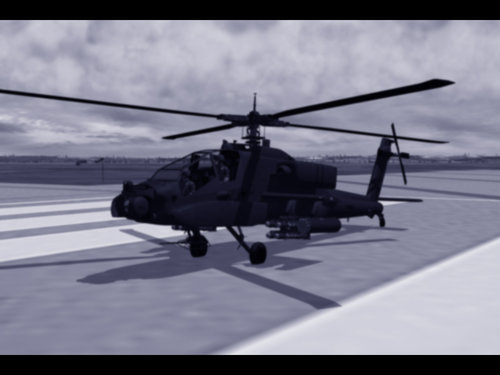 Shock and awe!
 -
Great work Dels - I am seriously impressed. Incredibly I took off and landed it on my first mission... and did a heap of damage on a convoy too!
-
Belgian Super Mystéres
-
There are a couple of methods and it depends on the complexity of the actual skin, the nature and extent of the details and whether the decal covers two or more colours (like on a camo scheme). When I started I used to crudely use the 'colour pick' tool and paint over the marking. This works brilliantly on a simple solid colour but less so on a skin that has a bit of 'noise' applied to it and it does obliterate details such as lines and rivets. But if you're then putting your chosen decal in the same place it doesn't work out too bad. More recently, I tend to copy a small part of the skin close to the offending marking (so that colours and shades are a good match) and simply paste it over - sometimes in one go and sometimes in smaller pieces. This looks much neater but, as mentioned, is very tricky where colours meet like on a camo scheme. Hope this is sufficient to get you started. Don't forget to make a copy but you can always 'undo' if you make a balls-up.
-
Hitting the heights....
-
That's great news Ed. Congratulations!
-
Loaded for action