

shredward
-
Posts
812 -
Joined
-
Last visited
Content Type
Profiles
Forums
Gallery
Downloads
Store
Everything posted by shredward
-
You will have to resort to what the real Pfalz pilots did. Can't remember who it was off the top of my head, I think it was Stark, counselled his pilots to only engage under certain conditions. What it boiled down to was, come in from on high, shoot, and keep on going. Stick around to fight, you're dead. Cheers, shredward
-
from the History Channel: April 2, 1917 Wilson Asks Congress for Declaration of War “The world must be made safe for democracy,” U.S. President Woodrow Wilson proclaims on this day in 1917, as he appears before Congress to ask for a declaration of war against Germany. Under Wilson, the former Princeton University president and governor of New Jersey who was voted into the White House in 1912, the United States had proclaimed its neutrality from the beginning of World War I in the summer of 1914. Even after the German sinking of the British passenger ship Lusitania in May 1915, which killed 1,201 people, including 128 Americans, caused a public outrage in the U.S. and prompted Wilson to send a strongly worded warning to Germany, the president was re-elected in 1916 on a platform of strict neutrality. Late that same year, Wilson even attempted to broker a peace between the Allies and the Central Powers, which was looked at favorably by Germany but eventually rejected by both France and Great Britain. The first months of 1917, however, brought new offenses by Germany against American interests at sea, namely the resumption of the German navy’s policy of unrestricted submarine warfare on February 1 and the sinking of the American cargo ship Housatonic two days later. An angry Wilson broke off diplomatic relations with Germany that same day. Meanwhile, British intelligence had decoded and informed the U.S. government of a secret message sent by the German foreign secretary, Arthur Zimmermann, to the German ambassador to Mexico. The so-called Zimmermann Telegram proposed a Mexican-German alliance in the case of war between the United States and Germany and promised Mexico financial and territorial rewards for its support. Wilson authorized the State Department to publish the text of the telegram; it appeared in America’s newspapers on March 1, provoking a great storm of anti-German sentiment among the U.S. population. With German submarine warfare continuing unabated, the final straw came on April 1, 1917, when the armed U.S. steamer Aztec was torpedoed near Brest and 28 of its crew members drowned. The next day, Wilson stepped before Congress to deliver his historic war message, making clear exactly how high he considered the stakes of the war to be. “It is a fearful thing to lead this great peaceful people into war, into the most terrible and disastrous of all wars, civilization itself seeming to be in the balance.” Despite the risks, Wilson felt the U.S. could not stand by any longer; in the face of continued German aggression, the nation had the moral obligation to step forward and fight for the principles upon which it had been founded. “We shall fight for the things which we have always carried nearest our hearts,” Wilson famously intoned, “for democracy, for the right of those who submit to authority to have a voice in their own governments, for the rights and liberties of small nations, for a universal dominion of right by such a concert of free peoples as shall bring peace and safety to all nations and make the world itself at last free.” In this speech, Wilson displayed the idealism and moral fervor that characterized his view of the rightful role of the U.S. in the world—a supremely self-righteous outlook that would earn him acclaim from many and criticism and derision from others during his lifetime and after his death (especially after his pet project at war’s end, the League of Nations, proved a failure). It was also an outlook that would, for better or worse, determine the direction of U.S. foreign policy for decades to come, up to and including the present day. On April 4, the U.S. Senate voted in favor of war by 82 votes to 6; two days later, the House of Representatives delivered their own yes vote by 373 votes to 50, formally announcing the entrance of the United States into the First World War.
-
Great historical source for german aviators
shredward replied to Creaghorn's topic in WOFF UE/PE - General Discussion
Leutnant Hans Jeschonnek Ja40s 22/4/18 > EoW Born 9 April 1899, Hohensalza. Entered military service 10 August 1914, as a Fähnrich in 3. Niederschlesisches Infanterie-Regiment Nr.50. Promoted Leutnant 26 September 1914. WiA 6 October 1915. Commenced pilot training at AFPs on 19 July 1917. Awarded EKI; Knight's Cross with Swords of the Royal Hohenzollern House Order. Ritterkreuz on 27 October 1939. Generaloberst in WWII on 1 March 1942; Luftwaffe Chief of Staff, from 1 Febuary 1939, until he committed suicide 19 August 1943. from Jasta Pilots, Franks, Bailey, Duiven -
Screen Shots, Videos, Media, OFF Posters
shredward replied to MK2's topic in WOFF UE/PE - General Discussion
Great shot Catfish! -
Not just early war - armament was a work in progress. I'd have to look it up, but one of the major German aces was put out of action when the ammo in his DVII cooked off. It was a serious hazard with the DVII - happened more than once. One often sees photos of them with their engine covers removed, or highly modified. Cheers, shredward
-
Standard loadout for the RFC was one tracer to three ball rounds. Individual pilots sometimes asked their armourers for other mixes, but 1 and 3 was the norm. We must be careful to distinguish between ammunition types - tracer was very different to incendiary, and then of course there was Buckingham, Pomeroy, Brock, and various AP rounds. If you want to explore the legal framework, niceties, and practice of their use, you could start here: http://www.theaerodrome.com/forum/other-ww...ary-ammo-2.html Cheers, shredward
-
A little Red Baron reminiscence
shredward replied to HomeBoy's topic in WOFF UE/PE - General Discussion
Now THAT was a trip down memory lane. We stand on the shoulders of giants. shredward -
Hi Guys, Tracer was first used before WW1 but suffered from the fact that as the phosphor burnt away the bullet became lighter and the trajectory departed from that of the normal rounds that it was mixed with. The "Woolwich Flaming Bullet" was introduced in 1914 but proved to be useless! The Ministry of Munitions developed a bullet known as the "Sparklet" (it was made in a soda syphon factory and Sparklet was a brand name of the inserts used in the syphons). The correct name for this tracer bullet was the SPK Mk VII-T. The SPK Mk VII-T, issued to the RFC in July 1916, contained a mixture of 1 part magnesium to 8 parts barium peroxide which gave a "clear bright light which can be clearly observed". The SPK Mk VII-G was an update on the T introduced in 1917. The magnesium burns with a clear bright white light - the barium leaves a smoking trail . Most RFC pilot literature describes tracer as white smoking trails. The above of course was the Allied effort. The Central Powers developed their own variants and the "LS" was in use by late 1916. LS stood for Leuchtspur - luminous tracing ammunition. An armour piercing tracer was introduced in early 1917, known as the PL - Panzer Leuchtspur. British tests showed this round to be almost as effective as a standard armour piercing round. With thanks to Mike Westrop and Harry Woodman - Early Aircraft Armament Cheers, shredward
-
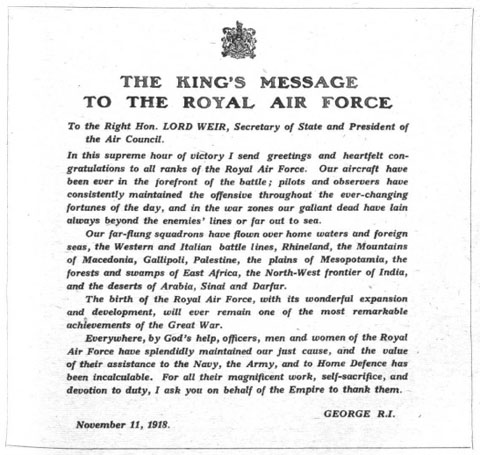
from the History Channel: April 1, 1918 Birth of the RAF On April 1, 1918, the Royal Air Force (RAF) is formed as an amalgamation of the Royal Flying Corps (RFC) and the Royal Naval Air Service (RNAS). The RAF took its place beside the Royal Navy and the British Army as a separate military service with its own ministry. In April 1911, eight years after the American brothers Wilbur and Orville Wright made the first-ever flight of a self-propelled, heavier-than-air aircraft, an air battalion of the British Army's Royal Engineers was formed at Larkhill in Wiltshire. The battalion consisted of aircraft, airship, balloon and man-carrying kite companies. In December 1911, the Royal Navy formed the Royal Naval Flying School at Eastchurch, Kent. The following May, both were absorbed into the newly created Royal Flying Corps, which established a new flying school at Upavon, Wiltshire, and formed new airplane squadrons. In July 1914 the specialized requirements of the Navy led to the creation of RNAS. Barely more than a month later, on August 4, Britain declared war on Germany and entered World War I. At the time, the RFC had 84 aircraft, while the RNAS had 71 aircraft and seven airships. Later that month, four RFC squadrons were deployed to France to support the British Expeditionary Force. During the next two years, Germany took the lead in aerial warfare with technologies like the Zeppelin airship and the synchronised machine gun. England's towns and cities subsequently endured many bombing raids which spread fear among the populace and loss of production in the factories. Repeated German air raids led British military planners to push for the creation of a separate air ministry, which would carry out strategic bombing against Germany. On April 1, 1918, as a result of these efforts, the RAF was formed, along with a female branch of the service, the Women's Royal Air Force (WRAF). By the war's end in November 1918, the RAF had dropped 5,500 tons of bombs and claimed 2,953 enemy aircraft destroyed, gaining clear air superiority along the Western Front and contributing to the Allied victory over Germany and the other Central Powers. It had also become the largest air force in the world at the time, with some 300,000 officers and airmen—plus 25,000 members of the WRAF—and more than 22,000 aircraft. Happy Birthday!!!
-
OT: My Great War Library
shredward replied to RAF_Louvert's topic in WOFF UE/PE - General Discussion
I'm gobsmacked!!! -
Hi Willy, There can be problems if your addresses don't match up - billing address, mailing address, email address, PayPal etc. Seems like everything has to be linear, or the Avangate protocol balks. It can make you crazy trying to straighten it out, but you will eventually. If that was any help... shred
-
New Campaign Suggestions
shredward replied to CaptSopwith's topic in WOFF UE/PE - General Discussion
Well, I'm a diehard Naval Ten guy, so you know they got the good stuff! Cheers, shredward -
Odd Jasta6 Aircraft Choices . .
shredward replied to Kamikaze's topic in WOFF UE/PE - General Discussion
Thanks Kamikaze, Well spotted. We are looking into it. Cheers, shredward -
I love some of the models they've got - chateaux for the chaps to live in, cathedrals for landmarks, ships of the Grand and High Seas Fleets - they've got some fun stuff going there! Cheers, shredward
-
Thanks Moritz! I'm scratching my head over this one. Thanks for noting it! We'll try and puzzle it out. Cheers, shredward
-
Correct your aim, or speak to your ground crew
-
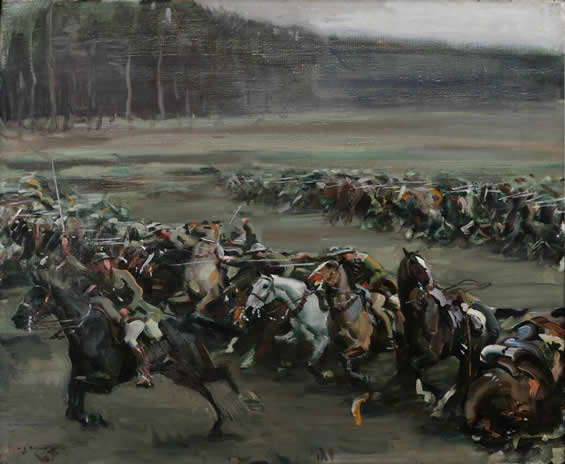
from Paul F. Wilson March 30, 1918 The Charge at Moreuil Wood Gordon Muriel Flowerdew served as an Lieutenant (Acting Captain) in "C" Squadron, Lord Strathcona's Horse, Canadian Cavalry Brigade. Born in Billingford, Norfolk, England, he emigrated to Canada in 1903 and settled in as a rancher in British Columbia where he joined the British Columbia Horse, a militia cavalry unit. When the war broke out he transferred to Lord Strathcona's Horse. Flowerdew was awarded his VC for action at the Bois de Moreuil (a.k.a. Moreuil Wood), southeast of Amiens, France, March 30, 1918, during the “Kaiserschlact,” the final, last-ditch series of major German offensives designed to break the Allied lines in Flanders, Picardy, and the Artois, and divide the French and British armies. A gap developed between the British 20th Division to the north and French forces to the south – the Bois de Moreuil was right in the middle of the gap, and Flowerdew’s unit was one of those assigned to take it and hold it. From his citation: "For most conspicuous bravery and dash when in command of a squadron detailed for special service of a very important nature. On reaching the first objective, Lt. Flowerdew saw two lines of the enemy, each about sixty strong, with machine guns in the centre and flanks, one line being about two hundred yards behind the other. Realising the critical nature of the operation and how much depended upon it, Lt. Flowerdew ordered a troop under Lt. Harvey, V.C. to dismount and carry out a special movement [to outflank the Germans still in the Wood] while he led the remaining three troops to the charge. The squadron (less one troop) passed over both lines, killing many of the enemy with the sword; and wheeling about galloped at them again. Although the squadron had then lost about 70 per cent of its numbers, killed and wounded, from rifle and machine gun fire directed on it from the front and both flanks, the enemy broke and retired. The survivors of the squadron then established themselves in a position where they were joined, after much hand-to-hand fighting, by Lt. Harvey's party. Lt. Flowerdew was dangerously wounded through both thighs during the operation, but continued to cheer on his men. There can be no doubt that this officer's great valour was the prime factor in the capture of the position." The action was one of very few during World War I where cavalry took an active part in successful operations. He died of wounds the next day at the 41st Casualty Clearing Station, Bois de Moreuil.
-
from the History Channel: March 30, 1918 Moreuil Wood On March 30, 1918, British, Australian and Canadian troops mount a successful counter-attack against the German offensive at Moreuil Wood, recapturing most of the area and forcing a turn in the tide of the battle in favor of the Allies. After launching the first stage of a major spring offensive on March 21, 1918--masterminded by Erich Ludendorff, chief of the German general staff--the German army swiftly pushed through the British 5th Army along the Somme, crossing the river on March 24. Their attacks were less successful to the north, however, around the crucially important Vimy Ridge, where Britain's 3rd Army successfully held its positions. Determined to push on toward Paris, Ludendorff threw his troops against the town of Amiens. To Ludendorff's distress, although they came within 11 miles of the city, the Germans had great difficulty capturing Amiens and its railway junction, which the British and French were told to hold at all costs. Lacking sufficient cavalry, the Germans also had problems delivering artillery and supplies to their front-line troops; those troops also received no relief, and were expected to sustain the momentum of the attack all on their own. By the morning of March 30, the Germans had occupied Moreuil Wood, some 20 kilometers south of Amiens. On that day, an Allied force including British and Canadian cavalry and air brigades confronted the Germans head-on. By the end of the day, the Allies had managed to halt the German advance at Moreuil Wood, despite suffering heavy casualties. The events at Moreuil Wood broke the momentum of the German attacks. While the operation had technically been successful, resulting in a gain of almost 40 miles of territory and inflicting heavy losses on the Allies; 177,739 British troops died or were taken prisoner during the battle, at a daily rate of 11,000 men, while the French lost nearly 80,000; German troops had also lost over a quarter of a million men to injury or death. The casualties included Ludendorff’s own stepson, a German pilot shot down over the battlefield during the attacks. Ludendorff called off the attacks on April 5; the next stage of the offensive would begin just four days later. By early April 1918, both the Allies and the Central Powers had entered a crucial period of reckoning. A major German victory on the Western Front would mean the end of the war, in their favor. As British Prime Minister David Lloyd George told the leaders of the British Dominions in a speech on March 31: “The last man may count.” The Allies, at least, could count on fresh infusions from the United States, which increased its troops in France to more than 300,000 by the end of that month. For their part, the Germans were prepared to wager everything they had on this spring offensive—the last they would undertake in World War I.
-
Best flying scenes from the 2008 Red Baron film ..
shredward replied to Wels's topic in WOFF UE/PE - General Discussion
Great Stuff! I sure hope it comes to the widescreen here. I like to think of myself as a student of history, and I could give a rat's ass whether this film is historically accurate. Those flying sequences are brilliant - they give you the pure adrenalin rush of whirling through the cloud canyons and columns of fire that were the mass dogfights of the Great War. And though we strive for complete historical accuracy in Over Flanders Fields, I hope that we also convey some of the flavour and the sizzle of what it was like to fly and fight in those first winged chariots of fire. Cheers, shredward -
The Glory and Tragedy of Hauptmann Gunter Mahlo
shredward replied to Olham's topic in WOFF UE/PE - General Discussion
Hubris. If he hadn't painted that aiming mark on his centre-section, he might still be alive. Rest in Pieces. -
We do have , in my extremely biased opinion, an amazing Great War flight sim. But, we are six friends, not a corporation with staff and budgets and marketing and all that other stuff. So, it is available online, cause it's easy, and we would rather devote our time and energy to doing what we are good at - building Over Flanders Fields. Cheers, shredward
-
I'm confused about Ace skins and have a question
shredward replied to MK2's topic in WOFF UE/PE - General Discussion
All of them. Cheers, shredward -
I'm confused about Ace skins and have a question
shredward replied to MK2's topic in WOFF UE/PE - General Discussion
There are about 3200 skins in the current version. I haven't counted, but I would guess that about one tenth of them are unit skins. The rest are all individual aces. Cheers, shredward -
Royal Engineers. Wartime necessity whot!
-
Xavier Jouve has just done his AceKill list for OFF, should be available soon! Cheers, shredward