

Fubar512
-
Posts
8,418 -
Joined
-
Last visited
-
Days Won
42
Content Type
Profiles
Forums
Gallery
Downloads
Store
Everything posted by Fubar512
-
64 bit PC utilization of RAM
Fubar512 replied to Wrongway's topic in Thirdwire: Strike Fighters 2 Series - General Discussion
Are you sure that your OS is installed in 64-bit mode? This line, "Total Physical Memory 3.25 GB", suggests otherwise. A 32-bit OS has that limitation. Also, the maximum physical memory that a 32-bit application (such as any TW game) will utilize, is 1024 mb, and that's irregardless of whether it's running on a 32-bit, or a 64-bit OS. EDIT: I stand corrected, a 32-bit app can only utilize 2048 mb (2 gb) of physical memory under a 64-bit OS, not the 1024 mb / 1 gb that I had mentioned earlier. Perhaps this article may be of some assitance to you: http://www.tomshardware.com/reviews/vista-workshop,1775-7.html -
The UllyB mega-uberthread
Fubar512 replied to UllyB's topic in Thirdwire: Strike Fighters 1 Series - Mods/Skinning Discussion
There is no such thing as an "air-to-air" or "surface-to-air" missile RWR The acronym "RWR" (Radar Warning Reciever) itself should provide a clue as to what its function is. And that is, obviously, to warn the aircrew of the presence, and the mode of, any radars in the area, whether they be ground-based, or airborne. You're undoubtedly getting shot down by IRMs (InfraRed Missiles), which one must acquire visually in order to avoid. -
SF2 Screenshot Thread
Fubar512 replied to Stary's topic in Thirdwire: Strike Fighters 2 Series - General Discussion
High Flight, Lufwaffe style....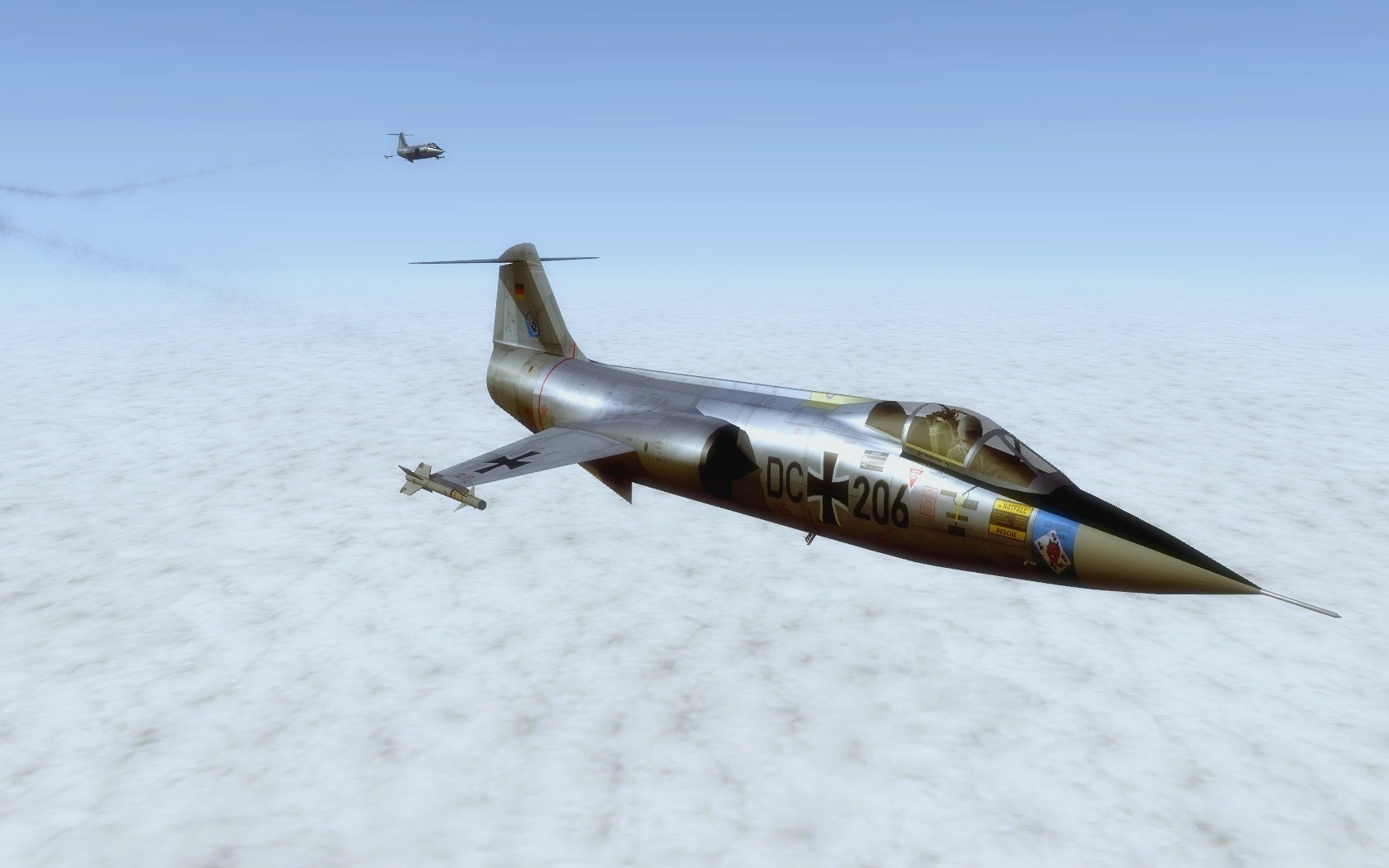
-
It appears that there are certain conditions that have to be met, first: Your flight must be engaged, the enemy must have a numerical or tactical advantge over you (you're outnumbered, or you've lost members of your flight through attrition. Your flight is tasked with a strike or a bombing mission, and is not loaded out for A2A).
-
Wrench, The last time I recall seeing "High Flight" was during the Spring break of my freshman year in high school...easy to recall, as by then (1973) the NYC-area network affiliates (ABC, CBS, NBC) didn't sign off on weekdays until after 3:00 AM To those of you who weren't around during the 60s, most networks signed off for the night between midnight and 1:30 AM, except on Fridays and Saturdays, leaving one to stare at a test pattern, like the one below....
-
Teen Series Fighters
Fubar512 replied to Slartibartfast's topic in Thirdwire: Strike Fighters 1 Series - General Discussion
I've always thought that the USAF made a mistake in not ordering a few for further evaluation. -
Nothing beats an electric leaf blower for blasting crap out of a PC case
-
The UllyB mega-uberthread
Fubar512 replied to UllyB's topic in Thirdwire: Strike Fighters 1 Series - Mods/Skinning Discussion
#4. soundlist.ini entry -
Teen Series Fighters
Fubar512 replied to Slartibartfast's topic in Thirdwire: Strike Fighters 1 Series - General Discussion
The YF-17 was a beautiful concept. Re-engineering it into the carrier-capable F/A-18A added so much weight and complexity onto what was originally such a light airframe (for a twin-engined fighter). "The first prototype (tail number 72-1569) was rolled out at Hawthorne on 4 April 1974, and made its first flight at Edwards AFB on 9 June. The second YF-17 (72-1570) first flew on 21 August. Through 1974, the YF-17 competed against the General Dynamics YF-16. The two YF-17 prototypes flew 288 test flights, totaling 345.5 hours. The YF-17 attained a top speed of Mach 1.95, a peak load factor of 9.4 g, and a maximum altitude of over 50,000 ft (15,000 m). It could attain a sustained 34° angle of attack in level flight, and 63° in a climb at 50 kn (58 mi, 93 km/h)." Let's compare the specs of both variants: YF-17 Crew: 1 Length: 56 ft 0 in (17.0 m) Wingspan: 35 ft 0 in (10.5 m) Height: 16 ft 6 in (5.0 m) Wing area: 350 ft² (32 m²) Empty weight: 17,180 lb (7,800 kg) Loaded weight: 23,000 lb (10,430 kg) Max takeoff weight: 34,280 lb (15,580 kg) Powerplant: 2× General Electric YJ101-100 afterburning turbofans, 14,400 lbf (67 kN) each Performance Maximum speed: Mach 1.95 Range: 2,990 mi (4,810 km) Service ceiling: 50,000 ft (15,000 m) Rate of climb: 50,000 ft/min (250 m/s) Wing loading: 66 lb/ft² (320 kg/m²) Thrust/weight: 1.25 F/A-18A Crew: F/A-18C: 1, F/A-18D: 2 (pilot and weapons system officer) Length: 56 ft (17.1 m) Wingspan: 40 ft (12.3 m) Height: 15 ft 4 in (4.7 m) Wing area: 400 ft² (38 m²) Airfoil: NACA 65A005 mod root, 65A003.5 mod tip Empty weight: 24,700 lb (11,200 kg) Loaded weight: 37,150 lb (16,850 kg) Max takeoff weight: 51,550 lb (23,400 kg) Powerplant: 2× General Electric F404-GE-402 turbofans Dry thrust: 11,000 lbf (48.9 kN) each Thrust with afterburner: 17,750 lbf (79.2 kN) each Performance Maximum speed: Mach 1.8 (1,190 mph, 1,915 km/h) at 40,000 ft (12,190 m) Combat radius: 330 mi (290 NM, 537 km) on hi-lo-lo-hi mission Ferry range: 2,070 mi (1,800 NM, 3,330 km) Service ceiling: 50,000 ft (15,000 m) Rate of climb: 50,000 ft/min (254 m/s) Wing loading: 93 lb/ft² (450 kg/m²) Thrust/weight: >0.95 -
RDRAM is Ram bus memory, which was first made available for Pentium III-based systems in 1999 (it had been used in game-consoles prior to this). DRAM, on the other hand, is a general term (Dynamic Random Access Memory). Back In the mid 1990s, or almost a decade after I started building systems for fun & profit, the first Pentiums used what was then marketed as FPM-DRAM (Fast Page Mode DRAM), and later, EDO-DRAM (Extended Data Out DRAM). By 1997, SDRAM (Synchronus DRAM) was starting to predominate. And that's all for today's history lesson.
-
Yes, I can verify that it is indeed working now.
-
About TRACER.tga file?
Fubar512 replied to AGOSTINO's topic in Thirdwire: Strike Fighters 2 Series - General Discussion
In the objects folder. -
2 new questions
Fubar512 replied to pistitom's topic in Thirdwire: Strike Fighters 1 Series - General Discussion
Yes -
crooked takeoff run
Fubar512 replied to Veltro2k's topic in Thirdwire: Strike Fighters 1 Series - Mods/Skinning Discussion
PM it to me, and I'll have a look at it. -
Fuel consumption
Fubar512 replied to xclusiv8's topic in Thirdwire: Strike Fighters 2 Series - General Discussion
He's been asked at least a dozen times, and his answer is always the same: "This isn't that sort of a title....consider it more of a 'sim-lite'. We have no plans to add air to air refueling." The 2/3-scale maps used in the series offset (to a degree) the need for air to air refueling. Would it be a nice addition? Sure, but he's balked at it in the past, as it would probably be prohibitively expensive to implement. Probably because it would require a re-write of the existing code, or a possibly even completely new game engine. -
How to add weapons
Fubar512 replied to Pilot94's topic in Thirdwire: Strike Fighters 1 Series - General Discussion
All that information is in the knowledge base: http://combatace.com/topic/12210-getting-the-weapon-editors-to-work-in-winxp/ -
2 new questions
Fubar512 replied to pistitom's topic in Thirdwire: Strike Fighters 1 Series - General Discussion
TEWS (as well as Vector) RWR displays require SF2 to work properly, as only the second-gen titles contain the necessary avionics code. Ditto for the RWR-list and its associated TGA files. You could always try the SFP1-style simulated TEWS symbology in its place : http://combatace.com/files/file/6838-rwr-symbology/ -
How to add weapons
Fubar512 replied to Pilot94's topic in Thirdwire: Strike Fighters 1 Series - General Discussion
Use this weapons editor with the October 2008 patch: http://www.thirdwire.net/files/dl/WeaponEditor_022008.zip -
crooked takeoff run
Fubar512 replied to Veltro2k's topic in Thirdwire: Strike Fighters 1 Series - Mods/Skinning Discussion
Well, the aerodynamic values seem to be in order, but the min-max extents are duplicated, instead of offset left & right. That shouldn't have any bearing on flight characteristics, but the way they're currently setup, damage to the "right" vert tail will effect the left vert tail. -
crooked takeoff run
Fubar512 replied to Veltro2k's topic in Thirdwire: Strike Fighters 1 Series - Mods/Skinning Discussion
I said the vert stabs, as in vertical, not the horizontal stabs.... First, use ThrustPosition=0.0,0.0,0.0 on both engines, for trouble shooting purposes. Next, while I believe that "PropRotationDirection" is mostly cosmetic, why do you have them both set to left? -
crooked takeoff run
Fubar512 replied to Veltro2k's topic in Thirdwire: Strike Fighters 1 Series - Mods/Skinning Discussion
Ah, then....the plot thickens! Check both vert stabs, make sure that they mirror one another, and ditto for the engine values. Regarding the latter, critical areas are prop efficiency, power levels, throtte rates, moments of inertia (all must be equal or mirrored), and prop torque...since this is a twin-engine ac, it stands to reason that the props are opposed in rotation...that may be your problem. -
S!
-
crooked takeoff run
Fubar512 replied to Veltro2k's topic in Thirdwire: Strike Fighters 1 Series - Mods/Skinning Discussion
Ed, is this model twin engined, or twin-tailed, by chance? -
They'ed be getting fat on apple-turnovers, muffins, and bagels, instead....
-
Vampire cockpit
Fubar512 replied to FalconC45's topic in Thirdwire: Strike Fighters 2 Series - Mods & Skinning Discussion
Did you add the nessesary lines to the vampire's .ini file? The lines for the Cockpit & avionics.ini files, etc?