
-
Topics
-
(Semi-fictional) Vipers over the Apeninnes
By ValAstur, in Thirdwire: Strike Fighters 2 Series - Sci-Fi/Anime/What If Forum
- 6 replies
- 105 views
-
- 6 replies
- 98 views
-
Strike Fighters 2 Screenshots Thread 1 2 3 4 251
By Wrench, in Thirdwire: Strike Fighters 2 Series - Screen Shots
- 6,270 replies
- 965,654 views
-
DCS/LOMAC Screen Shot Thread 1 2 3 4 11
By Dave, in Digital Combat Simulator Series General Discussion
- 272 replies
- 81,675 views
-
[Fictional] Dassault Mystère IVE
By ValAstur, in Thirdwire: Strike Fighters 2 Series - File Announcements
- 0 replies
- 25 views
-
-
Available Subscriptions

Subcategories
-
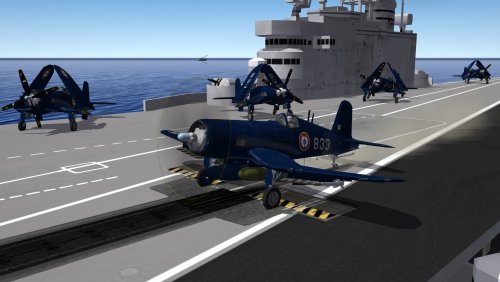 AU-1: U.S. Marines attack variant with extra armor to protect the pilot and fuel tank,
and the oil coolers relocated inboard to reduce vulnerability to ground fire.
The supercharger was simplified as the design was intended for low-altitude operation.
Extra racks were also fitted.
Fully loaded for combat the AU-1 weighed 20% more than a fully loaded F4U-4,
and was capable of carrying 8,200 lb of bombs.
The AU-1 had a maximum speed of 238 miles per hour at 9,500 ft,
when loaded with 4,600 lb of bombs and a 150-gallon drop-tank.
When loaded with eight rockets and two 150-gallon drop-tanks,
maximum speed was 298 mph at 19,700 ft. When not carrying external loads,
maximum speed was 389 mph at 14,000 ft. First produced in 1952 and used in Korea, and retired in 1957.
Re-designated from F4U-6
WHAT's IN:
- the original plane tweaked for Aéronavale;
- 5 new, upgraded jpg skins;
- Historical decalset
- pilot, weapons, sound;
OPERATIONS:
- Key 0 canopy
- Key 9 wingfold
All autoclosing on take off
CREDITS:
- all credits to TMF The Mirage Factory;
- Wrench for upgrades and temps;
- paulopanz skin, reskin, decals, repack
INSTALL:
- all in your mod folder and overwrite.
That's all
Yours
@paulopanz
By paulopanz122 0 -
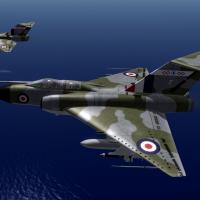 The Gloster Javelin was a twin-engined all-weather interceptor aircraft that served with Britain's Royal Air Force in the late 1950s and most of the 1960s. It was a T-tailed delta-wing aircraft designed for night and all-weather operations and was the last aircraft design to bear the Gloster name. Introduced in 1956 after a lengthy development period, the aircraft received several upgrades during production to its engines, radar and weapons, including support for the De Havilland Firestreak air-to-air missile.
The Javelin was succeeded in the interceptor role by the English Electric Lightning, a supersonic aircraft capable of flying more than double the Javelin's top speed, which was introduced into the RAF only a few years later. The Javelin served for much of its life alongside the Lightning; the last Javelins were withdrawn from operational service in 1968 following the induction of successively more-capable versions of the Lightning.
FAW 8 Upgraded Sa.7R engines with reheat, raising thrust to 12,300 lbf (54.7 kN) thrust above 20,000 ft (6,100 m); at lower altitudes, the limitation of the fuel pump caused a loss of cold thrust. New "drooped" wing leading edge and auto-stabilizer for better handling. Short nose.
FAW 9 A total of 118 FAW 7s refitted with the revised wing and engines of the Mk 8. Wet pylons. Long nose.
FAW 9R (range) fuel probe added.
Special test modified plane.
What's in:
- 4 new planes;
- 18 new skins;
- Historical decalsets by plane;
- open canopy 10 key auto closing at take off;
- weapons
- pilots
- guns
- New screens;
- loadout.tga;
Credits:
- VELTRO2k - plane model 2.0;
- Baffmeister FM;
- Paulopanz - Skins, Decals, screens;
Install:
- all mod folder content in your mod install
- overwrite
* not to be used with anything that is payware statement
V. 1.05
Fixes this (you can do by youself if you have 1.0 Javs) in all 4 data.inis:
.....
[Engine2]
ReferenceName=Armstrong Siddeley Sapphire SA.7R
SystemType=JET_ENGINE
InputName=THROTTLE_CONTROL
EngineID=1 -----> 2 (change this 1 to 2)
HasAfterburner=TRUE
NumAfterburnerStages=1
SLThrustDry=48900.0
SLThrustWet=54713.0
.....
Thanks Eric.
That's all
Enjoy
@ paulopanz
By paulopanz804 2 -
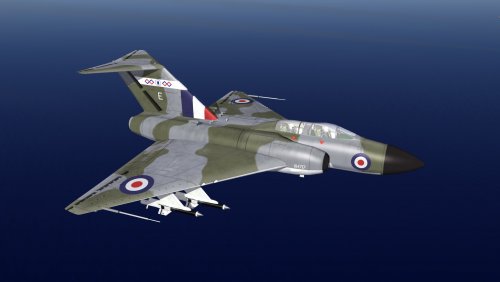 The Gloster Javelin was a twin-engined all-weather interceptor aircraft that served with Britain's Royal Air Force in the late 1950s and most of the 1960s. It was a T-tailed delta-wing aircraft designed for night and all-weather operations and was the last aircraft design to bear the Gloster name. Introduced in 1956 after a lengthy development period, the aircraft received several upgrades during production to its engines, radar and weapons, including support for the De Havilland Firestreak air-to-air missile.
The Javelin was succeeded in the interceptor role by the English Electric Lightning, a supersonic aircraft capable of flying more than double the Javelin's top speed, which was introduced into the RAF only a few years later. The Javelin served for much of its life alongside the Lightning; the last Javelins were withdrawn from operational service in 1968 following the induction of successively more-capable versions of the Lightning.
FAW 7 Introduced new Sa.7 engines with 11,000 lbf (48.9 kN) thrust each, powered rudder, extended rear fuselage. Armed with two 30 mm ADEN plus four Firestreak air-to-air missiles. 142 produced.
What's in:
- 1 new plane;- 7 skins;
- Historical decalsets by plane;
- open canopy 10 key auto closing at take off;
- weapons
- pilots
- guns
- New screens;
- loadout.tga;
Credits:
- VELTRO2k - plane model;
- Coupi Baffmeister FM;
- Paulopanz - Skins, Decals, Screens;
Install:
- all mod folder content in your mod install
- overwrite
That's all
Enjoy
PS: all the previous series could be made if Veltro will tweak his model .....
By paulopanz249 4 -
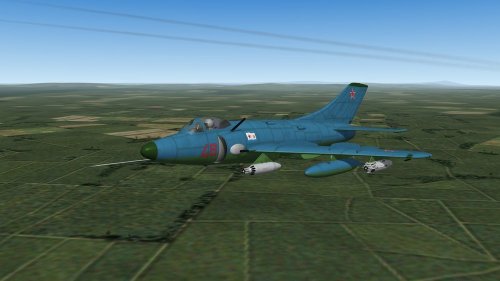 The MiG-19SK by CAF team, 3d work by Cocas, skins by Nyghtfall, other work by Coupi, testing by Stratos, Coupi, Wrench, Nyghtfall.
Some Background:
After the success of the Soviet Union’s first carrier ship, the Moskva Class (Projekt 1123, also called „Кондор“/„Kondor“) cruisers in the mid 1960s, the country became more ambitious. This resulted in Project 1153 Orel (Russian: Орёл, Eagle), a planned 1970s-era Soviet program to give the Soviet Navy a true blue water aviation capability. Project Orel would have resulted in a program very similar to the aircraft carriers available to the U.S. Navy. The ship would have been about 75-80,000 tons displacement, with a nuclear power plant and carried about 70 aircraft launched via steam catapults – the first Soviet aircraft carrier that would be able to deploy fixed-wing aircraft.
Beyond this core capability, the Orel carrier was designed with a large offensive capability with the ship mounts including 24 vertical launch tubes for anti-ship cruise missiles. In the USSR it was actually classified as the "large cruiser with aircraft armament".
Anyway, the carrier needed appropriate aircraft, and in order to develop a the aircraft major design bureaus were asked to submit ideas and proposals in 1959. OKB Yakovlev and MiG responded. While Yakovlev concentrated on the Yak-36 VTOL design that could also be deployed aboard of smaller ships without catapult and arrester equipment, Mikoyan-Gurevich looked at navalized variants of existing or projected aircraft.
While land-based fighters went through a remarkable performance improvement during the 60ies, OKB MiG considered a robust aircraft with proven systems and – foremost – two engines to be the best start for the Soviet Union’s first naval fighter. “Learning by doing”, the gathered experience would then be used in a dedicated new design that would be ready in the mid 70ies when Project 1153 was ready for service, too.
Internally designated “I-SK” or “SK-01” (Samolyot Korabelniy = carrier-borne aircraft), the naval fighter was based on the MiG-19 (NATO: Farmer), which had been in production in the USSR since 1954.
Faster and more modern types like the MiG-21 were rejected for a naval conversion because of their poor take-off performance, uncertain aerodynamics in the naval environment and lack of ruggedness. The MiG-19 also offered the benefit of relatively compact dimensions, as well as a structure that would carry the desired two engines.
Several innovations had to be addresses:
- A new wing for improved low speed handling
- Improvement of the landing gear and internal structures for carrier operations
- Development of a wing folding mechanism
- Integration of arrester hook and catapult launch devices into the structure
- Protection of structure, engine and equipment from the aggressive naval environment
- Improvement of the pilot’s field of view for carrier landings
- Improved avionics, esp. for navigation
Work on the SK-01 started in 1960, and by 1962 a heavily redesigned MiG-19 was ready as a mock-up for inspection and further approval. The “new” aircraft shared the outlines with the land-based MiG-19, but the nose section was completely new and shared a certain similarity to the experimental “Aircraft SN”, a MiG-17 derivative with side air intakes and a solid nose that carried a. Unlike the latter, the cockpit had been moved forward, which offered, together with an enlarged canopy and a short nose, an excellent field of view for the pilot.
On the SK-01 the air intakes with short splitter plates were re-located to the fuselage flanks underneath the cockpit. In order to avoid gun smoke ingestion problems (and the lack of space in the nose for any equipment except for a small SRD-3 Grad gun ranging radar, coupled with an ASP-5N computing gun-sight), the SK-01’s internal armament, a pair of NR-30 cannon, was placed in the wing roots.
The wing itself was another major modification, it featured a reduced sweep of only 33° at ¼ chord angle (compared to the MiG-19’s original 55°). Four wing hardpoints, outside of the landing gear wells, could carry a modest ordnance payload, including rocket and gun pods, unguided missiles, iron bombs and up to four Vympel K-13 AAMs.
Outside of these pylons, the wings featured a folding mechanism that allowed the wing span to be reduced from 10 m to 6.5 m for stowage. The fin remained unchanged, but the stabilizers had a reduced sweep, too.
The single ventral fin of the MiG-19 gave way to a fairing for a massive, semi-retractable arrester hook, flanked by a pair of smaller fins. The landing gear was beefed up, too, with a stronger suspension. Catapult launch from deck was to be realized through expandable cables that were attached onto massive hooks under the fuselage.
The SK-01 received a “thumbs up” in March 1962 and three prototypes, powered by special Sorokin R3M-28 engines, derivatives of the MiG-19's RB-9 that were adapted to the naval environment, were created and tested until 1964, when the type – now designated MiG-SK – went through State Acceptance Trials, including simulated landing tests on an “unsinkalble carrier” dummy, a modified part of the runway at Air Base at the Western coast of the Caspian Sea. Not only flight tests were conducted at Kaspiysk, but also different layouts for landing cables were tested and optimized as well. Furthermore, on a special platform at the coast, an experimental steam catapult went through trials, even though no aircraft starts were made from it – but weights hauled out into the sea.
Anyway, the flight tests and the landing performance on the simulated carrier deck were successful, and while the MiG-SK (the machine differed from the MiG-19 so much that it was not recognized as an official MiG-19 variant) was not an outstanding combat aircraft, rather a technology carrier with field use capabilities.
The MiG-SK’s performance was good enough to earn OKB MiG an initial production run of 20 aircraft, primarily intended for training and development units, since the whole infrastructure and procedures for naval aviation from a carrier had to be developed from scratch. These machines were built at slow pace until 1965 and trials were carried out in the vicinity of the Black Sea and the Caspian Sea.
FROM NOW ON IS MY WORK. STRATOS.
With the reception of the first new carrier in late 1965, the new aircraft began sea trials during the spring of 1966 and for summer the first planes were permanently deployed on board. The ship and it's planes began a cruise around the world doing good will port visits showing the flag and the new capabilities of the Soviet Navy. The carrier was permanently escorted by USN info gathering ships monitoring the capabilities of the new vessel and its air component.
The first real deployment with combat ocured in the Pacific Ocean in 1969, in a dare move, the carrier slipped into the Yellow Sea during the night and launched it's aircraft at first light, the planes strike several military facilities in China mainland, specially around Shangai, and the first A-A combat took place when a pair of SK's engaged intercepting J-6 of the PLAAF while escorting strike armed SK's. All the soviets returned to the carrier that was already steaming to get out of the South China sea trough Tsushima straits.
By early 1972, new models are being introduced into the fleet and the SK's started to show their age in the fast pace of aviation during Cold War, so as soon as the new models completed the air component the SK's were passed to train new naval pilots on the fleet training installations in Crimea, were it served with distinction until the last cells were too worn out to be safely operated beyond 1980.
So the SK's story came to an end with the honor of being the first real combat aircraft onboard soviet carriers, and the plane that first tasted the blood for carrier based pilots.
By Stratos306 1 -
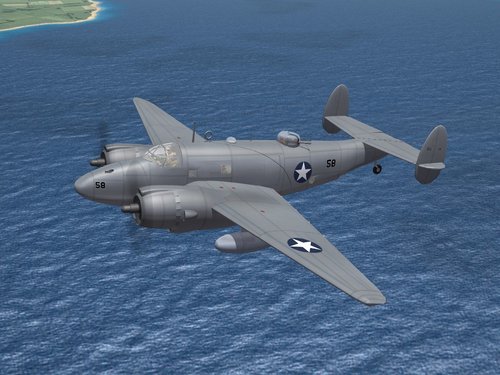 SF2 WW2 PTO PV-1 Ventura (Early) by Veltro2K 8/30/2014
-- Something for the WW2 PTO players --
= For SF2 ONLY, Full-5 Merged (Reccomended/Preferred) =
**Note: This mod will -NOT- work in 1stGen game installs at any patch level.A Full-5 merged is reccomended.**
This is a the release of Veltro2K's =NEW= Lockheed/Vega PV-1 Ventura USN Patrol Bomber. This represents the early "glass nosed" version as used in the PTO.
There are 4 skin/decals set(s) in the package:
USN (42-43, NS Blue over NS Grey, star-and-ball)
USN43 (star-&-bar, 3 tone)
and
RNZAF (overall blue/grey mid-war light blue roundels, as used from Henderson Field)
RNZAF43 (overall blue/grey, roundel-and-bar)
The skins use the SF2 "date switch", and will change in approx September, 1943
Although the US Navy skins are tagged for VPB-138, they are representative of pretty much ALL USN PTO Ventura units from Australia to the Aleutians.
The RNZAF skins, while tagged for No.3 Squadron, are also fairly representative of NZ units in the SoWesPac regions of the PTO.
All markings are decals, and Decal Randomization is TRUE. Serial number/BuNums are accurate for the model depicted, but should be considered 'generic' in nature, as they reprsent no specific unit. Lighting is as accurate as possible, given the lack of pictures of the bottom.
Engine sounds, pilot figures, and skin-specific Hangar Screens are included. Weapons, guns, bombs, etc, are NOT; you should have them already. Operational service dates are rounded to 'whole months', and ARE relatively correct for ALL in-theatre usages.
When in game, you'll see
PV-1 Ventura (Early) (v2k)
on the Aircraft Selection Drop down menu. As different versions are planned, this will help keep them diferentiated, so to speak.
As always, fairly easy to follow, yet detailed install instructions are included. PLEASE read them!!!
Happy Landings!!
Wrench
Kevin Stein
Updated 9/1/2017:
All hit boxes reset or newly created for those components without
Small adjustment to some FM parameters.
Destroyed model referenced to a stock 3W aircraft, available in all versions
By Veltro2k200 2 -
 SF2 WW2 PTO Pv-1 Ventura (Mid) by Veltro2K 9/2/2014
-- Something for the WW2 PTO players --
= For SF2 ONLY, Full-5 Merged (Reccomended/Preferred) =
**Note: This mod will -NOT- work in 1stGen game installs at any patch level. A Full-5 merged is reccomended.**
This is a the release of Veltro2K's =NEW= Lockheed/Vega PV-1 Ventura USN Patrol Bomber. This represents the mid-production solid nosed, with 2-guns as used in the PTO.
There are 4 skin/decals set(s) in the package:
USN (42-43, NS Blue over NS Grey, star-and-ball)
USN43 (star-&-bar, 3 tone)
and
RNZAF (dark blue over grey mid-war light blue roundels)
RNZAF43 (dark blue overgrey, roundel-and-bar, various Pacfic Places (tm) )
The skins use the SF2 "date switch", and will change in approx September, 1943
Although the US Navy skins are tagged for various VB/VPB squadrons, they are representative of pretty much ALL USN PTO Ventura units from Australia to the Aleutians.
The RNZAF skins, while tagged for No.3 Squadron, are also fairly representative of NZ units in the SoWesPac regions of the PTO.
All markings are decals, and Decal Randomization is TRUE. Serial number/BuNums are accurate for the model depicted, but should be considered 'generic' in nature, as they reprsent no specific unit. Lighting is as accurate as possible, given the lack of pictures of the bottom.
Engine sounds, pilot figures, Hangar & Loading Screens are included. Weapons, guns, bombs, etc, are NOT; you should have them already. Operational service dates are rounded to 'whole months', and ARE relatively correct for ALL in-theatre usages.
When in game, you'll see
PV-1 Ventura (Mid) (v2k)
on the Aircraft Selection Drop down menu. As several versions are planned, this will help keep them diferentiated, so to speak.
As always, fairly easy to follow, yet detailed install instructions are included. PLEASE read them!!!
Happy Landings!!
Wrench
Kevin Stein
Updated 9/1/2017:
All hit boxes reset or newly created for those components without
Small adjustment to some FM parameters.
Destroyed model referenced to a stock 3W aircraft, available in all versions
By Veltro2k169 0 -
 SF2 WW2 PTO Pv-1 Ventura (Late) by Veltro2K 9/2/2014
-- Something for the WW2 PTO players --
= For SF2 ONLY, Full-5 Merged (Reccomended/Preferred) =
**Note: This mod will -NOT- work in 1stGen game installs at any patch level. A Full-5 merged is reccomended.**
This is a the release of Veltro2K's =NEW= Lockheed/Vega PV-1 Ventura USN Patrol Bomber. This represents the late-production solid nosed, with 5 guns (3 in a 'chin pak' under the nose) as used in the PTO.
There are 1 skin/decals set(s) in the package:
USN (star-&-bar, 3 tone)
Although the skin is tagged for VPB-137 (Phillipine based in late 44), it is representative of pretty much ALL USN PTO Ventura units from Australia to the Aleutians.
All markings are decals, and Decal Randomization is TRUE. Serial number/BuNums are accurate for the model depicted, but should be considered 'generic' in nature, as they reprsent no specific unit. Lighting is as accurate as possible, given the lack of pictures of the bottom.
Engine sounds, pilot figures, Hangar & Loading Screens are included. Weapons, guns, bombs, etc, for the most part, are NOT; you should have them already. However, a set of HVAR mounts, the rockets themselves, and the drop tank is. Operational service dates are rounded to 'whole months', and ARE relatively correct for ALL in-theatre usages.
When in game, you'll see
PV-1 Ventura (Late) (v2k)
on the Aircraft Selection Drop down menu. As several versions are planned, this will help keep them diferentiated, so to speak.
As always, fairly easy to follow, yet detailed install instructions are included. PLEASE read them!!!
Happy Landings!!
Wrench
Kevin Stein
Updated 9/1/2017:
All hit boxes reset or newly created for those components without
Small adjustment to some FM parameters.
Destroyed model referenced to a stock 3W aircraft, available in all versions
By Veltro2k187 0 -
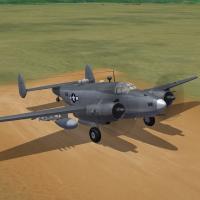 SF2 WW2 PTO PV-2 Harpoon by Veltro2K 9/21/2014
-- Something for the WW2 PTO players --
= For SF2 ONLY, Full-5 Merged (Reccomended/Preferred) =
**Note: This mod will -NOT- work in 1stGen game installs at any patch level. A Full-5 merged is reccomended.**
This is a the release of Veltro2K's =NEW= Lockheed/Vega PV-2 Harpoon USN Patrol Bomber.
There are 2 skin/decals set(s) in the package:
USN (star-&-bar, 3 tone for WW2)
DGNB (dark gloss Navy blue overall, post-war)
Although the 3 tone skin is tagged for VPB-138 (Northern Pacific/Aleutian Islands region), it is representative of pretty much ALL USN PTO Ventura units from Australia to the Aleutians.
The DGNB skin is tagged for VP-772, a post-war reserve squadron based at NAS Los Alimitos, California circa 1948. The base blue skin can also be used for several of the other post-war users.
All markings are decals, and Decal Randomization is TRUE. Serial number/BuNums are accurate for the model depicted, but should be considered 'generic' in nature, as they reprsent no specific unit. Lighting is as accurate as possible, given the lack of pictures of the bottom.
Engine sounds, pilot figures, and a 'box art' Hangar Screen are included. Weapons, guns, bombs, etc, for the most part, are NOT; you should have them already. However, a set of HVAR mounts, the rockets themselves, and the drop tank is. Operational service dates are rounded to 'whole months', and ARE relatively correct for ALL in-theatre usages.
When in game, you'll see
PV-2 Harpoon (v2k)
on the Aircraft Selection Drop down menu. As several versions are planned, this will help keep them diferentiated, so to speak.
As always, fairly easy to follow, yet detailed install instructions are included. PLEASE read them!!!
Happy Landings!!
Wrench
Kevin Stein
Updated 9/1/2017:
All hit boxes reset or newly created for those components without
Small adjustment to some FM parameters.
Destroyed model referenced to a stock 3W aircraft, available in all versions
By Veltro2k265 0
-
Download Statistics
14,433
Files12,671
Comments27,059
Reviews