

streakeagle
-
Posts
2,713 -
Joined
-
Last visited
-
Days Won
8
Content Type
Profiles
Forums
Gallery
Downloads
Store
Everything posted by streakeagle
-
X-36 USB was pretty much my favorite. The X-45 was an X-36 made cheaper and with flashy colors/lights. I passed on the X-52 as my X-45 and X-36 both functioned fine. But the X-52 Pro popped up at only $100 on the old GoGamers.com, so I couldn't resist and got the Pro Pedals, too. The X-52 Pro was great in many ways, but I liked the rudder rocker on the X-36/X-45 better than the twisty stick of the X-52/X-52 Pro. My son still used the X-52 Pro when he wants to play Mech Warrior, but the twisty stick pot has gotten dirty/noisy from lack of use. I had cut up the X-45 in my 2nd revision of my real B-8 grip/F-4 Phantom stick, but the X-36 is still fully functional. After getting a Warthog for only $350 a few years back, and also having the final BU0836X derived version of my F-4 stick, I had zero interest in the non-moving X-65 that was exactly the opposite of what I wanted and already had. The X-55 looked interesting, but my son moved on to tablets and/or mouse/keyboard shooter games so I still don't need another stick with the Warthog still performing flawlessly other than "stiction", which I improved with an extension and some lube. The X-56 looks like it is the X-45/X-52 to the X-55... flashier but somewhat of a step backwards. Saitek sticks have always suffered from some ergonomic issues despite efforts to avoid them. But reading Ken's X-56 review and looking at the photos, they don't seem to actually try playing games with a design before finalizing and producing it! While I am most interested in scale reproductions of real aircraft controls, close approximations in color and style of real controls that are very PC game friendly are a good way to go. The looks and arrangement of the X-36 USB and X-52 Pro represent what I would expect and want from Saitek at a fair price. The X-65 looked good to me, but I prefer a conventional stick to an F-16 like pressure transducer. The X-55 looke pretty good, but seeing the X-56 review makes me think the X-55 might have had similar ergonomics problems beyond the quality control issues I read about on various forums. Fortunately for me, my Warthog has had only one problem: the serial board that communicates the stick button positions to the controller base lost the first stage trigger function, so I had to order and install a new board. At about $40 including shipping, that was way cheaper than buying a new HOTAS. With that one repair, every function on the Warthog continues to work as well as brand new. I don't want to see Saitek go out of business. The X-36, X-45, and X-52 Pro gave me years of great flight simming at very affordable prices. But, I won't buy new sticks when my existing stick is still working flawlessly and better than Saitek's best. So, I hope new gamers who can't afford or don't want Warthogs or CH Products will continue to support Saitek. At some point, I will need new rudder pedals. With the years of use/abuse my Saitek Pro Pedals have survived, I wouldn't mind getting another set, but Saitek is having money issues and has allowed many of their high end flight sim products to go out of production and run out of inventory. So, when my Saitek pedals finally die, I may end up buying one of those high-end, low-production, all-metal, high-precision, expensive rudder pedals I always see on all the flight sim forums. The stick I would consider getting if it wasn't out of stock and my Warthog died is the highest end version of the Russian Mamba. It is Warthog grip compatible and appears to be the absolute best in hardware. But they are very low production rate, high-priced, and sell out every time they are offered up for sale. I keep following them with a watchful eye. One day my Warthog will not be cost-effective to repair and may even be out of production... Why isn't Thrustmaster making a range of replica grips for the Cougar/Warthog sticks? I would have a B-8 grip, a P-51 grip, an Su-27 grip... and/or any other major fighter grip if they weren't too expensive. They shouldn't make them out of metal. Not just to keep costs down, but because the real grips weren't metal. My F-4 B-8 is the standard US milspec grip... some sort of resin/plastic that is very sturdy and much more comfortable than cold metal.
- 1 reply
-
- 2
-

-

F-15 Strike Eagles Over Saudi Arabia: Then And Now
streakeagle replied to MigBuster's topic in Military and General Aviation
Are there any MiG-21 pilots who have ever painted an F-15 kill on their aircraft? Sometimes size gives you things to make up for your ease of being spotted. The F-15's kill record would indicate the trade-off was the right one if you can afford the price tag. -
Fantastic history!
-
Calling Phantom experts - radar scope colour?
streakeagle replied to dtmdragon's topic in Mods & Skinning Discussion
This is the display from the backseat, but the glass part is visually identical: This is the front seat with the red filter: Notice the similarity in tech of the RWR indicator: Finally, a screenshot of one of my SFP1/WoX series F-4 cockpit texture upgrades that used a cleaned up version of the backseat display image for the front seat: The SF2 stock cockpits were so accurate that I never bothered to try to make an updated F-4 cockpit texture set... however, I liked to copy over the radar and RWR screen textures, despite their comparatively low quality. -
Calling Phantom experts - radar scope colour?
streakeagle replied to dtmdragon's topic in Mods & Skinning Discussion
The actual display has the traditional colors of an oscilloscope CRT: light gray-green screen with bright yellow-green display indications. This is covered by and engraved graticule that looks white contrasted against the gray-green screen. But the display is not very bright, so it is recessed a bit into the panel. On the front of the panel is a night filter lens that can be removed. The night filter is a red color to make it match traditional night lighting. -
Don't give up. It is worth the effort to get it working!
-
While their products had flaws, I bought and enjoyed all of the RAZBAM SF aircraft releases. One of the aircraft that keeps me flying SF2 is their F2H-2. When they originally sold their products, IIRC, they did have quite a disclaimer about how long you would be able to download from them and that it was the purchaser's responsibility to store/backup the purchased files. I remember a number of people being ignored who needed new copies later. I don't understand why they aren't more customer friendly? But, I have all of my aircraft backed up on a dvd (among countless other SF files) as well as stored on multiple hard drives. As I don't fly SF2 that much anymore, I don't know that I would be bothered if I lost the files at this point, but if I really missed the F2H-2, I might buy that one again, because it was dramatically better than the "A-Team"'s version. As far as the DCS Mirage 2000C goes, I have done a few take-offs/landings and some WVR air combat with guns. I like what I see, but won't bother getting to know this plane until its feature set/flight model is more stable. Based on how well it works right now, I won't hesitate to buy their DCS Mirage IIICJ when/if it becomes available.
-
Even the AIM-9B had some sort of prox fusing... it was one of several advantages it held over the AIM-4 (which required a direct hit to detonate). But the "kill radius" is a measure of the warhead's effectiveness, not the range/sensitivity of the fusing. I don't know about the game's logic for prox fusing, but in real life a rear aspect missile like an AIM-9 would want to wait until the missile had reached its closest point of approach before detonating, so most likely, it would either have a fairly close prox range with hardly any delay, or a small delay for a longer prox range to give the missile time to get closer before detonating. A head on aspect missile like the early AIM-7s needed to be fused for high closure rates... longer range proximity with very fast detonation, putting up a wall of fragments in front of the target. This made early AIM-7s less than useful for tail shots. Later versions improved for dogfighting had a more dynamic fusing setup allowing for different aspects.
-
The key is that it is not a true simulation, it looks and feels like a simulation, but its primary purpose is to be a fun game. I don't like it when a random bomber or sub comes and destroys one of my favorite ships with almost nothing I can do about it, but those are just about the only problems I can't work around. Carriers are oddly implemented... they are easily taken out since they start within gun range, but if you know how to use torpedo and dive bombers correctly, they are even more powerful than submarines with their lethal and and long ranged attacks. My favorite is a straight BB vs BB fight... or other well balanced matchups such as DD vs DD or CA vs CA.
-
Due to the format of the game, submarines are unrealistically powerful. Using three submarines, normally at least two will have good positions to intercept and kill the targets as they drive by. If not, just disengage and try again. It is fairly easy to win the static campaigns with only submarines. But, for me, the fun is trying to duke it out with battleships. So, unless there are enemy aircraft carriers or enemy subs, I like to use all surface ships to have more fun.
-
High turnover rate -> rapid advancement. I made E-6 in 5 years. Some branches have people retiring as an E-6 after 20 years. There are always trade-offs.
-
Compared to WW2 and Korea, Vietnam kill claims were remarkably accurate. Most US claims were backed by VPAF loss records. The US tended to distort its losses: VPAF claims frequently coincided with US losses to flak and SAMs. In many cases, the pilots' never saw what hit them and just guessed based on the circumstances. But I also suspect that when in doubt, the USAF preferred to deflate their losses to MiGs based on the way they ran the entire war based on statistics. Such as trying to rack up sorties even when there weren't enough bombs to send out more sorties.
-
It was kind of painful transitioning from SFP1 to SF2. A lot of great work was lost due to changes or ignored and forgotten.
-
My SF2V take on that mission is available here: http://combatace.com/files/file/12285-650404-f-100d-probable-mig-kill/ The interesting fact is that the VPAF claimed that it lost not just one, but three MiG-17s to aerial dogfights that day. It is possible that the one Kilgus claimed did not actually go down due to his attacks, but even if he didn't shoot it down, that aircraft didn't make it home. The other two, if not all three, were most likely shot down by their own air defenses. Despite the surviving MiG-17 pilot's claim of losing his other three wingmen to US aircraft, the USAF only had one claim. If any F-100 or F-105 pilot had been in a position to even have a chance of claiming a kill, they would have tried to claim it. I would give Kilgus the credit: he repeatedly fired on and hit the target, and the target didn't make it home.
-
Welcome to Combat Ace. This is a great place to come if you are a Strike Fighters fan (or any other flight sim for that matter). How long have you been playing Strike Fighters?
-
From the depth/width of the spine, I am going to say BIS.
-
F-8 Crusader vs MiG-17 in Vietnam
streakeagle replied to streakeagle's topic in Military and General Aviation
Pilot quality is everything. F-8 pilots had extensive dogfight/gunfight training. F-4 pilots had none, and in fact didn't even have good live fire training for the missiles they carried. Once Navy F-4 pilots got that training, their kill ratio reflected it. USAF F-15s not only lost to F-4s, but also F-104s. A good pilot will recognize a bad pilot's weakness and exploit it with tactics when aircraft performance can't get the job done. On energy-maneuverability, if you search the internet, you can find quotes from F-8 pilots that converted to the F-4. One of my favorites basically stated that he couldn't understand how an F-4 could lose to an F-8 in a dogfight with all of the extra power available. The F-4 wasn't the cleanest aircraft in terms of zero-lift drag. It also had a fairly high level of induced drag due to its nearly pure delta Mach 2 wing. Yet it was both faster in level flight and had higher sustained climb rates than any F-8 (the F-4 set climb records only broken by the MiG-25 and F-15). That many pilots tasked with flying the F-4 weren't trained to fly it to its limits does not make the F-4 inferior to the F-8. -
I think you will find that TK eliminated the ability to run an engine with negative fuel consumption, which allowed "refueling". YAP's 05 was absolutely livid about SFP1/WoX's final patches with the release of WoI that "broke" bugs that YAP was exploiting to enhance its missions. From TK's perspective, the ability to have a negative fuel consumption was an oversight that was finally corrected. From 05's point of view, TK was intentionally breaking his 3rd party addons. It is simple to test, use a negative fuel rate on a stock aircraft and see what happens to the fuel weight.
-
Some information on Balter flight, the top cover for Oyster flight: - Oyster Flight, 4 F-4D (with Combat Tree) from 555th TFS/432nd TRW, lead by Maj. Robert Locher - Balter Flight, 4 F-4D (with Combat Tree) from 13th TFS/432nd TRW, lead by ? A crew member photo and name is in the book, "One Day in a Long War": Capt Bill Ridge, presumably one of the two pilots that didn't turn back. I can't find any more information on Balter flight of May 10. The name doesn't get any hits on the internet, no matter what qualifiers I use to filter the search.
-
The key involves reverting back to DX9, but TK may have deleted code/hooks that render that path impossible without carefully merging some code from SFP1/WoX games. It would be a daunting task unless you can read hex code like a dick and jane book. I found it is a lot more practical to try to retrofit SF2 material back into WoI with the last expansion pack. Up to a certain patch level, SF2 3d models could be retrofitted back into This version of WoI, which retains multiplayer. However, that final WoI+Expansion pack needed a patch to fix some bugs, and TK abandoned it. Also, getting the nicer, newer 3d models into the older game is one thing, but the RWR and some other functions take a step back. It would take a lot of work to bring all the aircraft, weapons, ground objects and terrain from all of the other games into this one installation. In the end, the original multiplayer was so limited in capability, it would largely be a waste of time to do so. The best path is to multiplayer is to play the original SFP1/WoX/FE games as is (with everyone sharing compatible mods). For all their limitations, I had a lot of fun playing them online. But, I have tried the DCS World F-86F online before the flyable MiG-15bis was released. You could fight AI with co-op or fly F-86F vs F-86F. It was so much better than any SFP1 based mutliplayer: runway starts, full graphics for terrain and clouds, complex AI scripting, landing/refueling/rearming. DCS still needs the SF terrain, plane, and ground object libraries, but the engine is pretty solid. The release of the F-14 and F-5, combined with Nevada and the MiG-21bis largely replaces the SFP1 experience with a far superior multiplayer setup. However, finding a multiplayer server that runs during your free time with people that want to play the same way you do remains the challenge. I thoroughly enjoyed the one F-86 server, but it disappeared after the MiG-21 was released, and I never really found another server that caught my interest. As a single player game, the SF2/FE2 series still has a lot to offer that you can't do with DCS World, yet. But multiplayer for the SF series just wasn't ever good enough to draw a crowd, and much better options are available. If someone wants to try to get an online group going for the old games, I can try to participate. I have all the old games and will install them as necessary to try. But there are some tricks required to get anything beyond Wings Over Vietnam or SFP1 running via HyperLobby. The real trick is using virtual LAN software to get around the issues DirectPlay and the SFP1 series games have with routing/firewalls. Hamachi used to be perfect for getting players all joined together despite routers, but it has changed over the years and I am not certain it is as useful any more.
- 6 replies
-
- 1
-
-
- fe2
- first eagles 2
- (and 2 more)
-
I have been spending time on this well before there were PC flight sims. SPI had a board game named "Air War. "https://boardgamegeek.com/boardgame/1629/air-war-modern-tactical-air-combat It was re-released by TSR while I was in high school about 1983, which was when I bought it. There were two scenarios in that game that were my all time favorite ones to play: two F-105s being bounced by MiG-17s (possibly recreating the first F-105 lost to MiGs) and "The Death of Major Lodge". Later on, around 1987 or 1988, I bought a very big book, "Modern Fighting Aircraft Volume 4 F-4 Phantom". http://www.amazon.com/F-4-Phantom-Modern-Fighting-Aircraft/dp/0668060689/ref=sr_1_20?s=books&ie=UTF8&qid=1460837049&sr=1-20&keywords=F-4+Phantom It had a detailed description of this same air battle, complete with a diagram summarizing all of the key events. Over the years, I have built a decent library of books on F-4 Phantoms, the Vietnam air war, and air combat in general, which frequently mention this particular incident. Somewhere along the way, the narrative description changed as the existence, function, and employment of Combat Tree was declassified. Before, this incident was famous not for the death of Major Lodge, or being the source of one of Steve Ritchie's 5 kills, but because it was the sole textbook example from the entire Vietnam air war showing how great a weapon the AIM-7 Sparrow could be when employed Beyond Visual Range. The text would explain the unique circumstances of this mission that enabled Oyster flight to be certain that they were not firing on friendlies without getting a visual ID. Red Crown, airborne monitoring, and a lack of any allied aircraft in front of them. Now we no the truth: this was just one of many incidents where Combat Tree got an IFF response from MiGs confirming their identity as an enemy without a doubt and permitting AIM-7s to be fired well beyond visual range.
-
With blue numbers, which are USSR issue colors. Of course, humans aren't the best witnesses. Subject to errors. The USSR is steadfast that it did not fight in the air in Vietnam as it did in Korea. But what would make Locher see/recall these details other than actually having seen them up close? I would take his word unless better evidence such as photos/film contradicted him. But the VPAF records are fairly good, too. They certainly knew which aircraft/pilots didn't come home on any given day. It is difficult to accurately peel back the fog of war, especially when the whole incident was somewhat classified until recently due to the use of Combat Tree.
-
Reading and re-reading my sources on this subject take me back in time. The names are so familiar. ACIG has an alternative description of what happened taking into account what the VPAF reported sorties and losses were for that day. The US perspective had a flight of 4 x MiG-21s supplemented by a flight of 4 x MiG-19s. The VPAF claimed 2 x MiG-21 + 4 x MiG-19. But Roger Locher's description of the MiG-21 that Bob Lodge died trying to kill is indicative of a Soviet flown MiG-21. No VPAF MiG-21s meet Locher's description. The VPAF description would fit the initial detection of and killing of two MiG-21s, but then Roger Locher identified an additional MiG-21 at point blank range and Steve Ritchie also thought he had shot down a MiG-21. It is possible that the three known kills were 1 x MiG-21 and 2 x MiG-19 with Roger Locher having seen the second MiG-21. But then what did Markle see attacking Lodge? 2 x MiG-19 or 4 x MiG-19? I think the ACIG later amended their description of this fight to include for the possibility that there really were 4 x MiG-21s involved despite the VPAF claims, because I don't remember them previously accepting the possibility that there really were 4 x MiG-21s and my latest re-reading of their post did include that possibility rather than outright refuting it as I remembered. The USSR records admit flying combat missions in Korea but have never admitted doing so in Vietnam. But first hand pilot accounts (such as Locher's) indicate that it may have occurred whether the USSR realized it or not. One bonus in having the VPAF's account of that day is that there was one more kill that should be credited to that flight, and most probably Bod Lodge and Roger Locher: the MiG-19 that shot them down ended up running out of fuel, landing too fast, and flipping over on landing, killing the pilot. So the final tally for the day would be 4:1 in favor of the US. If Bob Lodge had heeded the "break" call from Oyster 2, it probably would have been 3:0. As smart and good as Maj Lodge was, he apparently had become obsessed with becoming the first USAF Vietnam ace. If he hadn't suffered from target fixation on that day, he probably would have been. He is a classic tragic hero. It still makes me sad to read about this mission. Especially hearing the recording of Locher describing the events. I am sure the VPAF pilots were heroic, too. The Osprey books on the VPAF Mig-17/MiG-19 and VPAF MiG-21 units do a good job of showing the war from their perspective. But as a US citizen and veteran who grew up loving our fighter pilots, I can't quite feel the pride and sadness of their situation as much as I can for US pilots. The same goes for Nazi and Japanese pilots vs Allied pilots. I love and respect them all, but I can't help but root and cry more for the home team.
-
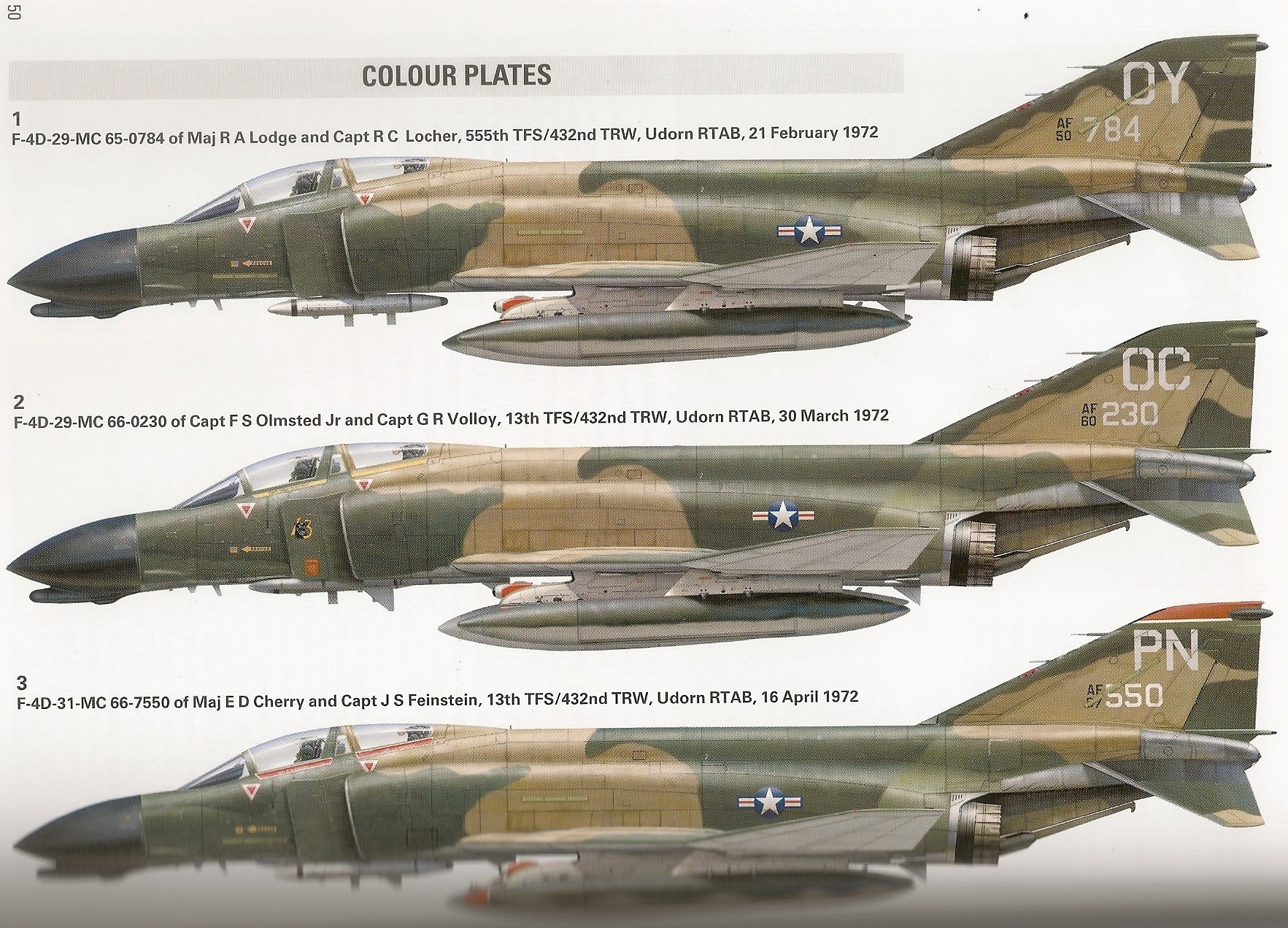
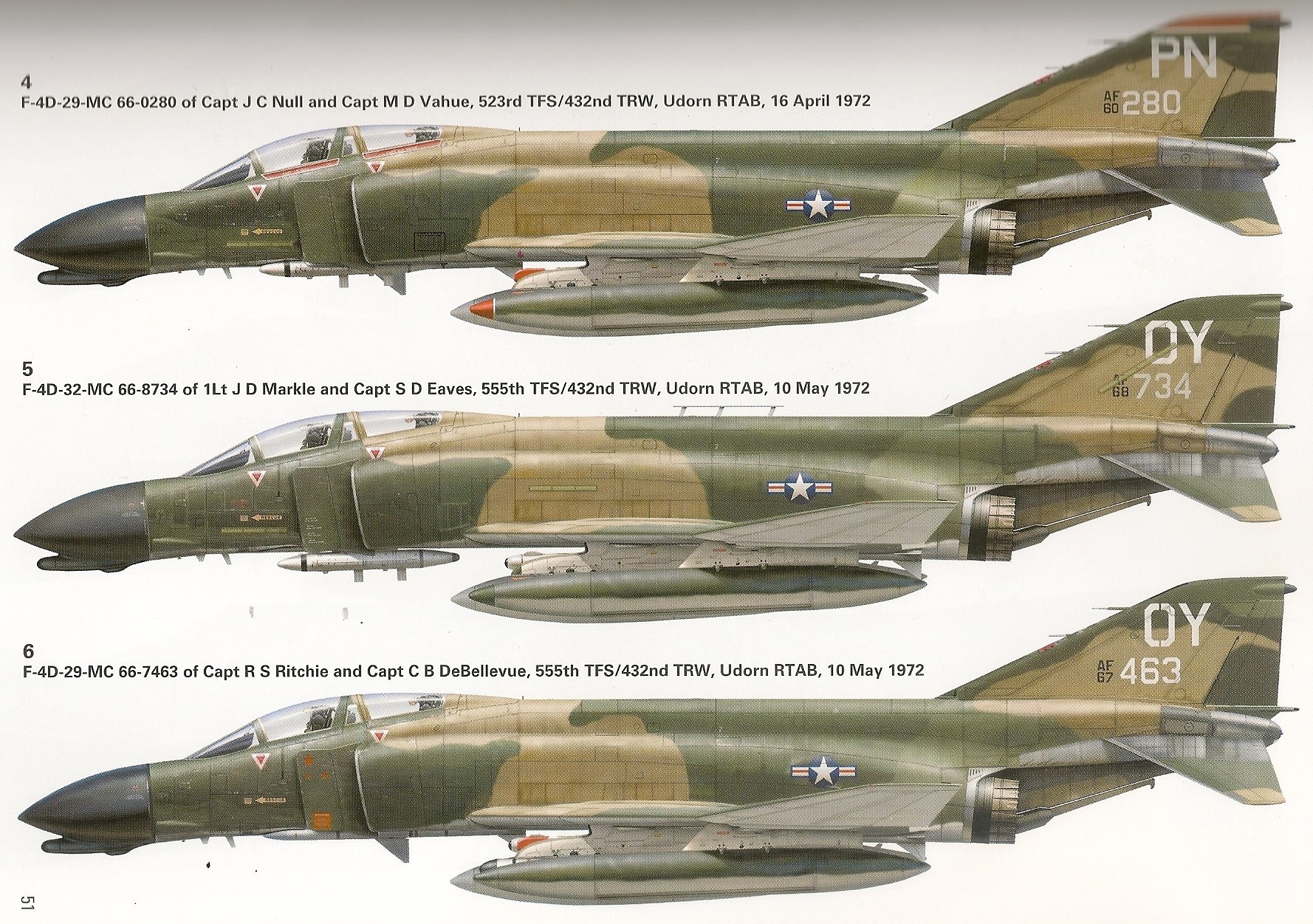
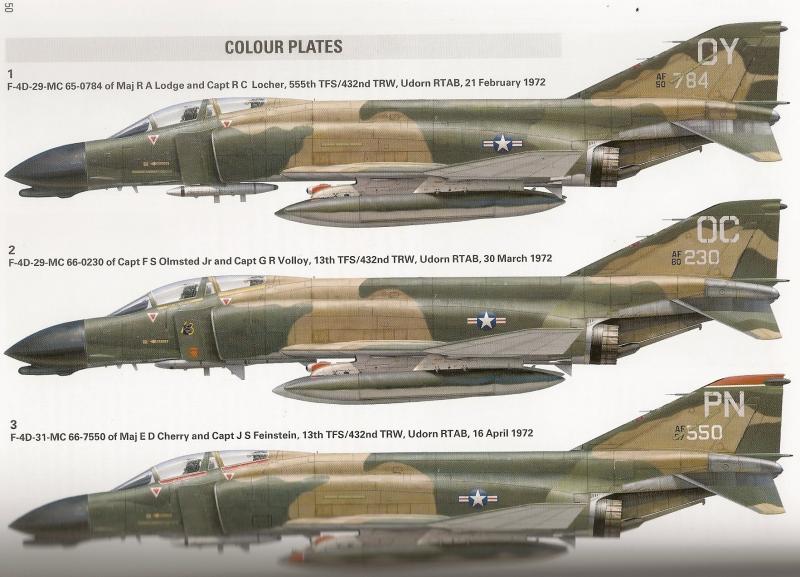
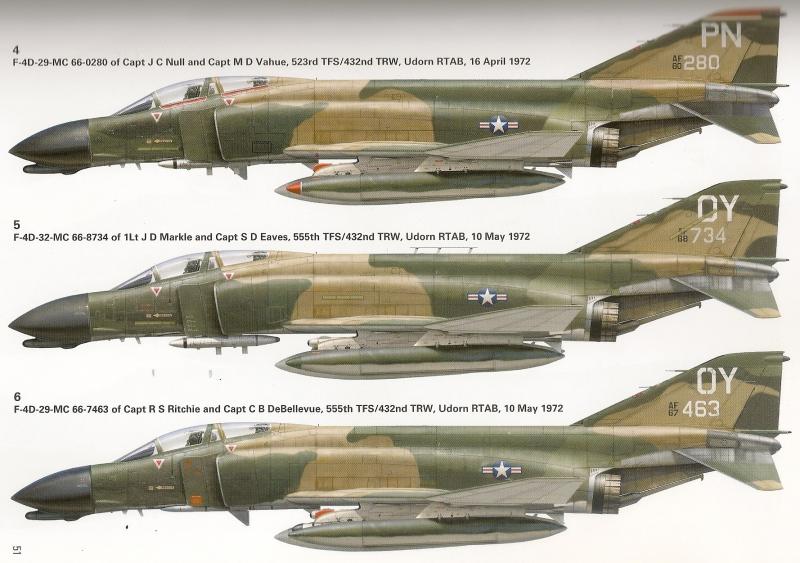
Oyster flight on May 10, 1972 consisted of four F-4Ds: Oyster 1, OY 65-0784 crewed by Maj. Robert Lodge and Capt. Roger Locher Oyster 2, OY 66-8734 crewed by 1Lt. John Markle and Capt. Steven Eaves. Oyster 3, OY 66-7463 crewed by Capt. Steve Ritchie and Capt. Chuck DeBellevue Oyster 4, OY ? crewed by 1Lt. Tommy Feezel and Capt. Larry Pettit Here are some profiles from the Osprey book, "USAF F-4 Phantom II MiG Killers 1972-73": Having seen real photos of OY 65-0784 just two days prior to May 10, the first obvious error is the ecm pod in the front AIM-7 well. It should be an ALQ-101, not an ALQ-71. The 71 was under the left wing. OY 65-0784 and OY 66-7463 both had combat tree, so they both should probably have the red warning label seen on the splitter plate of OC 66-0230 and OY 66-6463. This red square is about the self-destruct mechanism for the highly classified combat tree system. While the profile doesn't show it, I have seen photos that indicate OY 66-7463 had "slimer" formation lights as depicted for OY 66-8734 and OY 65-0784. Knowing that the loadout on OY 65-0784 is probably wrong in the profile, the other two should be equally inaccurate, but may reflect what the pilots recalled in past interviews. Of interest to me is that Oyster 1 and 2 show ALQ-71 pods in the forward AIM-7 well while Oyster 3 shows AIM-7s up front and an ALQ-101 pod on the wing pylon.
-
Limitations of available SF2 Freeware
streakeagle replied to streakeagle's topic in General Discussion
It is just interesting after all these years with so many user mods that the carriers remained neglected. At this point, the limited life remaining for this sim due to operating system/driver version issues makes the value of any further labor intensive addons questionable.